

Agenda
Ordinary Council Meeting
18 September 2025, 7:00 PM
Council will commence consideration of
all business paper agenda items at 7.00
pm.
Notice
of Meeting
Dear Councillors,
Notice is
given of the Ordinary Council Meeting, to be held in
the Council Chambers on Thursday 18
September 2025 commencing at 7:00 PM. The
business to be transacted at the meeting is included in this business paper.
In accordance with clause 3.26 of the Code of Meeting Practice
Councillors are reminded of their oath or affirmation of office made under
section 233A of the Act, and of their obligations under the Council’s
Code of Conduct to disclose and appropriately manage conflicts of interest.
Yours faithfully
Louise Kerr
General Manager
Council
Meeting Procedures
The Council meeting is chaired by
the Mayor, Councillor Merri Southwood. Councillors are entitled to one vote on
a matter. If votes are equal, the Chairperson has a second or casting vote.
When a majority of Councillors vote in favour of a Motion it becomes a decision
of the Council. Minutes of Council and Committee meetings are published on
Council’s website www.lanecove.nsw.gov.au by 5.00 pm on the Tuesday following
the meeting.
The
Meeting is conducted in accordance with Council's Code of Meeting Practice. The
order of business is listed in the Agenda on the next page. That order will be
followed unless Council resolves to modify the order at the meeting. This may
occur for example where the members of the public in attendance are interested
in specific items on the agenda.
The Public Forum will hear
registered speakers from the Public Gallery as well as online using the web
platform Zoom. All speakers wishing to participate in
the public forum must register by using the online form no later than midnight, on the day
prior to the meeting (Wednesday, 17 September 2025) and
a Zoom meeting link will be emailed to the provided email address of those
registered as an online speaker. Please note that the time limit of three
minutes per address still applies, so please make sure your submission meets
this criteria. Alternatively, members of the public can still submit their
written address via email to service@lanecove.nsw.gov.au. Written addresses are to be received by Council no later
than midnight, on the day prior to the meeting. (500 words maximum).
Please note that meetings held in
the Council Chambers are webcasted, and recordings are made publicly available
on the Council's website. Should you require assistance to participate in the
meeting due to a disability; or wish to obtain further information in relation
to Council, please contact Council’s Director - Corporate Services and
Strategy on (02) 9911 3550.
Ordinary Council 18 September 2025
TABLE OF
CONTENTS
DECLARATIONS OF INTEREST
APOLOGIES
ACKNOWLEDGEMENT TO COUNTRY
MINUTE OF SILENCE FOR RELECTION OR PRAYER
NOTICE OF WEBCASTING OF MEETING
public forum
Members of the public may address
the Council Meeting on any issue for 3 minutes.
CONFIRMATION OF MINUTES
ORDINARY
COUNCIL MEETING - 21 AUGUST 2025
Mayoral Minutes
1 Mayoral
Minute - Vale WilLiam Arthur (Bill) Henningham Jr. PSM... 5
Notices of Motion
2 Notice
of Motion - Lane Cove Camp: Drag Community Grant for Pride and Mardi Gras........................................................................................................ 7
3 Notice
of Motion - Extend Lane Cove Library Opening Hours........... 9
Officer Reports
for Determination
4 Election
of Deputy Mayor............................................................................... 11
5 SEP
2025 Update - Lane Cove Sport and Recreation Project........... 13
6 Proposed
Voluntary Planning Agreement for 2-4 Pacific Highway, St Leonards.................................................................................................................. 17
7 New
Model Code of Meeting Practice 2025............................................... 20
8 Establishment
of a Performance Review Panel - General Manager...................................................................................................................................... 27
9 2025
Local Government NSW Conference Motions............................... 30
10 Draft
- Policy - Council Policy Framework............................................. 38
11 Audit,
Risk & Improvement Committee Confirmed Minutes - 25 March 2025.............................................................................................................................. 40
12 Asphalt
2027 – NSROC Tender for Road Surfacing, Patching and Associated Works............................................................................................... 42
13 Managing
abandoned watercraft in Dunois Reserve, Longueville 46
14 Car
Share Policy 2025......................................................................................... 50
Officer Reports
for Information
15 Council
Snapshot August 2025....................................................................... 55
Ordinary Council Meeting 18 September 2025
Mayoral Minute - Vale
WilLiam Arthur (Bill) Henningham Jr. PSM
Item No: 1
Subject: Mayoral
Minute - Vale William Arthur (Bill) Henningham Jr. PSM
Record No: SU8996 - 64454/25
Division: Lane
Cove Council
Author(s): Councillor
Merri Southwood
It is with
sadness that I note the passing of William Henningham, known to many as Bill,
on 12 August 2025.
William Arthur
Henningham Jr. was born with local government in his DNA. His father, William
Henningham Snr, served on Lane Cove Council for ten years and the Greenwich
Community Association (formerly known as the Greenwich Progress Association)
was founded in 1944 in the home of Bill’s parents.
Bill was elected
to Lane Cove Council in April 1976 and continued as an elected representative
until September 1983, serving as Mayor for four years from 1977.
Our much-loved
Lane Cove Plaza was opened by Bill in November 1977.
Bill was active
in many of the Lane Cove institutions that continue today, such as Centrehouse
and Lane Cove Community Aid.
His commitment
to Lane Cove was acknowledged in the award of Lane Cove Citizen of the Year in
2009.
Whilst the Lane
Cove community was an important focus of Bill’s life, in his role as a
practising solicitor, Bill was highly respected as an expert on local
government law, serving as Secretary of the NSW Local Government and Shires
Association in 1983.
He was a
foundation member of the Environmental Planning and Development Law Committee
of the Law Society of NSW.
Bill was awarded
a Public Service Medal in the 1990 Australia Day Honours.
Bill is survived
by Wendy, his wife for 60 years, and was a loved father to Lisa and Tracy, Paul
and Edwina, Steve and Nancy and grandfather to Jamie, Georgia, Angus, Zoe and
Gilbert.
The Lane Cove
community will be the poorer for Bill’s passing.
I seek the
support of my fellow Councillors to the motion below.
|
RECOMMENDATION
That Council:
1. receive and note the
report;
2. notes, with sadness, the
passing of former Mayor, Councillor and active community member, William
(Bill) Henningham PSM;
3. acknowledges the
outstanding commitment and contribution of Bill to the community of Lane Cove
and to the local government sector more generally; and
4. extends its condolences to Bill’s wife, Wendy, and to his
children and grandchildren.
|
Councillor Merri Southwood
Councillor
ATTACHMENTS:
There are no supporting documents for this report.
Ordinary Council Meeting 18 September 2025
Notice of Motion - Lane
Cove Camp: Drag Community Grant for Pride and Mardi Gras
Item No: 2
Subject: Notice
of Motion - Lane Cove Camp: Drag Community Grant for Pride and Mardi
Gras
Record No: SU10074 - 64681/25
Division: Lane
Cove Council
Author(s): Councillor
Katie Little
Executive Summary
Why should Sydney’s Eastern
Suburbs have all the fun? This motion proposes a one-off community grant
program for Lane Cove hospitality venues to add sequins and sparkle with a
professional drag entertainer – during Pride Month (June) and/or the Sydney
Gay and Lesbian Mardi Gras Festival period (13 February – 1 March 2026).
Drag bingo and bowls? A
café with a little cabaret? A Bollywood lip-syncing extravaganza, or
maybe an ice cream server dishing up double scoops with double entendres
Far from frivolous, this motion
aims to boost local business and align with Council's Social Inclusion Strategy
Drag is an internationally
recognised art form that combines theatre, fashion, music and humour. Above
all, drag thrives on community participation and is the most fabulous fun way
to send a clear message: everyone is welcome here.
Background
Lane Cove prides itself on being
cosmopolitan with a huge variety of restaurants, a world-class gallery space,
an outdoor theatre and now one of the most sought-after small performance
venues in Sydney. But currently, there are no dedicated queer venues. Members
of our LGBTQIA+ community often travel to Darlinghurst, Newtown, Erskineville,
Marrickville — even Newcastle has a gay bar! — to find spaces where
they feel welcomed and celebrated.
Meanwhile, visitors travel from
the Northern Beaches, Blue Mountains and beyond because there is always
something culturally diverse happening. Let’s make the rainbow of culture
on offer complete and put Lane Cove not-so-squarely on the rainbow map.
With strategic, small-scale
investment there is the potential to deliver major community benefits:
· Celebrating
diversity and culture by creating surprising, fun, visible LGBTQIA+ events
interspersed throughout the community of Lane Cove.
· Generating
revenue for local hospitality venues by creating fabulous reasons for
people to go out mid-week and outside major event dates, while
also attracting visitors from out of area.
· Taking
practical action to combat homophobia by replacing misinformation and
prejudice with visibility, connection and shared experiences. In an age where
particularly young males are being targeted and negatively influenced online by
'toxic masculinity', it is important to show there is a vibrant,
supportive world beyond the social media feed — and that being expressive
and creative is a gift that we love and treasure.
· Creating
safe, affirming spaces for the LGBTQIA+ community, particularly LGBTQIA+
youth. The Australian Bureau of Statistics (2023) reported almost 1 in
10 young people aged 16–24 identify as LGBTQ+. La Trobe
University’s Writing Themselves In 4 survey (2021) on
the health and wellbeing of LGBTQA+ young people in New South Wales reported
nearly 60% had experienced verbal harassment and 1 in 5 had
experienced physical harassment based on their sexuality or gender. LGBTQIA+
young people are particularly vulnerable with higher rates of depression,
anxiety and self-harm compared to heterosexual and cisgender young people
of the same age.
Drag queens aren’t just
glitter and sequins — they’re brave beacons of diversity and
radical self-expression.
If passed, this motion will not
only celebrate Lane Cove’s commitment to inclusion and diversity but also
boost the local economy, strengthen community bonds, and remind everyone
— whether in sequins or sneakers — that Lane Cove is the place
to visit where everyone belongs.
|
RECOMMENDATION
That: Council:
1. Establish a one-off total community grant program of
up to $5,000 for Lane Cove hospitality venues to apply for funding to engage
professional drag performers in ways that compliment their establishments,
2. The funding for this community grant program is to
be sourced from Council’s Social Inclusion Operating Budget,
3. Make the grant available for use
during Pride Month (June 2026),
4. Promote the program widely to encourage a variety of
venues to participate, ensuring events are safe, inclusive and welcoming to
LGBTQIA+ community members and allies; and
5. Note that professional drag artists are not limited
by gender and that Kings are equally welcome.
|
Councillor Katie Little
Councillor
ATTACHMENTS:
There are no supporting documents for this report.
Ordinary Council Meeting 18 September 2025
Notice of Motion -
Extend Lane Cove Library Opening Hours
Item No: 3
Subject: Notice
of Motion - Extend Lane Cove Library Opening Hours
Record No: SU1705 - 64684/25
Division: Lane
Cove Council
Author(s): Councillor
Caleb Taylor
Executive Summary
This Notice of Motion seeks Council to consider an initiative
of extending library opening hours at the next Corporate Planning Weekend and
as part of the 2026/27 Budget preparation process to extend the current Lane
Cove Library hours on Friday, Saturday, and Sunday until 7:00pm for a trial
period of six months
Background
Lane Cove Library is a vital community
asset and resource, serving residents of all ages with access to books,
technology, quiet study spaces, educational programs, and cultural events.
While its services are highly valued, current opening hours do not fully meet
the growing and diverse needs of the community.
Key Points:
1. Meeting
Increased Demand from Students and Professionals
The library is frequently used by
high school and university students, especially during exam periods, as well as
remote workers and freelancers. Extended hours in the evenings and on weekends
would give them much needed access to quiet study and workspaces outside of
traditional business hours.
2. Inclusivity for Working
Families
Working parents and caregivers
often find it difficult to visit the library during its current hours.
Extending the opening hours on weekends and Friday evening would improve access
for families who want to read with their children, attend programs, or borrow
books after work, sporting activities, or school hours.
3. Reducing Social Isolation
For seniors and other vulnerable
groups, the library is more than just a place for books, it’s a safe,
social, and inclusive environment. More flexible hours would allow greater engagement.
4. Economic and Educational
Benefits
A well utilized library
contributes to educational outcomes, digital literacy, and economic
participation. Investing in extended hours is an investment in the social and
intellectual capital of Lane Cove.
5. Benchmarking with
Comparable Libraries
Many councils across NSW have
their libraries open later Friday, Saturday, and Sundays. Extending Lane Cove
Library’s hours would bring it in line with best practices and
demonstrate the council’s commitment to serving a growing and diverse population.
Conclusion
Extending Lane Cove Library's opening hours
is a reasonable, community driven initiative that would enhance access,
inclusion, and educational opportunity for all residents. As Lane Cove
continues to grow, so too should the availability of its most essential public
services.
There is a real opportunity to extend the current Library
hours on Friday, Saturday, and Sunday until 7:00pm for a trial period of six
months, during which time council staff could collect data and community
feedback with a view to presenting the information to a workshop and subsequent
council meeting for further consideration.
|
RECOMMENDATION
That Council consider the initiative of extending library
opening hours at the next Corporate Planning Weekend and as part of the
2026/27 Budget preparation process.
|
Councillor Caleb Taylor
Councillor
ATTACHMENTS:
There are no supporting documents for this report.
Ordinary Council Meeting 18 September 2025
Election of Deputy Mayor
Subject: Election of Deputy Mayor
Record No: SU868 - 60373/25
Division: Corporate and
Strategy Division
Author(s): Stephen
Golding
Executive Summary
The purpose of this
report is to consider the election of a Councillor to the office of Deputy
Mayor for a term ending September 2026.
Background
Election of Deputy Mayor
At its meeting on 10 October 2024,
Council resolved (192/2024) to elect a Deputy Mayor for the period ending
September 2025.
In accordance with the Schedule 7
of the Local Government (General) Regulation 2021, the general manager, or a
person appointed by the general manager is the returning officer. The returning
officer is to announce the names of the nominees at the council meeting at
which the election is to be held.
If only one Councillor is
nominated, that Councillor is elected. If more than one Councillor is
nominated, the council is to resolve whether the election is to proceed by:
a. open voting
b. ordinary ballot
c. preferential ballot
The election is to be held at the
council meeting at which the council resolved on the method of voting. The
returning officer is to conduct the ballot.
If the method is open vote, this
is to be conducted by a show of hands. If the method is by preferential or
ordinary ballot, this will be conducted by a secret vote.
Secret votes are not able to be
conducted by remote audio-visual methods, therefore in the event some
councillors are granted approval by the council to participate in the council
meeting by remote audio-visual link, the most practicable method will be to
conduct the election by open voting.
The Office of Local
Government’s fact sheet for the Election of Mayor and Deputy Mayor by Councillors setting out election procedures is attached to the report.(AT1)
Nomination forms
Councillors have been provided
nomination forms for the position of Deputy Mayor. Nominations must be handed
to the General Manager (as returning officer) prior to the commencement of the
Ordinary Council Meeting on 18 September 2025.
Clause 2, Schedule 7, of the Local
Government (General) Regulation (2005) provides that nominations for Deputy
Mayor must be in writing and signed by at least two (2) Councillors, one of
whom may be the nominee. The nominee must consent in writing to the nomination
and the Returning Officer will announce at the meeting the names of all
nominees.
A copy of the nomination form is
attached to this report. (AT-2)
|
RECOMMENDATION
That Council:
1. determine whether
to elect a Deputy Mayor in accordance with section 231 of the Local
Government Act 1993 and for a term ending September 2026;
2. if required,
nominations be called for candidates for the office of Deputy Mayor;
3. if required,
determine the method of election for the Deputy Mayor to be conducted by one
of the following methods:
A. Open voting
B. Ordinary ballot
C. Preferential ballot; and
4. conduct any
election of the Deputy Mayor in accordance with the provisions of the Local
Government (General) Regulation 2021.
|
Steven Kludass
Director - Corporate Services and Strategy
Corporate and Strategy Division
ATTACHMENTS:
|
AT‑1 View
|
Election of Mayor and Deputy Mayor by Councillors Fact
Sheet - Election of Mayor and Deputy Mayor by Councillors Fact Sheet
|
6 Pages
|
Available Electronically
|
|
AT‑2 View
|
Nomination Form for the Office of Deputy Mayor 2025
|
1 Page
|
Available Electronically
|
Ordinary Council Meeting 18 September 2025
SEP 2025 Update - Lane
Cove Sport and Recreation Project
Item No: 5
Subject: SEP 2025 Update - Lane Cove Sport and Recreation
Project
Record No: SU9115 - 63058/25
Division: Office of the
General Manager
Author(s): Sebastian
Stivala
Executive Summary
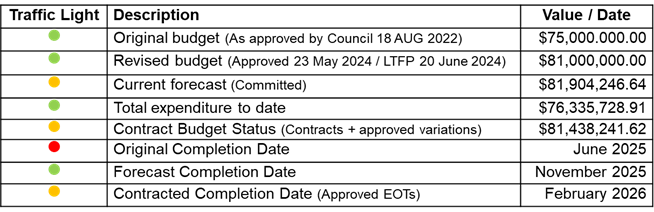
The purpose of this report is to provide an
update on the construction status of the Galuwa Recreation Centre (formerly
known as Lane Cove Sport and Recreation Facility) and to seek Council approval
to a reforecast of the project budget by 1.85% from the previously approved
$81M to $82.5M.
The Galuwa Recreation Centre project is
nearing practical completion, which is currently forecast for November 2025.
While construction progress remains positive, previously identified risks
associated with the project, particularly latent conditions, continue to impact
the project budget. The primary risk at this stage of the project is surplus
spoil management and site remediation, however with earthworks reaching
completion, the associated costs and quantities of soil that have been required
to be removed from the site are known, and a budget variance will be required
to accommodate these additional costs.
The additional costs will exceed the
approved budget of $81M by approximately $1M, representing a 1.23% variation to
the approved project budget, thus bringing the construction project to
approximately $82M.
In addition to the additional construction
related costs, there are a number of other works in progress that can be
referred to a ‘precinct wide works’. These works include
items such as the signalised intersection, practice putting green and golf
course (including the upgrades to the first tee), general signage, consultants,
and it is recommended that a further allowance of $500,000 be allocated to
these works for contingency purposes.
The addition of this contingency amount for
‘precinct wide works’ would result in an overall budget increase to
approximately $82.5M representing a 1.85% increase over the approved $81M
budget.
Background
Detailed information related to the history
of the project is available in previous reports to Council, but in summary the
Lane Cove Sport and Recreation project commenced in 2008, progressing through
various stages until 2016. During this time, a number of studies, community
consultation and stakeholder engagement was undertaken before Council sought
expressions of interest from industry in 2018.
In 2019 the project gained Council approval
to progress through the design and planning phase, including further community
consultation and stakeholder engagement through to 2021.
Feedback received was adopted into the
design, and the development application was approved in May 2023.
Construction began in August 2023 which
aligned with the conditions of the Office of Sport Grant funding. Construction
has progressed steadily, with no significant deviations in design. Completion
is forecast for late 2025 ahead of the adjusted contract schedule.
Council has remained largely insulated from
external commercial and economic pressures, under the terms of a
well-provisioned contract.
The facility once complete will provide:
- 8 x multi-sport courts (4 indoor + 4 outdoor courts).
- Golfing amenities and Pro-Shop.
Three (3) flexible program space(s) 97m2 each for
recreation and leisure activities, functions, and events incorporating a
separate bar and lounge space
- One (1) 360m2 multi-purpose space with sprung timber floor and
spectator viewing.
- Bistro, commercial kitchen and outdoor dining.
- 248 parking spaces, including 5 accessible, 20 bicycle and 16
motorcycle.
Budget and timing summary
Request for additional project budget
An additional $1.5M is being sought to
fulfil Council’s commitment to the ADCO contract and to cover other
project and other ‘precinct wide’ costs through to completion. A
breakdown of the request is as follows:
ADCO Contract
The Galuwa Recreation Centre project is
nearing practical completion, which is currently forecast for November 2025.
While construction progress remains positive, previously identified risks
associated with the project, particularly latent conditions, continue to impact
the project budge and account for the majority of cost overruns. This has
largely been mitigated through an effective spoil retention strategy,
delivering both cost savings and improved outcomes.
These project risks were identified in 2024
and resulted in Council approving in May 2024 an additional $6M to the project
budget, resulting in the current $81M project budget.
The current costs associated with the
previously identified risks are shown below:
- Latent conditions $6.48M
- Authority Approvals $1.92M
- Provisional Sum Costs $2.49M
The primary risk that remains at this stage
of the project is surplus spoil management and site remediation, however with
earthworks reaching completion, the associated costs and quantities of soil
that have been required to be removed from the site are known, and a budget
variance will be required to accommodate these additional costs.
Notwithstanding the above, the additional
costs will exceed the approved budget of $81M by approximately $1M,
representing a 1.23% variation to the approved project budget, thus bringing
the construction project to approximately $82M.
Contingency – precinct wide works
To maintain good corporate governance, it
is recommended a small contingency be allocated to cover potential latent
conditions and other precinct wide related costs to completion. A sum of
$500,000 is recommended for this purpose. This approach enables Council
to meet financial obligations effectively and improve transparency in reporting
on project and capital works budgets.
Ongoing Cost Risk Exposure
With Practical Completion forecast for
November 2025, the project team does not anticipate significant further project
budget deviations. All known and anticipated cost /risks have been incorporated
into the current budget forecast.
The team will continue to closely monitor
progress and manage the contract through to finalisation.
Funding source for additional $1.5M
project budget
The $1.5M forecast project variance is
proposed to be funded by the Capital Works Reserve, which currently holds an
uncommitted balance of approximately $5.7 M. The purpose of a capital works
reserve is for scenarios such as this, noting that the report to Council in May
2024 identified the reserve as a suitable funding source in the event of
project cost overruns.
Conclusion
Construction of the Galuwa Recreation
Centre is scheduled for completion in November 2025. The committed project
costs to complete is forecast at approximately $82 million.
In addition, to ensure Council can
effectively meet its financial obligations and account for potential costs
associated with any additional anticipated project costs as described, it is
recommended that Council approve $500K (0.61%) contingency, taking the
total project budget and associated capital works to $82.5 million approx
(representing a 1.85% increase from the approved $81M project budget).
Funding has been identified from the
Capital Works Reserve, with no impact to other existing projects. The 2025/26
Budget will be updated to reflect the necessary adjustments required in both
total budget and source of funding as part of the September Budget Review
process
|
RECOMMENDATION
That Council:
1. receive and note the
report; and
2. reflect the necessary
budget adjustments in the 2025/26 September Quarter Budget Review.
|
Louise Kerr
General Manager
Office of the General Manager
ATTACHMENTS:
There are no supporting documents for this report.
Ordinary Council Meeting 18 September 2025
Proposed Voluntary Planning
Agreement for 2-4 Pacific Highway, St Leonards
Item No: 6
Subject: Proposed Voluntary Planning Agreement for 2-4 Pacific Highway, St
Leonards
Record No: SU6258 - 53613/25
Division: General Manager's
Unit
Author(s): David
Stevens
Executive Summary
The purpose of this report is to seek Council’s
endorsement to publicly exhibit a draft Planning Agreement for 2-4 Pacific
Highway St Leonards.
Council has received an offer to enter into
a Planning Agreement with JCDecaux (the Proponent). The Offer (AT-1)
comprises a monetary contribution for local works or projects at
Council’s discretion and, a share of advertising time on the sign, at no
charge to Council. First payment of the monetary contribution will be made at
Practical Completion of the proposed LED Billboard upgrade.
A Development Application (DA) has been
prepared but not submitted for an upgraded LEP Billboard at 2-4 Pacific
Highway, St Leonards. Upon submission and pending Council’s endorsement
of the Draf VPA, both will be publicly exhibited concurrently.
Senior Council staff have considered the Offer and
determined there is a public benefit arising that includes financial and social
benefit to Council and the broader community. A draft Planning Agreement (PA)
has been prepared and is now presented to Council for consideration (AT-2).
If Council agrees, the draft PA and supporting documentation
will be publicly exhibited in accordance with statutory requirements (28 days)
with the outcomes of the community consultation reported to Council.
Background
Council has received a Letter of Public
Benefit Offer from the Proponent to enter into a Planning Agreement (PA) for
the site.
State Environmental Planning Policy
Industry and Employment (SEPP) (Chapter 3 Advertising and Signage)
provides Council with the assessment criteria to consider for signage, in
conjunction with Council’s own DCP controls.
Clause 3.1 of the SEPP titled “Aims,
objectives” section (3) “to ensure that public benefits may be
derived from advertising in and adjacent to transport corridors” is a
cornerstone of the Proponents offer, and indeed Council’s assessment
thereof.
A Planning Agreement is a legal arrangement
between a Developer/Landowner and Council to facilitate the delivery of a
public benefit. Public benefits may include the dedication of land at no cost
to Council, the payment of a monetary contribution and/or the provision of
infrastructure works.
Planning Agreements are voluntary and
initiated by the developer.
Discussion
The Proponent offers the following public
benefit contributions:
1. A 5% share of advertising time at no charge to
Council that may only be used for community messages that are directly
affiliated with Council; and
2. A fixed (recurring) monetary contribution of $10,000
per annum indexed at CPI to be expended by Council on local community works or
projects at Council’s discretion.
Council staff have determined that the
annually indexed monetary contribution shall be deployed to the maintenance of
Wadanggari Park, St Leonards for a term of 10 years. Under Section 3.19 (2) (a)
of the SEPP, consent granted ceases to be in force “on the expiration of
10 years after the date on which the consent becomes effective”. The
Proponent’s financial performance under the PA is secured by a $10,000
Bank Guarantee for the 10 year term.
In conjunction with the Monetary
Contribution previously agreed in-principle with Realside Pty Ltd at the 170
Pacific Highway site under a separate PA, this Offer will further augment
Council’s funding for maintenance and repairs at the award-winning
Wadanggari Park site. Further, such external and recurring revenue streams
afford Council the opportunity to re-deploy working capital to other projects
and works in the LGA.
The proposed share of advertising time at
no charge, provides Council an opportunity to elevate community messaging from
a prominently visible site and in so doing, raise awareness and activation to
capture an audience that extends beyond the LGA. Such an opportunity aligns
with Council’s economic development activities that most recently include
an agreement to take up the Commonwealth Bank’s “Council iQ”
platform on a six (6) month trial basis.
Council iQ has been rolled out to more than
100 Councils and measures economic spend across a diversity of categories that
include but are not limited to: date (ie event specific); industry sector (eg
retail, hospitality, and professional services); and demographics (age, family,
residential location). Events of note that can be “economically
measured” are the Lane Cove Festival, Food and Wine by the River, Rotary
Fair, and any / all community events at The Canopy and Plaza sites.
Community Consultation
Statement of Intent
The consultation is designed to obtain
feedback on the proposed Planning Agreement for the delivery of Public Benefit
as described. Any comments received will be reviewed and evaluated to assist in
preparing a report back to Council which will determine whether (or not), to
accept the Planning Agreement.
Method
|
Level of Participation
|
Inform
|
Inform
|
Consult
|
|
Form of Participation
|
Open
|
Targeted
|
Open
|
|
Target Audience
|
Lane Cove Community and community groups
|
Properties in the vicinity.
Local community associations.
|
Lane Cove Community
|
|
Proposed Medium
|
Advertisement
and
e-Newsletter
|
Notification
Letters
|
Public
Exhibition,
Website
Exhibition and Survey
|
|
Indicative
Timing
|
In conjunction
with the Development Application Notification
|
Conclusion
The Monetary Contribution offered for the
medium-term maintenance of Wadanggari Park represents a considerable public
benefit. Further, it provides flexibility to Council for the re-deployment of
financial resources to other unfunded and / or partially funded projects and
services in the Lane Cove Local Government Area (LGA).
Simultaneously, and at no charge, Council
can pro-actively enhance its community outreach for Council organised and
sponsored events and services from the display of advertisements in a prominent
location that supports the Lane Cove LGA in terms of activation and visitation.
|
RECOMMENDATION
That Council:
1. places the draft Planning
Agreement for 2-4 Pacific Highway, St Leonards and supporting documentation
on public exhibition concurrently with the DA; and
2. receives a report on the
outcomes of the public exhibition for the draft Planning Agreement.
|
Louise Kerr
General Manager
General Manager's Unit
ATTACHMENTS:
|
AT‑1 View
|
Letter of Public Benefit Offer: 2-4 Pacific Highway
|
|
Available Electronically
|
|
AT‑2 View
|
Final DRAFT VPA 2-4 Pacific Highway - LED Billboard
Upgrade
|
45 Pages
|
Available Electronically
|
Ordinary Council Meeting 18 September 2025
New Model Code of
Meeting Practice 2025
Subject: New Model Code of Meeting Practice 2025
Record No: SU837 - 61375/25
Division: Corporate and Strategy
Division
Author(s): Stephen
Golding
Executive Summary
The NSW
Office of Local Government released a new Model Code of Meeting Practice for
Local Councils in NSW on Friday 29 August 2025, (NSW OLG Circular 25-20). The
new 2025 Model Meeting Code has been published in the Government Gazette and is
expected to be prescribed under the Local Government (General) Regulation 2021
(the Regulation) shortly.
The new
Model Code of Meeting Practice comprises mandatory and non-mandatory
provisions.
Councils
must adopt a Code of Meeting Practice that incorporates the mandatory
provisions of the Model Code of Meeting Practice no later than 31 December
2025.
This report
recommends that the Lane Cove Council Draft Code of Meeting Practice which has
been developed with regards to the new Model Code, be adopted for community
consultation and that a further report addressing any submissions received and
any proposed amendments to the Draft Code, be received by Council following the
consultation period.
Background
The
current Code of Meeting Practice was recently adopted by Council at the
Ordinary Council Meeting of 21 August 2025. Council was aware the OLG was
finalising the new Model Code of Meeting Practice, however had a statutory
obligation to adopt the current version as it was required to do so within 12
months of a council election.
The new
Model Code of Meeting Practice has been the subject of discussion and
consultation across the local government sector over the past 12 months.
Council, on 2 occasions, expressed some concerns in relation to proposed
changes, including the banning of pre-meeting briefings.
Council
has reviewed the new Model Code of Meeting Practice for Local Councils in NSW
with regards to Council’s current Mode of Meeting Practice and developed the Draft Code
of Meeting Practice 2025. In doing so, it is recommended that Council
adopt all mandatory and non-mandatory provisions of the Model Code, together
with several supplementary provisions that are contained in the current Code of
Meeting Practice that are considered appropriate for inclusion in the new code
and are not inconsistent with any of the mandatory provisions.
The new
Draft Code of Meeting Practice 2025 is attached as AT-1.
The OLG
Frequently Asked Questions is attached as AT-2.
The
Model Code of Meeting Practice prepared by the OLG is attached as AT-3.
The new
Draft Code of Meeting Practice 2025 contains different coloured text to
highlight the distinction between mandatory provisions (black text),
non-mandatory provisions (red text) and supplementary provisions (green text).
Discussion
A key focus of the changes made to the 2025 Model Meeting
Code is to ensure meetings are conducted in a dignified and orderly way
befitting to a chamber of democracy and to promote community confidence in
councils and their decisions.
The following is a summary of the major changes, noting
they are all ‘mandatory provisions’ that cannot be altered (mandatory
provisions are identified as black text in AT-1).
Prohibition on pre-meeting briefing sessions:
• The 2025 Model Meeting Code prohibits briefing
sessions being held to brief councillors on business listed on the agenda for
meetings of the council or committees of the council.
• The prohibition on briefing sessions does not
prevent a councillor from requesting information from the general manager about
a matter to be considered at a meeting, provided the information is also
available to the public. The information must be provided in a way that does
not involve any discussion of the information
Public forums:
• The public forum provisions are now mandatory
but leave it to councils to determine whether to hold public forums before
council and committee meetings.
• Councils are also free to determine the rules
under which public forums are to be conducted and when they are to be held. OLG
will be issuing model best practice public forum rules that councils can use if
they choose to.
• Public forums must be livestreamed.
It is recommended that Council conduct Public Forums on the
same evening as Council Meetings, prior to the commencement of the council
meeting. It is further recommended that Public Forums commence at 6.30pm and
conclude at 7.30pm. It is also recommended to
reference the rules of public forums as ‘Guidelines’ accompanying
the Model Code, rather than provisions enshrined within the Model Code itself.
Dealing with disorder:
• Councils will be required to determine on the
adoption of the new code and at the commencement of each council term, whether
to authorise the person presiding at a meeting to exercise a power of
expulsion.
• The definition of acts of disorder by
councillors have changed. The following constitute acts of disorder under the
Regulation and the 2025 Model Meeting Code:
o contravening the Act, the Regulation, or the
council’s code of meeting practice,
o assaulting, or threatening to assault, another
councillor or person present at the meeting,
o moving or attempting to move a motion or an
amendment that has an unlawful pose, or deals with a matter that is outside the
jurisdiction of the council or committee or addressing or attempting to address
the council or committee on or such a motion, amendment or matter,
o using offensive or disorderly words,
o making gestures or otherwise behaving in a way
that is sexist, racist, homophobic or otherwise discriminatory, or if the
behaviour occurred in the Legislative Assembly, would be considered disorderly,
o imputing improper motives, or unfavourably
personally reflecting, on another council official or a person present at the
meeting, or
o saying or doing anything that would promote
disorder at the meeting or is otherwise inconsistent with maintaining order at
the meeting.
• Where a councillor fails to remedy an act of
disorder at the meeting at which it occurs, they can be required to do so at
each subsequent meeting until they remedy the act of disorder. On each occasion
the councillor fails to comply with a direction by the chairperson to remedy an
act of disorder, they can be expelled from the meeting and each subsequent
meeting until they comply.
• Members of the public can be expelled from
meetings for engaging in disorderly conduct. Disorderly conduct includes:
o speaking at meetings without being invited to,
o bringing flags, signs or protest symbols to
meetings,
o disrupting meetings,
o making unauthorised recordings of meetings.
• The 2025 Model Meeting Code notes that failure
by a councillor or members of the public to leave a meeting when expelled is an
offence under section 660 of the Act. Section 660 provides that a person who
wilfully obstructs a council, councillor, employee of a council or a duly
authorised person in the exercise of any function under the Act, or Regulation
is guilty of an offence. An offence under section 660 carries a maximum fine of
$2,100.
Councillors’ attendance at meetings by audio-visual
link:
• The provisions governing attendance by
councillors at meetings by audio-visual link have been made mandatory and the
option to attend meetings by audio-visual link has been restricted to where
councillors are prevented from attending a meeting in person because of
ill-health or other medical reasons or because of unforeseen caring
responsibilities.
New rules of etiquette at meetings:
• Councils may determine standards of dress for
councillors when attending meetings.
• Where physically able to, councillors and staff
are encouraged to stand when the mayor enters the chamber and when addressing
the meeting.
• The 2025 Model Meeting Code prescribes modes of
address.
Making information considered at closed meetings public:
• Consistent with ICAC’s recommendation, the
general manager must publish business papers for items of business considered
during meetings that have been closed to public on the council’s website
as soon as practicable after the information contained in the business papers
ceases to be confidential.
• Before publishing this information, the general
manager must consult with the council and any other affected persons and
provide reasons for why the information has ceased to be confidential.
The following is a summary of the major changes, noting
they are all ‘non-mandatory provisions’ (non-mandatory
provisions are identified as red text in AT-1) that can be altered however
it is recommended they be incorporated into the new Model Code.
Power of Expulsion:
• On the adoption of the Code and at the
commencement of each council term, the council must determine whether to
authorise the person presiding at a meeting to exercise a power of expulsion.
• If adopted, clause’s 15.15 and 15.16 of
the Model Code confer a standing authorisation on all chairpersons of meetings
of the council and committees of the council to expel persons from meetings.
• If adopted, clause 15.15 authorises chairpersons
to expel any person, including a councillor, from a council or committee
meeting.
• Alternatively, if adopted, clause 15.16
authorises chairpersons to expel persons other than councillors from a council
or committee meeting (5.35).
It is recommended that Clause 15.16 of the Model Code apply
in Council’s new Draft Model Code of Meeting Practice 2025.
Record of Voting:
• All voting at council meetings, (including
meetings that are closed to the public), must be recorded in the minutes of
meetings with the names of councillors who voted for and against each motion or
amendment (including the use of the casting vote) being recorded (11.10).
This reflects Council’s current practice.
Dealing with Items by Exception:
• The council or a committee of council may, at
any time, resolve to adopt multiple items of business on the agenda together by
way of a single resolution where it considers it necessary to expedite the
consideration of business at a meeting (13.1).
• Before the council or committee resolves to
adopt multiple items of business on the agenda together under clause 13.1, the
chairperson must list the items of business to be adopted and ask councillors
to identify any individual items of business listed by the chairperson that
they intend to vote against the recommendation made in the business paper or
that they wish to speak on (13.2).
• The council or committee must not resolve to
adopt any item of business under clause 13.1 that a councillor has identified
as being one they intend to vote against the recommendation made in the
business paper or to speak on (13.3).
• Where the consideration of multiple items of
business together under clause 13.1 involves a variation to the order of
business for the meeting, the council or committee must resolve to alter the
order of business in accordance with clause 8.2 (13.4).
• A motion to adopt multiple items of business
together under clause 13.1 must identify each of the items of business to be
adopted and state that they are to be adopted as recommended in the business
paper (13.5).
• Items of business adopted under clause 13.1 are
to be taken to have been adopted unanimously (13.6).
• Councillors must ensure that they declare and
manage any conflicts of interest they may have in relation to items of business
considered together under clause 13.1 (13.7).
It is recommended these non-mandatory provisions be
included in Council’s new Draft Code of Meeting Practice.
Recommitting resolutions to correct an error:
• Despite the provisions of this Part, a
councillor may, with the leave of the chairperson, move to recommit a
resolution adopted at the same meeting (17.16):
(a) to correct
any error, ambiguity or imprecision in the council’s resolution, or
(b) to confirm
the voting on the resolution.
• In seeking the leave of the chairperson to move
to recommit a resolution for the purposes of clause 17.16(a), the councillor is
to propose alternative wording for the resolution (17.17).
• The chairperson must not grant leave to recommit
a resolution for the purposes of clause 17.16(a), unless they are satisfied
that the proposed alternative wording of the resolution would not alter the
substance of the resolution previously adopted at the meeting (17.18).
• A motion moved under clause 17.16 can be moved
without notice. Despite any other provision of this code, only the mover of a
motion referred to in clause 17.15 and the chairperson, if they are not the
mover of the motion, can speak to the motion before it is put (17.19).
• A motion of dissent cannot be moved against a
ruling by the chairperson under clause 17.16 (17.20).
• A motion moved under clause 17.16 with the leave
of the chairperson cannot be voted on unless or until it has been seconded
(17.21).
Time limits on Council Meetings:
• If the business of the meeting is unfinished at
11:00 pm (the time the council has determined), and the council does not
resolve to extend the meeting, the chairperson must either (18.2):
(a) defer
consideration of the remaining items of business on the agenda to the next
ordinary meeting of the council, or
(b) adjourn the
meeting to a time, date and place fixed by the chairperson.
• Clause 18.2 does not limit the ability of the
council or a committee of the council to resolve to adjourn a meeting at any
time. The resolution adjourning the meeting must fix the time, date and place
that the meeting is to be adjourned to (18.3).
• Where a meeting is adjourned under clause 18.2
or 18.3, the general manager must (18.4):
(a) individually
notify each councillor of the time, date and place at which the meeting will
reconvene, and
(b) publish
the time, date and place at which the meeting will reconvene on the
council’s website and in such other manner that the general manager is
satisfied is likely to bring notice of the time, date and place of the
reconvened meeting to the attention of as many people as possible
The following is a summary of the ‘supplementary
provisions’ which are non-mandatory provisions that either add value
or context to the new Model Code (supplementary provisions are identified as
green text in AT-1):
• The inclusion of ‘Respectful’ to the
Meeting Principles section of the Code (this is in the current Code).
• Clarification
that seven (7) days’ notice before a meeting of the Council includes a
Saturday, Sunday and/or a Public Holiday (this is in the current Code).
• Notice of
Motions are to be submitted within 14 days before the Ordinary Council meeting
is to be held (by 5.00pm on the Thursday, two weeks before the Council
meeting).
• The inclusion
of guidance around the consideration of Late Items (this is in the current
Code).
• The
inclusion of a statement of ethical obligations (this is in the current code).
• The rules
under which public forums are to be conducted and when they are to be held are
proposed to be outlined in a Public Forums Guidelines (2025) document to be
developed.
• A limitation
may be placed on the number of members of the public admitted to a meeting of
the Council or a Committee of the Council, where such a limitation is for
reason of safety or security (this is in the current Code).
• The
recording of a meeting is to be made publicly available on the council’s
website at the same time as the meeting is taking place or as soon as
practicable after the meeting, if technical difficulties are being experienced
during the meeting. (inclusion of wording in italics).
• Councillors
and Council Officers are required to stand and use their microphone when
speaking during a Council Meeting (this is in the current Code).
• The general
order of business is included in the Draft Code (this is in the current Code).
• Where a
motion is moved and seconded, the chairperson shall enquire before the speech
in support of the motion whether there is any dissent, if there is no dissent
the motion shall then be put without discussion. When dissent is
expressed, the speakers shall be in a series of for and against. (this is in
the current Code).
• The
inclusion of how Foreshadowed Motions are to be managed (this is in the current
Code).
• The grounds
on which a meeting is closed to the public must be specified in the decision to
close the meeting and recorded in the minutes of the meeting. (this is in the
current Code).
• The
inclusion of how to manage speakers who wish to speak before Council goes into
a Closed Session (this is in the current Code).
• A point of
order cannot be made with respect to adherence to the principles contained in
the Meeting Principles. (this is in the current Code).
• The
inclusion of attendance provisions at Committee Meetings (this is in the
current Code).
• The
inclusion of foreshadowed amendments and motions in the definitions section of
the Code (this is in the current Code).
Given the number
and nature of changes to the Code of Meeting Practice, it is important the
Office of Local Government offer appropriate training and development to
council officials in implementing the new provisions of the Model Code.
Community Consultation
Statement of Intent
The consultation is designed to ascertain the community’s
views on the Draft Code of Meeting Practice 2025. Any comments received will be
reviewed and evaluated to determine whether to incorporate any amendments or
additional supplementary provisions.
Method
|
Level of Participation
|
Inform
|
Consult
|
|
Form of Participation
|
Open
|
Open
|
|
Target Audience
|
Lane
Cove Community
|
Lane
Cove Community
|
|
Proposed Medium
|
e-Newsletter
|
Website Exhibition
“Have Your Say”
|
|
Indicative Timing
|
Late
September to early November 2025l
|
Conclusion
The new
Model Code of Meeting Practice for Local Councils in NSW, was released on 29
August 2025 by the Office of Local Government.
It is recommended that Council adopts all the mandatory,
non-mandatory and supplementary provisions set out in the new Model Code of Meeting Practice.
It is recommended that the Draft
Code of Meeting Practice 2025 be adopted for the purpose of community
consultation and that a further report be received by Council following the
public exhibition period.
|
RECOMMENDATION
That:
1. Council
adopt, for the purpose of public exhibition, the Draft Code of Meeting
Practice 2025 which includes both mandatory and non-mandatory provisions,
consistent with the Office of Local Government’s Model Code of Meeting
Practice and ‘supplementary provisions’ as outlined in this
report;
2. Council
endorse the proposal to conduct Public Forums immediately prior to Ordinary
Council Meetings with a commencement time of 6.30pm and a conclusion time of
7.30pm;
3. Council
undertakes community consultation for a period of six (6) weeks as per the
consultation plan outlined in this report;
4. following
the public exhibition period, the Draft Code of Meeting Practice, together
with a report on any submissions received and any proposed amendments, be
considered at the Council meeting to be held 20 November 2025, and
5. Council
write to the Office of Local Government requesting that they provide training
and development (and/or tools) that is offered to Mayors and other council
officials in implementing the provisions of the new Model Code.
|
Steven Kludass
Director - Corporate Services and Strategy
Corporate and Strategy Division
ATTACHMENTS:
|
AT‑1 View
|
Draft Code of Meeting Practice 2025
|
|
Available Electronically
|
|
AT‑2 View
|
Model Meeting Code - FAQ
|
|
Available Electronically
|
|
AT‑3 View
|
OLG - Model Code of Meeting Practice
|
|
Available Electronically
|
Ordinary Council Meeting 18 September 2025
Establishment of a
Performance Review Panel - General Manager
Item No: 8
Subject: Establishment of a Performance Review Panel - General
Manager
Record No: SU828 - 60691/25
Division: Corporate Services
and Strategy Division
Author(s): Steven
Kludass
Executive Summary
The purpose of this report is to appoint a
Performance Review Panel to review the performance of the recently appointed
General Manager (GM), and to delegate to the panel the performance management
of the GM having regard to the guidelines issued by the Office of Local
Government, Department of Planning and Environment (2022).
Background
It is proposed that the performance
management of the new GM be undertaken in accordance with the ‘Guidelines
for the Appointment and Oversight of General Managers 2022’
publication prepared by the Office of Local Government in 2022. A copy of the
publication is available at AT-1.
The guidelines state that Council’s
governing body is to establish a Performance Review Panel and delegate the task
of performance management of the GM to the panel.
The guidelines also identify that the
Performance Review Panel be comprised of the Mayor, Deputy Mayor, a Councillor
nominated by Council and a Councillor nominated by the GM.
Being newly appointed, the GM prefers to
forgo her opportunity to nominate a Councillor, in favour of Council nominating
2 Councillors for the panel. The GM is of the view that having 2
Council-nominated Councillors will best reflect the governing body’s
collective expectations of the GM.
The guidelines recommend that full
responsibility of performance management of the GM be delegated to the
Performance Review Panel, including discussions about performance, any actions
that should be taken and the determination of the initial and subsequent
performance agreements. This includes the conduct of formal performance reviews
and reporting of findings and recommendations to Council following performance
reviews.
The guidelines also provide that:
· The governing body of Council and the GM may agree on the
involvement of an external facilitator to assist with the process of
performance review and the development of a performance agreement. This person
should be selected by the governing body of Council or the Performance Review
Panel.
· At all times, those Councillors not on the panel can contribute to
the performance review process by providing feedback to the Mayor on the
performance of the GM, relevant to the agreed performance criteria in the
performance agreement.
Discussion
The GM is accountable to Council,
principally through the contract of employment. The contract requires that the
performance of the GM is to be reviewed at least annually against agreed
performance criteria.
Consistent with previous practice, it is
considered appropriate for Council to undertake the GM’s performance
management in accordance with the ‘Guidelines for the Appointment and
Oversight of General Managers 2022’ publication, issued by the Office
of Local Government and to delegate the performance management of the GM to a
Performance Review Panel established in accordance with the guidelines.
The guidelines require performance criteria
to be agreed within 3 months of commencement of employment and set out in a
performance agreement. Within a further 2 months of signing the performance
agreement the GM must submit to Council an action plan establishing how
performance criteria are to be met.
To align with Council’s planning and
performance cycle, it is proposed that the year one performance cycle be for
the period 21 July 2025 to 30 June 2026.
Given this will be the first performance
agreement set for the new GM, the Mayor is proposing that the draft performance
agreement for the 2025/26 performance year be reported to Council at the
October Ordinary Council Meeting for adoption following discussions with the
GM, Performance Review Panel and external facilitator.
|
RECOMMENDATION
That for the remainder of the
Council term, Council:
1. undertake performance
management of the General Manager having regard to the Guidelines for the
Appointment and Oversight of General Managers 2022 issued by the Office
of Local Government;
2. establish a Performance Review
Panel to undertake the performance management of the General Manager;
3. resolve the composition of the
General Manager’s Performance Review Panel to consist of the Mayor,
Deputy Mayor, and 2 nominated Councillors through to June 2026;
4. delegate the panel
responsibility for performance management of the General Manager, including
discussions about performance and performance reviews, any actions that
should be taken, the determination of each new performance agreement, the
reporting of performance findings and recommendations to Council, and the
selection of a qualified external facilitator to assist with the performance
review process, and the development of each performance agreement; and
5. agree to the involvement of an
external facilitator to assist with the performance review process and the
development of each new performance agreement.
|
Steven Kludass
Director - Corporate Services and Strategy
Corporate Services and Strategy Division
ATTACHMENTS:
|
AT‑1 View
|
Guidelines for the Appointment & Oversight of General
Managers
|
|
Available Electronically
|
Ordinary Council Meeting 18 September 2025
MOTIONS FOR LOCAL GOVERNMENT NSW ANNUAL CONFERENCE 2025
Item No: 9
Subject: 2025 Local Government NSW Conference Motions
Record No: SU10698 - 58165/25
Division: Corporate Services
and Strategy Division
Author(s): Stephen
Golding
Executive Summary
The purpose of
this report is to recommend motions to submit to the Local Government NSW
(LGNSW) annual conference to be held Sunday 23 November to Tuesday 25 November
2025.
Background
LGNSW is the
peak industry body for councils across NSW and its annual conference is the
main policy making event for all NSW councils and associate members. The 2025
conference will be held in Penrith between Sunday 23 November and Tuesday 25
November 2025.
Motions proposed
to be submitted to the annual conference are first required to be supported by
Council resolution.
The latest date
motions can be accepted for inclusion in the business paper for the LGNSW
Conference is 12 midnight (AEDT) on Sunday 26 October 2025. Members however are
encouraged to submit motions by 30 September 2025.
The annual
conference can only accommodate debate on approximately 100 motions within the
available time and as such LGNSW requests that motions be limited to those
addressing the highest priorities.
The LGNSW Board
has resolved that motions will be included in the Business Paper for the
Conference only where they fit in with the following criteria.
Criteria for motions
To be included in the Business Paper,
motions must:
1. Be consistent with the objects of the LGNSW Rules
(Rule 4)
2. Demonstrate that the issue concerns or is likely to
concern a substantial number of local governments in NSW
3. Seek to establish or change a policy position of
LGNSW and/or improve governance of the association (noting that the LGNSW Board
is responsible for any decisions around resourcing and campaigns or operational
activities, and any necessary resource allocations will be subject to the LGNSW
budgetary process)
4. Be strategic
5. Be concise, clearly worded and unambiguous
6. Not be focused on just a small specific part of NSW
7. Not encourage violation of prevailing laws
8. Not seek to advantage one or several members at the
expense of other members.
Motions of a similar objective:
9. May be consolidated by LGNSW as a single item.
Motions reflecting existing LGNSW
policy:
10. Remain part of LGNSW’s Policy Platform but will not be
included for debate as they have already been considered by Conference.
Discussion
There are four
(4) proposed motions for the LGNSW Conference that address key issues affecting
the Lane Cove community.
Motions 1 and
2 have arisen from resolutions of Council from the
21 June and 24 July 2025 Council meetings being Notice of Motion –
Electoral Campaign Reform for Local Governments: Review and Response to the
Conduct of the 2025 Federal Election (Resolution 124/25) and Notice of Motion -
Leadership In Child Safety - Working With Children Checks For Elected
Councillors (Resolution 149/25).
Two further motions have been received from
Councillors for consideration, those being Motion 3 and Motion 4.
Accordingly, it is recommended that the
four (4) motions be submitted for inclusion in Local Government NSW Conference
Agenda for discussion and debate.
Suggested Motions
Motion 1
Motion Title
Electoral Campaign Reform for Local
Governments:
Motion
That Local Government NSW (LGNSW) requests
that the Federal and State Electoral Commissioners liaise with Councils to
review current rules and regulations governing electoral campaigning and in
particular campaign rules around the erection of signage on public property and
at polling booths so that the rules are consistent across all levels of
government.
Background note
During the 2025
Federal election campaign, the conduct of some political participants fell
short of the standards of integrity, fairness, and adherence to local
government rules. These behaviors pose a risk to the integrity and goodwill of
democratic processes and placed significant strain on Council resources.
Political materials were mass-produced and widely distributed, with many
illegally installed on public land and infrastructure.
Council staff
worked diligently to remove these items, particularly plastic signage and
digital trailers to ensure public safety, accessibility, and amenity. Numerous
community complaints were received, diverting rangers from their core duties.
Motion 2
Motion Title
Mandatory Working with Children Checks
(WWCC) for Elected Councillors (and MPs) in NSW
Motion
That Local
Government NSW (LGNSW):
1. Advocate
to the NSW Government to amend the Local Government Act 1993 to require
a valid Working with Children Check (WWCC) prior to a Councillor taking the
oath or affirmation of office, using the proposed wording; insert in s233A after
(1) of the Act;
(1A) Before taking the oath of office or making the affirmation of
office under subsection (1), a Councillor must provide the general manager with
evidence of holding a current Working With Children Check (WWCC) clearance
issued under the Child Protection (Working with Children) Act 2012.
A Councillor who
does not comply with this subsection is not entitled to take the oath or
affirmation and must not exercise any functions of civic office until the
requirement is met.
2. Request
the Office of Local Government (OLG) and the Office of the Children’s
Guardian (OCG) to issue guidance for councils on privacy, verification,
exemptions/appeals, transition arrangements for sitting councillors, and
record-keeping by General Managers.
3. Support inclusion in the Model Code
of Conduct of an obligation to maintain a current WWCC where duties involve
interaction with children and to provide proof to the General Manager,
consistent with the legislative amendment, using the proposed wording,
Councillors
must maintain a current Working With Children Check (WWCC) clearance where
their official duties may involve interaction with children and must provide
proof of such clearance to the General Manager as required by s 233A(1A) of the
Local Government Act 1993.
4. Write
to the Premier and the Minister for Local Government seeking Cabinet
consideration of these reforms; and raise the matter with the Federal Minister
for Local Government (via ALGA) to explore a nationally harmonised approach for
elected representatives.
Background note
Recent
high-profile child-safety failures have heightened community expectations that
public officials model best practice. In NSW, council staff and volunteers who
do “child-related work” must hold a WWCC under the Child
Protection (Working with Children) Act 2012. However, elected councillors
are not currently required to hold a WWCC because the role is not classified as
child-related work.
Despite this,
Councillors, especially Mayors, regularly meet children and families at school
visits, citizenship ceremonies, library storytimes, youth events, holiday
programs and major civic events. The inconsistency between strict screening for
staff/volunteers and no screening for elected officials undermines public
confidence.
This motion
proposes a straightforward fix: require councillors to obtain a WWCC before
taking office, with complementary Code of Conduct provisions and practical
guidance for councils. The approach is low-burden, privacy-aware, and signals
that child safety and integrity are core expectations of civic leadership. It
also requests national exploration, via ALGA, for consistency across
jurisdictions.
Motion 3
Motion Title
Supporting people seeking asylum within our
communities.
Motion:
That Local
Government NSW (LGNSW) write to the Minister for Immigration to call upon the Australian
Government to:
1. Provide people seeking asylum with a valid visa and
the opportunity to work while they await decisions on their protection
application, including automating the bridging renewal process. By providing
people work rights, they can contribute skills to Australia, remain independent
in society and stay engaged in the immigration system.
2. Expand the eligibility criteria of the Status
Resolution Support Services program to ensure people’s basic needs are
met, including health care, accommodation, crisis support, so people in need
can live safely and not in destitution and deep poverty.
3. Provide a fair pathway to permanency for the
approximately 7,700 individuals who were subjected to the 'Fast Track' visa
assessment process.
Background note
Councils support
refugee resettlement, provide services for newly arrived migrants, fill the
gaps in the provision of essential human services when there are no other
providers, and advocate for equitable access to infrastructure and services.
Four out of five
people seeking protection in our communities are not eligible for federal
funded support and rely on support from local government and charities to keep
food on the table. This has placed huge burdens on local government and service
providers, families are facing poverty and trust in Government systems is
eroded.
Financial
assistance delivered through the Federally funded Status Resolution Support
Services (SRSS) Program has been cut by 93% (from $300 million in 2015-16 to
$20 million in 2025-26) and the number of people assisted has dropped to only
1,057 in 2024. The NSW government has ceased support in expectation the Federal
Government would step in.
Lengthy delays
in visa processing have made the situation much worse. The lack of assistance,
coupled with extended waiting times for decisions, have led to people waiting
for over 12 years without access to basic health care, safe accommodation and
the opportunity to work or study.
The Australian
Federal Government has responsibility for providing people seeking refugee
protection with a clear pathway to resolve their immigration status and
adequate support mechanisms while they navigate the asylum process.
There are still
8,000 people waiting for their immigration status to be resolved. These
individuals, part of the 'Legacy Caseload', arrived in Australia between August
2012 and December 2013 and were subjected to a refugee determination process
that has been widely criticized for its lack of procedural fairness.
The 'Fast Track'
process limited applicants' rights to a comprehensive review, without the
opportunity for interviews or the presentation of new evidence, despite changed
country conditions. Many have lived in Australia for over a decade on temporary
visas, contributing to their communities, yet remain in a state of uncertainty,
unable to reunite with family or access stable employment. Addressing their
situation by providing a clear pathway to permanency would rectify past
injustices and allow these individuals to fully participate in Australian
society.
Since 2018, the
Mayoral and Councillor Taskforce Supporting People Seeking Asylum has been
advocating for people seeking asylum. The Taskforce is made up of a growing
membership of over 40 councils nationwide, including 10 Councils in NSW, who
recognise that this issue is of significance to local government.
Motion 4
Motion Title
Early Childhood Education Reforms
Motion:
That Local Government NSW (LGNSW)
calls on the NSW Government to:
1. affirm the critical importance of providing safe and
high quality to care for children in Early Childhood Education and Care
settings,
2. recognise
the systemic failure of current systems to ensure quality standards have been
met, and as a consequence children have been endangered,
3. acknowledge that for-profit service providers are
more likely to fall below acceptable standards, and that Early Childhood
Education is best delivered by not-for-profit organisations,
4. acknowledge that Local Councils are well placed to
provide and to support not-for profit early childhood education,
5. fund Councils to establish safe staffing ratios so
that no educator is left alone with children and acknowledge that CCTV is no
substitute for safe staffing,
6. provide block funding to local councils for the
purpose of expanding the council-run early learning centres, and to allow
councils to help meet demand for early learning across NSW,
7. allocate
100% of Smart & Skilled Funding to TAFE NSW for early childhood education
& care training,
8. introduce rent controls upon landlords of early
learning centres; and
9. review
and resource the regulator so that it is fit for purpose and to ensure that all
centres are inspected and quality standards enforced and publicly reported.
Background note
The early
learning sector has slowly plunged into a labour crisis driven by low wages,
challenging working conditions, and a hyper privatised delivery model that
risks putting profit before quality.
Since the 1990s
the number of for-profit early learning services has exploded. Previously only
representing a fraction of the sector, for-profit services now represent 95% of
new builds and government run services represent 10% or less of total
market share. This is a result of ceasing
block funding for the operation of not-for-profit centres such as councils and
introducing subsidies to corporate organisations in the sector.
This creates
financial challenges for families as for-profit services cluster in
‘childcare oases’ in wealthier suburbs that can afford higher fees,
while much of NSW languishes in a ‘childcare desert’ where there
are far more children than available places. This trend is expected to continue
with real estate firms such as Ray White and CBRE pitching large size
for-profit services as ‘the most stable commercial investment’.
Educators share
this challenge, with for-profit providers tending to employ educators on the
Children’s Services Award rather than an Enterprise Agreement. This has
led to a situation where the majority of educators have indicated in a union survey that they plan to leave the sector in the
next few years. A 2024 audit of rental
prices by Anglicare, which indicates that less than 1% of rentals are
affordable for early childhood educators,
suggests that even educators at government run services on the Local Government
Award are not immune to this problem.
Recent release
of regulator documents in the NSW Parliament, and their reporting by ABC has
also shone light on how this impacts child safety. In particular private equity
firms like G8 and Affinity have been named in criminal investigations as a
result. But data shows that this trend impacts the sector broadly, with over 40% of government services rated
‘exceeding’ compared to 11% of for-profit services. This correlates with a clear pattern of Council services having
higher staffing ratios.
The
marketisation of training of educators has also created challenges for the
sector with Smart and Skilled funding available for private colleges who are
incentivised to pass students as quickly as possible. Audits by the Australian
Skills Quality Authority (ASQA) have shown an emerging issue of entirely non-existent qualifications, while fast track programs at other providers are otherwise
deemed as lacking by the sector.
Local government
is the main provider of public early childhood education and care, and
collectively runs approximately 300 services, and hosts many other
not-for-profit service providers. Rising land costs in Sydney increasingly also
make non-government not-for-profit education and care less viable as trends
continue. This makes Councils one of the largest players in not-for-profit
early childhood education and care in NSW and means that it is vital that
Councils be involved in responding to this crisis.
Recent federal
government responses are only the beginning of addressing an issue that deeply
impacts our local constituents. Restrictions on the use of phones and vapes and
the roll out of CCTV are not intended as nor suitable as preventative measures
against child abuse. Safe staffing levels are the most obvious preventative
response, and has been highlighted by the relevant Union.
The current
minimum standards for staffing ratios were implemented in 2005. They allow for
one educator to four babies, one educator to five toddlers, and one educator to
ten three- to five-year-olds. As the bare minimum these standards were never
intended to represent best practice, and it is well past time that these
standards are re-evaluated and best practice for safety established.
Councils are not
immune to safety concerns or the labour crisis occurring in the sector. Many
Councils rely on private labour hire firms such as ANZUK, Macarthur, and
Ranstadt in order to meet ratios due to extended vacancies in lower paid roles
or unexpected sick leave. These are educators who are paid less than
Council’s in-house staff and are strangers to the children, while the
Council pays significant fees to firms.
This means
educators who often have no relationship with children or staff may be left
alone with children. A significant case of this was reported in the media this year, with an alleged paedophile who worked at after school care in the
City of Sydney, Inner West, Northern Beaches, Willoughby. The investigation
into this case is ongoing at time of writing.
There are clear
reforms to be made by the NSW Government to ensure that the sector meets its
potential. This includes genuine resourcing and support of the regulator and
strengthening TAFE NSW to ensure that educators are trained appropriately. It
also entails resourcing Councils to expand service delivery so that safe,
affordable, and high quality public education and care is available for
families.
References
https://www.acecqa.gov.au/sites/default/files/202505/NQF%20Snapshot%20Q1%202025%20FINAL.PDF
https://www.raywhitecommercial.com/news-and-market-insights/news-media/western-sydney-childcare-market-shows-resilience-amid-challenges
https://unitedworkers.org.au/archive/60-of-educators-plan-to-leave-amid-staff-shortages/
https://www.anglicare.asn.au/publications/2024-rental-affordability-snapshot/
https://www.acecqa.gov.au/sites/default/files/202505/NQF%20Snapshot%20Q1%202025%20FINAL.PDF
https://www.abc.net.au/news/2025-07-07/fast-track-childcare-courses-put-children-at-risk-insiders-warn/105483042
https://unitedworkers.org.au/ecec-safer-staffing/
https://www.theguardian.com/australia-news/2025/jul/31/after-school-carer-david-james-charged-with-producing-child-abuse-material-at-six-facilities-across-northern-sydney-ntwnfb
Conclusion
To enable full
participation in the LGNSW Annual Conference, it is recommended that Council
endorse the motions outlined in this report, which are considered primary
issues affecting the Lane Cove community for submission to LGNSW for inclusion
in the Conference Agenda.
|
RECOMMENDATION
That Council endorse the draft
motions contained in this report seeking their inclusion in the business
paper of the LGNSW 2025 Annual Conference.
|
Steven Kludass
Director - Corporate Services and Strategy
Corporate Services and Strategy Division
ATTACHMENTS:
|
AT‑1 View
|
LGNSW Policy Platform 2025
|
40 Pages
|
Available Electronically
|
Ordinary Council Meeting 18 September 2025
Draft - Policy - Council
Policy Framework
Item No: 10
Subject: Draft - Policy - Council Policy Framework
Record No: SU6840 - 62985/25
Division: Corporate Services
and Strategy Division
Author(s): Stephen
Golding
Executive Summary
This report outlines the purpose,
structure, and application of Council’s Policy Framework and seeks
adoption by Council of the Policy Framework.
The framework establishes a
hierarchy for Council policies, Management Directives, and Guidelines, ensuring
consistency, transparency, and accountability in Council’s
decision-making and operations.
Each document type serves a
distinct role, ranging from strategic direction to operational guidance, with
clear requirements for approval, review, and publication.
Discussion
Council is committed to a
consistent and structured approach in the development, adoption,
implementation, amendment, and review of corporate documents. These documents
serve a dual purpose: providing transparency to the community regarding Council’s
strategic direction, and guiding staff in the effective delivery of services
and responsibilities.
The draft Policy
Framework (draft Framework) (AT-1) provides the strategic principles for
Council policies and outlines the tiers of corporate policy related documents.
The draft
Framework consists of three tiers of corporate documents, referred to as:
1. Council
Policy – Strategic, community-focused documents adopted by Council
resolution.
2. Management
Directive – Operational, internal documents guiding staff, approved
by the General Manager or delegate.
3. Guideline
– Supporting documents that provide detail for implementing policies or
directives.
The draft
Framework identifies that a Council policy has high level strategic intent, is
linked to Council’s Community Strategic Plan and/or is required by
relevant legislation and has community focus and/or significant public
interest.
The draft
Framework contemplates that a Council policy is adopted by Council resolution
and published on Council’s website. It also provides that a Council
policy may only be revoked or amended by Council resolution.
The draft
Framework also proposes that Council policies are reviewed at least once per
Council term, or more frequently if required due to material changes to
Council’s operating environment such as legislative amendment, Council
resolution or a variation to Council’s strategic direction.
It is proposed
that, due to the high-level strategic intent of the draft Framework, it be
adopted as a Council policy.
The draft Framework provides that the other
tiers of corporate documents (management determinations and guidelines) are
operational in nature and their purpose is to assist staff in the
administration and discharge of their Council duties. Accordingly, the
preparation, approval and review of determinations and guidelines is the
responsibility of the general manager.
This governance approach is also very
common across the local government sector.
Community Consultation
Due to the corporate nature of the document and its
alignment to standard industry practice, staff are not proposing to publicly
exhibit the draft Framework.
However, if Council considers the likely benefit of doing so
outweighs the cost, impact on resources and associated time involved it may
resolve to do so.
Conclusion
The draft Policy Framework
provides the strategic direction and governance framework for the ongoing
management, establishment and review of Council policies, management
determinations and guidelines.
The review principles proposed in
the draft Framework are a control to ensure Council’s core corporate
documents remain relevant, effective and in keeping with community
expectations.
|
RECOMMENDATION
That Council adopt the Draft -
Policy - Council Policy Framework.
|
Steven Kludass
Director - Corporate Services and Strategy
Corporate Services and Strategy Division
ATTACHMENTS:
|
AT‑1 View
|
Draft - Policy - Council Policy Framework
|
4 Pages
|
Available Electronically
|
Ordinary Council Meeting 18 September 2025
Audit, Risk & Improvement
Committee Confirmed Minutes - 25 March 2025
Item No: 11
Subject: Audit, Risk & Improvement Committee Confirmed Minutes - 25 March
2025
Record No: SU740 - 61720/25
Division: Corporate Services
and Strategy Division
Author(s): Steven
Kludass
Executive Summary
The purpose of this report is to provide the confirmed minutes of the
Audit, Risk and Improvement Committee (ARIC) meeting held on 25 March 2025.
Discussion
The Audit, Risk and Improvement Committee provides a pivotal role proving
Council with independent assurance and advice in the areas of internal audit,
financial management, risk management, compliance and control, and
organisational performance and improvement, along with external accountability
responsibilities.
Amendments made to the Local Government (General) Regulation 2021
commenced on 1 July 2024 and set out new requirements for ARICs. The Office of
Local Government’s Guidelines for Risk Management and Internal Audit
for Local Government support and guide the operation of ARICs. Council
adopted new ARIC Terms of Reference at the 18 July 2024 Council Meeting.
The minutes of each ARIC meeting are to be reported to the governing
body.
The minutes of the ARIC meeting held on 25 March 2025, and confirmed by
ARIC at its meeting held on 24 June 2025 are attached for noting by Council (AT-1).
In future, the confirmed minutes of ARIC
meetings will be presented to the governing body for noting each quarter. To
further improve the way in which the minutes are prepared, the Chair of ARIC
will be asked to include a brief description of the discussion points as part
of the preparation of the minutes, in addition to the existing Determinations
of the Committee. This practice will commence from the next ARIC meeting to be
held on 30 September 2025.
In preparing the schedule of ARIC Meetings
for 2026, regard will be given to the timing of ARIC meetings so that the
confirmed minutes of meetings are able to be reported to Council in a timelier
manner.
|
RECOMMENDATION
That Council note:
1. The confirmed minutes of the Audit, Risk and Improvement Committee
meeting held on 25 March 2025, and
2. The minutes do not seek action from Council.
|
Steven Kludass
Director - Corporate Services and Strategy
Corporate Services and Strategy Division
ATTACHMENTS:
|
AT‑1 View
|
ARIC Minutes - 25 March 2025
|
|
Available Electronically
|
Ordinary Council Meeting 18 September 2025
Asphalt 2027 –
NSROC Tender for Road Surfacing, Patching and Associated Works
Item No: 12
Subject: Asphalt 2027 – NSROC Tender for Road Surfacing, Patching and
Associated Works
Record No: SU8602 - 62642/25
Division: Open Space and
Infrastructure Division
Author(s): Pradip
Lamichhane
Executive Summary
Northern Sydney
Regional Organisation of Councils (NSROC), on behalf of its member councils,
invited tenders for the Road Surfacing, Patching and Associated Works Contract
to engage suitably qualified contractors and ensure best value for money.
The following
service providers are recommended for appointment to panels A, B and C to
deliver the specified services in accordance with the technical specifications
outlined in the tender:
· Panel A, for Reconstruction/Re-sheeting works: NSW Building & Civil Pty Ltd, Fulton Hogan, Bitupave Ltd T/A
NSW Boral Asphalt, Downer EDI, Convil Group, All Pavement Solutions/Bernipave
Road Solutions, Stateline Asphalt Pty Ltd, NA Group, State Asphalt Services Pty
Ltd, Resco Civil Pty Ltd, and ANJ Asphalt.
· Panel B, for Patching/Heavy Patching works: NSW Building & Civil Pty Ltd, Stateline Asphalt Pty Ltd, Fulton
Hogan, Convil Group, All Pavement Solutions/Bernipave Road Solutions, State
Asphalt Services Pty Ltd, ANJ Asphalt, NA Group, Roadworx Group Pty Ltd, Downer
EDI, JM Schembri, Planet Civil Pty Ltd, Bitupave Ltd T/A NSW Boral Asphalt,
Optimal Civil, Fenworx, and Resco Civil Pty Ltd.
· Panel C, for Specialist Services: RPQ Spray Seal Pty. Ltd., SuperSealing and both of which are also appointed under Panels A and B.
Background
NSROC Tender
Asphalt 2027 was issued to the market on 16 December 2024 for the supply of
asphaltic concrete surfacing and associated works to NSROC member councils over
a two-year contract period. To ensure a comprehensive assessment of market
conditions and contractor capability, the tender required tenders to provide
detailed documentation on qualifications, capacity, and pricing for the supply,
supply and delivery, and supply, delivery and laying of various grades and
quantities of asphaltic concrete.
Services covered in the tender are:
1. Services (road surfacing and
associated works) - Road reconstruction/re-sheeting works
a)
Supply, Delivery and Laying of Asphaltic Concrete Products
b)
Profiling or Milling
c)
Heavy Patching (Milling & Filling) – granular base
d)
Edge Milling
e)
Traffic Control
f)
Supply, Delivery and Laying of other grades of Asphaltic Concrete Products
2. Services (road surfacing and
associated works) – Patching and heavy patching
g)
Patching of Road Pavement
h)
Heavy patching granular base and asphalt intermediate and wearing course
3. Services (road surfacing and
associated works) – Specialist services
i)
Line and Pavement Marking
j)
Other surfacings
k)
Bituminous crack sealing of road pavement
l)
Pothole investigation
m)
Supply only and Supply & deliver Ex Bin asphalt
n)
Day works schedule: labour, equipment/plant hire
Discussion
The tender
evaluation was conducted in two stages: Non-Price Evaluation and Price
Evaluation. Each Council independently reviewed and scored the proposals
against the non-price criteria. The Price Evaluation was assessed by comparing
each price submission against the lowest priced package, with scores allocated
accordingly.
The Tender
Evaluation Report provides the overall scores and ratings of each tender and
has been provided to Councillors as a separate confidential memo.
Based on the scores, the tender evaluation
panel (TEP) agreed on recommending suppliers as follows:
|
Panel A: Road reconstruction/re-sheeting
panel
|
Tenderers that scored more than 80 points
overall
|
|
Panel B: Patching and heavy patching
panel
|
Tenderers that scored more than 65 points
|
|
Panel C: Panel A, Panel B and specialist
suppliers
|
All tenderers that satisfied the
selection criteria
|
Following evaluation of the responses, the TEP recommends
the following panels:
Panel A: Road
reconstruction/re-sheeting panel [scored more than 80 points overall]
1. NSW
Building & Civil Pty Ltd
2. Fulton
Hogan
3. Bitupave
Ltd T/A NSW Boral Asphalt
4. Downer
EDI
5. Convil
Group
6. All
Pavement Solutions/ Bernipave Road Solutions
7. Stateline
Asphalt Pty Ltd
8. NA
Group
9. State
Asphalt Services Pty Ltd
10. Resco Civil
Pty Ltd
11. ANJ Asphalt
Panel B: Patching and heavy patching
panel [scored more than 65 points]
1. NSW Building & Civil Pty Ltd
2. Stateline
Asphalt Pty Ltd
3. Fulton
Hogan
4. Convil
Group
5. All
Pavement Solutions/ Bernipave Road Solutions
6. State
Asphalt Services Pty Ltd
7. ANJ
Asphalt
8. NA
Group
9. Roadworx
Group Pty Ltd
10. Downer EDI
11. JM Schembri
12. Planet
Civil Pty Ltd
13. Bitupave
Ltd T/A NSW Boral Asphalt
14. Optimal
Civil
15. Fenworx
16. Resco Civil
Pty Ltd
Panel C: Other surfacings, crack sealing
and line marking panel
Panel
A and Panel B where they had quoted for panel C services and
1. Complete
Linemarking Services Pty Ltd
2. RPQ
Spray Seal Pty. Ltd.
3. SuperSealing
Contractor
Safety Management System:
Council uses BNG
Conserve for our contractor safety management to ensure that all our
contractors are up to date with their insurance policies, licenses and Work
Health and Safety (WHS) requirements. Therefore, the conditions of contract
will require these contractors to have their policies, licenses and WHS
requirements assessed and approved by BNG Conserve.
Referee
check:
The Panel
determined that referee checks were not required, as the recommended suppliers
are well known to the councils and have a proven history of successfully
delivering works within the region
Request
for Change:
Due to the
ongoing ICAC proceedings involving Complete Linemarking Services Pty Ltd and
the alleged corrupt relationship with Transport for NSW staff, all
participating Councils have requested that contracts with Complete Linemarking
Services Pty Ltd not be executed.
At the meeting
held on 31 July 2025, the General Managers resolved that NSROC undertake a
supplementary tender process for line marking services. This decision followed
the outcome of the initial tender, where the successful tenderer was Complete
Linemarking Services Pty Ltd.
NSROC has
advised that they are now working on preparing and issuing a new tender for
line marking services.
Conclusion
The Tender
Evaluation Panel (TEP) recommends the following:
That Council
accept all successful/recommended tenders nominated in Panel A, B and C as they
met the selection criteria and had the most cost-effective pricing structure,
noting Complete Linemarking has been excluded.
That each
participating council enter into contract arrangements for their preferred
Tenderer(s). The period during which councils may issue work orders to relevant
Contractors is anticipated to commence on the date of the relevant Contract or
1 July 2025 (whichever is earlier) and expire on 30 June 2027. Councils have
the option to extend the contract term twice by one (1) year at a time.
|
RECOMMENDATION
That Council:
1. accepts the
successful/recommended tenders listed below for Panels A, B, and C for a two
(2) years term:
Panel A: For road reconstruction/re-sheeting
panel
NSW Building & Civil Pty Ltd, Fulton
Hogan, Bitupave Ltd T/A NSW Boral Asphalt, Downer EDI, Convil Group, All
Pavement Solutions/ Bernipave Road Solutions, Stateline Asphalt Pty Ltd, NA
Group, State Asphalt Services Pty Ltd, Resco Civil Pty Ltd, ANJ Asphalt;
Panel B:
For patching and heavy patching panel
NSW Building & Civil Pty Ltd, Stateline Asphalt Pty
Ltd, Fulton Hogan, Convil Group, All Pavement Solutions/ Bernipave Road
Solutions, State Asphalt Services Pty Ltd, ANJ Asphalt, NA Group, Roadworx
Group Pty Ltd, Downer EDI, JM Schembri, Planet Civil Pty Ltd, Bitupave Ltd
T/A NSW Boral Asphalt, Optimal Civil, Fenworx, Resco Civil Pty Ltd;
Panel C:
For other surfacings, crack sealing and line marking panel
Panel A and Panel B where they had quoted for panel C
services, RPQ Spray Seal Pty. Ltd., SuperSealing; and
2. delegates authority to the
General Manager to enter into contracts with these companies.
|
Martin Terescenko
Director - Open Space and Infrastructure
Open Space and Infrastructure Division
ATTACHMENTS:
There are no supporting documents for this report.
Ordinary Council Meeting 18 September 2025
Managing abandoned
watercraft in Dunois Reserve, Longueville
Item No: 13
Subject: Managing abandoned watercraft in Dunois Reserve,
Longueville
Record No: SU10620 - 62857/25
Division: Open Space and
Infrastructure Division
Author(s): Harrison
Lillis; Jeff Culleton
Executive Summary
The purpose of this report is to provide the outcome of
community consultation related to the Dunois Reserve and Waterfront and to seek
endorsement for next steps for implementation of the project.
The aim of community consultation was to gauge community
perception of the condition and utilisation of Dunois Reserve and Waterfront.
Strong support (82% of responses) has been received for the installation of
dinghy racks to address cluttered and abandoned watercraft that damage
sensitive mangrove and saltmarsh habitats.
Given the strong community support for the introduction of
storage racks at this location, a concept design for storage racks will be
developed, identifying potential locations for the racks, prior to a second
stage of public engagement commencing. This will ensure the final solution
balances environmental protection, recreation, and community needs. The final
proposal, following public consultation will be reported back to Council for
adoption.
Background
Council at the May 2025 Council meeting considered Notice of
Motion – Commence process to manage abandoned watercraft and illegal
dumping in Dunois Reserve Longueville, and resolved (100/25) in part that:
· Staff proceed to community consultation for the
use of the grant received to install storage racks for watercraft;
The reserve is valued for its natural beauty and
recreational use particularly walking, kayaking, sailing, and family activities
however unmanaged storage currently impacts both amenity and ecology.
Installing dinghy racks would provide orderly storage, reduce environmental
harm, and maintain open grassy areas for sailing clubs.
Community Consultation
In accordance with the Council resolution, community
consultation occurred for six (6) weeks between 2 June 2025 and 14 July 2025.
The focus of the consultation was to gauge community
perception of the condition and utilisation of Dunois Reserve and Waterfront.
The consultation aimed to identify practical solutions that balance
recreational use with ecological protection, with particular attention to the
installation of organised dinghy racks or similar systems to better manage
watercraft in the area.
Strong support (82% of responses) was received for the
installation of dinghy racks to address cluttered and abandoned watercraft that
damage sensitive mangrove and saltmarsh habitats.
The consultation received:
· 149 visitors to
the Your Say page,
· 55 survey
responses were completed, and
· 16 written
submissions were received.
The survey collected the following information:
· background
information about who uses the reserve,
· how often they
visited,
· what the community
values about the waterfront,
· how it is
currently used, and
· potential
improvements that could be made to enhance the area.
A separate confidential memo has been supplied to
Councillors providing them with all survey results, responses and written
submissions.
Of the fifty-five (55) respondents
who completed the survey, 51% were aged between 55-74 and 45% lived
adjacent/nearby to the reserve. Additionally, 37 of the 55 survey respondents
stated that they visit the reserve at least every week.
The main reasons for visiting the
foreshore were varied across the survey participants, but the 3 most frequent
responses were:
1. Walking/exercise
2. Other
3. Launching my canoe/kayak
Breakdown of
“Other” responses for reasons for visiting foreshore were:
|
Sixteen (16) responses
mentioned use of the 12ft Sailing Skiff Club and adjacent grass area
|
|
One (1)
response mentioned the cooler microclimate adjacent the water for wading,
relaxing
|
|
One (1)
response referred to the park as a general area used for daily activities
|
Table 1: Survey Q4 “Other”:
Summarised responses
The reserve is widely
regarded as a beautiful, peaceful, and valuable community and natural asset,
cherished for its relaxed, undeveloped character and recreational
opportunities. However, many respondents’ expressed frustration at its
neglected state, particularly the disrepair of the baths and the unmanaged,
cluttered storage of dinghies and kayaks.
Table 2 below
summarises the respondents' general perception of the foreshore reserve.
|
Twenty-four
(24) responses mentioned that the reserve was a valuable, but neglected asset
that is precious, beautiful and peaceful though untidy, unkept and neglected
|
|
Twenty (20)
responses mentioned the need for a dedicated boat storage facility and that
disorganised boat storage is a significant issue
|
|
Nine (9)
responses note that the baths are in a state of disrepair and an eyesore and
that a direction to rebuild/demolish them should be made
|
|
Ten (10)
responses mention that the space is required for multiple uses, including
rigging for sailing craft and that it needs to remain flexible
|
Table 2: Survey Q5: Summarised responses
There is strong support
for improving maintenance, boat storage systems, and basic facilities, while
preserving the reserve’s natural charm, open spaces, and role as a
community hub for sailing, recreation, and quiet enjoyment.
Responses to the questions
specifically regarding dedicated boat storage gave the following results:
· Fifty-six (56)% of
survey participants currently use a dinghy or kayak at the reserve,
· Eighty-four (84)% are
aware of the damage that improper storage of watercraft can cause to the
ecosystem, and
· Eighty-two (82)% of
respondents support the introduction of organised storage, such as dinghy
racks.
16 written submissions were also
received as part of the community consultation process. These reveal a mix of
opinions, but several key recurring points of consensus summarised below:
· preserve the park's current character as a peaceful, unique, and restful space. There is
opposition to adding more playground equipment or furniture;
· current watercraft storage situation is an eyesore and calls for more formal solutions. Some noted that other
neighbouring councils charge a yearly fee for their use and that they expressed
a willingness to pay a fee for such a service;
· retain the open grassed area for rigging boats noting opposition to any new seating or structures that
would impede this use; and
· clear action on the future of the tidal baths - respondents are eager for a decision on whether the baths
will be rebuilt or demolished. (It is noted restoration of the baths were
reported to Council in June 2024 and is out of the scope of this consultation).
Conclusion
Overall, the results of the Stage
1 Community Consultation highlighted a clear desire to improve watercraft
storage at Dunois Reserve. Many respondents described the foreshore as
cluttered and untidy, with abandoned or poorly stored dinghies and kayaks causing
damage to sensitive mangrove and saltmarsh areas. This disorganised storage
also restricts access and detracts from the natural beauty of the area.
Community feedback supports a
practical solution that balances recreational access with environmental
protection. Installing dinghy racks would help restore order, reduce ecological
harm, and maintain the reserve’s character.
In response, Council will firstly develop a set of concept
plans for dinghy racks and propose suitable locations within the reserve for
their installation. This design will aim to balance environmental protection,
recreational use, and visual amenity.
Following
an internal evaluation by
Council’s design and maintenance team, a refined design will be made
available for final community consultation. This second stage of engagement
will ensure that the final design reflects the needs and values of residents,
reserve users, and environmental priorities. The outcome of the further
consultation will be reported to Council for adoption of the final design and
costings.
|
RECOMMENDATION
That Council:
1. prepare
a draft design and layout of proposed boat racks for further community
consultation;
2. amend
the design following consultation as required; and
3. report the
final proposal to Council for adoption.
|
Martin Terescenko
Director - Open Space and Infrastructure
Open Space and Infrastructure Division
ATTACHMENTS:
There are no supporting documents for this report.
Ordinary Council Meeting 18 September 2025
Car Share Policy 2025
Item No: 14
Subject: Car Share Policy 2025
Record No: SU3197 - 61788/25
Division: Open Space and
Infrastructure Division
Author(s): Ken
Yang
Executive Summary
Car sharing is a
recognised sustainable transport option that supports reduced private vehicle
ownership, lower greenhouse gas emissions, and is a more efficient use of urban
parking resources. The Car Share Policy provides the framework for managing
dedicated car share parking spaces in a fair and equitable manner, balancing
the needs of car share operators with competing parking demands.
Council resolved at the
19 June 2025 Council meeting to place the draft Car Share Policy on public
exhibition. The exhibition ran for a period of 6 weeks from 9 July to 18 August
2025. A total of 9 submissions were received during the exhibition, including
feedback from 2 car share operators and 7 residents of Lane Cove.
The consultation
highlighted strong overall support for car sharing as a transport option, while
views on specific provisions, such as the proposed 4-day booking limit and 5%
street allocation cap, were mixed.
Key amendments to the
final Policy arising from the public consultation and further engagement
include:
· Removal of the proposed 4-day booking limit, consistent with
operator feedback and industry practice.
· Strengthened operator obligations, including mandatory quarterly
reporting, minimum ANCAP safety standards, and improved environmental
performance.
· Extension of the review cycle for dedicated spaces from one year to
two years, providing greater certainty for operators.
· Removal of administrative and financial burdens on operators,
including the requirement for Council-issued permits and the cost of space
removals.
Overall, the draft Car
Share Policy 2025 strengthens the governance framework, responds to community
and operator feedback, and ensures the Local Government Area (LGA)
is well positioned to support sustainable, shared mobility.
The Policy is
recommended for adoption, with implementation to be supported by the
development of a new pricing structure and further collaboration with operators
on the rollout of new spaces.
Background
Council’s first Car Share Policy was
adopted in 2011 and last reviewed and updated in April 2024. The Policy
provides the framework for assessing applications and allocating on-street and
off-street car share spaces in the LGA.
Since the adoption of the 2024 version,
further opportunities for refinement have been identified, particularly in
relation to limiting the number of car share spaces within individual streets
to avoid over-concentration and address potential community concerns.
This current review of the Car Share Policy
introduces a key new provision that limits the maximum allocation of car share
spaces to no more than 5% of available on-street parking on any single street
or length of road. The Policy has also undergone an update to the list of
operator obligations to improve clarity and implementation. Informal engagement
with car share operators, including GoGet and Flexicar, has been undertaken,
and their feedback has been reviewed.
The draft Car Share Policy 2025 was
reported to the 19 June 2025 Council meeting where the following was resolved:
That Council:
1. endorse
the draft Car Share Policy for public exhibition for a period of 6 weeks.
2. receive
a further report following the public exhibition period detailing the outcomes
of the
community
consultation and presenting the final Policy for adoption.
Discussion
The draft Car Share Policy was exhibited to
the public from 9 July to 18 August 2025. During the consultation period, 9
responses were received. 8 responses were received via Council’s Have
Your Say survey and 1 response via email. 2 of the responses were from car
share operators and the remaining 7 were received from residents.
A summary of the responses to the survey
questions are listed below:
1. Car sharing is a good transport option for Lane
Cove
All 8 respondents strongly agree.
2. Do you support the proposed limit of no more than
5% of on-street parking being allocated to car share spaces on any single
street?
3 Respondents Support
3 Respondents did not Support
2 Respondents were unsure
3. Do you agree with the introduction of a four-day
booking limit for individual car share bookings?
1 Respondent Support
6 Respondents did not Support
1 Respondent was unsure
Table 1 below provides a summary of the
feedback from the car share operators and Council’s response to the
feedback.
|
Consultation
Summary from Car Share Operators and Council responses
|
|
Feedback
|
Council
Response
|
|
· Other LGA areas generally have a maximum 5
day booking limit.
· Remove 4 day booking limit and replace with
“All carshare operators must be able to demonstrate that 75% of
bookings are less than 24 hours from Council dedicated spaces”.
|
A majority of respondents did not support
the 4-day booking limit proposed. Car share operator feedback is for the
limit to be increased or removed entirely.
Further discussions with operators note
that the average booking duration is 5-6 hours from total bookings across
Australia of over 100k bookings. The final policy removes the booking limit.
|
|
· Vehicles must be ANCAP 5 and EV or Hybrid
models as a preference
|
The final Policy mandates all passenger
vehicles to have minimum 4-star ANCAP and all other vehicles preferences are
to have superior emission standards and fuel efficiency. This is in line with
other council policies.
|
|
· Quarterly reporting should be mandatory and
including number of bookings, KMs driven, Utilisation, duration or hours
booked, make and model of vehicle, number of members across LGA postcodes
|
The draft policy states that a quarterly report should be
provided to Council. The final policy will require quarterly
reporting to be mandatory.
|
|
· Being a Car Share operator (Flexicar) it
would be great to see a more flexible approach with the parking enforcement
(4.6). Across other LGA areas if the general public are parked in our bay
when a member returns we are permitted to park in either an unrestricted park
or restricted area. (as long as not a NO Parking or disabled space) We then
get an alert and move car back to home pod and we are not infringed.
|
The draft policy details that in the
event where members are unable to park within the dedicated on-street or
off-street parking spaces, the member must park in the closest legally
available unrestricted parking space and provide photographic evidence to the
car share operator. The car share operator must organise for the car share
vehicle to be relocated back to the dedicated car share space. The final
policy remains unchanged.
|
|
· The dedicated car share space reviewed
annually does not foster long term investment by car share operators. This
should be replaced with automated annual renewal, provided that the space is
well utilised by the community.
|
To acknowledge the investment the car
share operator is making to operate, the final policy will facilitate a
review of the dedicated car share spaces every 2 years instead of 1 year.
|
|
· A Council issued Car Share Permit is not
required. This is unnecessary burden on operators.
|
As all car share vehicles will be branded
with the operator’s logos there is no need for a separate permit. The
final policy removes the requirement for a Council issued Authorised Car
Share
Vehicle Permit or temporary Letter of
Authorisation displayed on each vehicle
|
|
· The removal of a dedicated car share space
shall not be met by the Car Share operator.
|
As a dedicated car share space can be
reused by another operator, the policy removes the requirement for Car Share
operators to bear the cost of dedicated car share space removal.
|
Table
1: Summary of the feedback from the car share operators
Table 2 below provides a summary of the
feedback from the car share operators and Council’s response to the
feedback.
|
Consultation
Summary from Lane Cove Residents and Council responses
|
|
Feedback
|
Council
Response
|
|
· 4-day booking limit is too long and does not allow for sharing of
these vehicles
· 4-day limit
is intrusive and limiting and does not seem justified in terms of car share
turnover.
|
A majority of respondents did not support
the 4-day booking limit proposed. Car share operator feedback is for the
limit to be increased or removed entirely. Further discussions with operators
note that the average booking duration is 5-6 hours from total bookings
across Australia of over 100k bookings. The final policy removes the booking
limit.
|
|
· Limiting dedicated car share
spaces to only 5% is decision to go backwards and will increase distance to
car share.
|
5% limit applies only to a single street
or length of road. There is ample opportunity to increase the number of
dedicated car share spaces within the LGA. The final policy remains 5%.
|
|
· More variety of car share vehicles, e.g van, small car, car with 5
seats including child seat.
|
Car operators determine the type of
vehicle based on user demand and customer feedback.
|
|
· Better enforcement of dedicated car share spaces being only used
by car share vehicles
|
Enforcement of dedicated car share spaces
is the responsibility of Council rangers. Car share users and operators have
a joint responsibility to notify Council of illegal parking.
|
|
· Car share operators should have human call
centre customer service at all times.
|
Council is not involved in Car Share
operators’ customer service operations. Council would like to encourage
competition within the LGA to provide the highest level of service to its
residents.
|
|
· Council to consider prioritising
dedicated, car share parking spaces in high-demand areas to improve
accessibility and visibility. It would also be beneficial to integrate car
share locations with public transport hubs to support multi-modal travel and
reduce reliance on private vehicles.
|
After adoption of the final car share
policy. Council is focusing on introduction of new dedicated car share spaces
in co-operation with car share operators.
|
Table
2: Summary of the feedback from residents
Based on the
feedback in Tables 1 and 2 above, the Car Share Policy has been updated and has
been included in Attachment AT-1.
Conclusion
The review of the Car Share Policy has
provided an important opportunity to update and refine the framework that
guides the allocation and management of dedicated car share spaces in the Lane
Cove LGA. Consultation with residents and operators demonstrated strong support
for car sharing as a sustainable transport option, while also highlighting
areas for improvement in how the Policy is applied.
The final Car Share Policy 2025 reflects
this feedback by removing unnecessary restrictions, strengthening operator
obligations, and providing greater certainty for both operators and the
community. In particular, the Policy balances the need to manage parking demand
fairly with the objective of supporting the growth of car sharing as a viable
alternative to private vehicle ownership.
By adopting the final Car Share Policy,
Council will ensure that car share services continue to be delivered in a way
that is equitable, transparent, and aligned with community expectations. The
Policy will also enable future expansion of car share in partnership with
operators, supporting Council’s broader sustainability and transport
objectives.
|
RECOMMENDATION
That Council:
1. receive and note the Car Share
Policy 2025 Consultation Report;
2. adopt the Car Share Policy
2025 (shown attached s AT-1);
3. develop a new pricing
structure for operators to remunerate Council for permission to utilise
dedicated car share spaces;
4. issue an expression of
interest for Car Share operators to work with Council on existing and new
dedicated car share spaces; and
5. conduct the next review of the
Car Share Policy after 2028 (unless needed).
|
Martin Terescenko
Director - Open Space and Infrastructure
Open Space and Infrastructure Division
ATTACHMENTS:
|
AT‑1 View
|
Car Share Policy Final 2025
|
7 Pages
|
Available Electronically
|
Ordinary Council Meeting 18 September 2025
Council Snapshot August
2025
Item No: 15
Subject: Council Snapshot August 2025
Record No: SU220 - 64667/25
Division: Office of the
General Manager
Author(s): Corinne
Hitchenson
Attached for the information of Councillors
is a review of Council’s recent activities.
This Snapshot report provides a summary of
the operations of each Division within Council for August 2025 at AT-1.
Included at AT-2 is Council’s
Resolution Tracker showing the progress of Council’s resolutions.
|
RECOMMENDATION
That Council receive and note the
report.
|
Louise Kerr
General Manager
Office of the General Manager
ATTACHMENTS:
|
AT‑1 View
|
Council Snapshot - August 2025
|
42 Pages
|
Available Electronically
|
|
AT‑2 View
|
Resolution Tracker for 18 September 2025 Council meeting
|
26 Pages
|
Available Electronically
|