Agenda
Ordinary Council Meeting
19 February 2026, 7:30 PM
Council will commence consideration of
all business paper agenda items at 7.30
pm.

Notice
of Meeting
Dear Councillors,
Notice is
given of the Ordinary Council Meeting, to be held in
the Council Chambers on Thursday 19
February 2026 commencing at 7:30 PM. The
business to be transacted at the meeting is included in this business paper.
In accordance with clause 3.26 of the Code of Meeting Practice
Councillors are reminded of their oath or affirmation of office made under
section 233A of the Act, and of their obligations under the Council’s
Code of Conduct to disclose and appropriately manage conflicts of interest.
Yours faithfully
Louise Kerr
General Manager
Council
Meeting Procedures
The Council meeting is chaired by
the Mayor, Councillor Merri Southwood. Councillors are entitled to one vote on
a matter. If votes are equal, the Chairperson has a second or casting vote.
When a majority of Councillors vote in favour of a Motion it becomes a decision
of the Council. Minutes of Council and Committee meetings are published on
Council’s website www.lanecove.nsw.gov.au by 5.00 pm on the Tuesday following
the meeting.
The
Meeting is conducted in accordance with Council's Code of Meeting Practice. The
order of business is listed in the Agenda on the next page. That order will be
followed unless Council resolves to modify the order at the meeting. This may
occur for example where the members of the public in attendance are interested
in specific items on the agenda.
The Public Forum will hear
registered speakers from the Public Gallery as well as online using the web
platform Zoom. All speakers wishing to participate in
the public forum must register by using the online form no later than midnight, on the day
prior to the meeting (Wednesday, 18 February 2026) and
a Zoom meeting link will be emailed to the provided email address of those
registered as an online speaker. Please note that the time limit of three
minutes per address still applies, so please make sure your submission meets
this criteria. Alternatively, members of the public can still submit their
written address via email to service@lanecove.nsw.gov.au. Written addresses are to be received by Council no later
than midnight, on the day prior to the meeting. (500 words maximum).
Please note that meetings held in
the Council Chambers are webcasted, and recordings are made publicly available
on the Council's website. Should you require assistance to participate in the
meeting due to a disability; or wish to obtain further information in relation
to Council, please contact Council’s Director - Corporate Services and
Strategy on (02) 9911 3550.
Ordinary Council 19 February 2026
TABLE OF
CONTENTS
1 DECLARATIONS
OF INTEREST
2 APOLOGIES
AND APPLICATIONS FOR LEAVE OF ABSENCE OR ATTENDANCE BY AUDIO-VISUAL LINK BY
COUNCILLORS
3 ACKNOWLEDGEMENT
TO COUNTRY
4 MINUTE
OF SILENCE FOR RELECTION OR PRAYER
5 NOTICE
OF WEBCASTING OF MEETING
6 CONFIRMATION OF MINUTES
6.1 Ordinary Council Meeting - 11 December
2025
6.2 Extraordinary Council Meeting - 2
February 2026
7 Mayoral
Minutes
Nil
8 Petitions
Nil
9 Recission
Motion
Nil
10 ITEMS OF BUSINESS BY EXCEPTION
11 Notices
of Motion
11.1.... Notice
of Motion - Supporting Domestic Violence Safe Phone Initiative............................................................................................................ 6
12 Office
of the General Manager Reports
12.1.... Establishment
of a Service Review Framework............................ 9
12.2.... Establishment
of a Legal Counsel Position................................. 15
12.3.... Governance
Health Check..................................................................... 19
13 Corporate
Services and Strategy Division Reports
13.1.... Delivery
Program and Operational Plan - 2025/26 Second Quarter Review........................................................................................... 24
13.2.... Quarterly
Budget Review - December 2025..................................... 28
13.3.... Draft
Public Forum Guidelines............................................................ 35
13.4.... Proposed
amendments to the Managing Conflicts of Interest for Council Related
Development Policy..................................... 38
13.5.... Draft
Audit, Risk and Improvement Committee Minutes - 9 December 2025............................................................................................... 42
13.6.... Councillor
Training - Mastering Motions and Notices of Motion for Councillors......................................................................................... 45
14 Community
and Culture Division Reports
14.1.... Council
Response to the Bondi Beach Attack............................. 48
14.2.... Future
of Jean Mitchell Lucretia Baths........................................ 53
14.3.... Draft
Submission to NSW Parliamentary Inquiry into the Music and Art Economy in NSW.......................................................................... 58
14.4.... Post
Exhibition - Civic Centre Grand Piano Hire........................... 62
15 Planning
and Sustainability Division Reports
15.1.... Public
Exhibition - Draft Sustainability Action Plan 2026-2030 and Outcomes Report for
the 2022-2025 Sustainability Action Plan............................................................................................................................. 66
15.2.... Public
Exhibition - Draft Electric Vehicle Charging Infrastructure Policy............................................................................ 71
15.3.... Draft
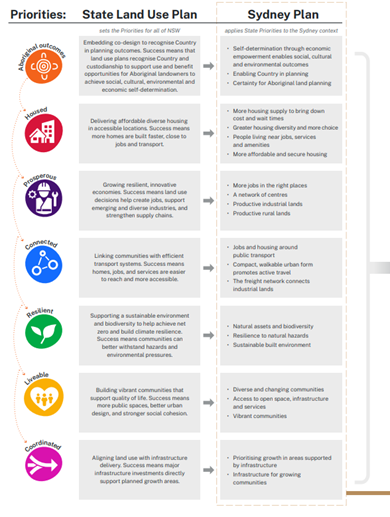
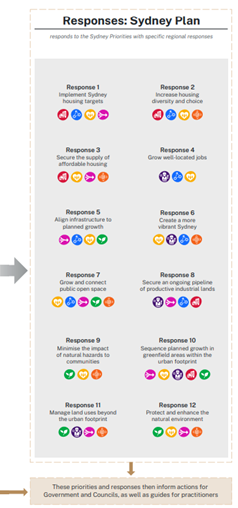
Sydney Plan - Public Exhibition.............................................. 75
15.4.... Adoption
- St Leonards South Section 7.11 Plan Review.......... 90
15.5.... Planning
Proposal 47 - Heritage Amendment - 3 Austin Crescent............................................................................................................................. 94
15.6.... Post
Exhibition - Road Naming Proposal....................................... 111
16 Open
Space and infrastructure Division Reports
16.1.... Response
to Notice of Motion - Enhancing infrastructure for dogs in Lane Cove - Update................................................................... 116
16.2.... Tender
for the Provision of Tree Pruning and Removal and Stump Grinding Services....................................................................... 124
16.3.... Tender
for St Vincents Road new Shared User Path Construction and Road Upgrade..................................................... 131
16.4.... Tender
for Provision of Minor Civil Works and Associated Services........................................................................................................ 138
17 Questions With Notice
Nil
18 Officer
Reports for Information
18.1.... Legal
Services Panel - Notice of Change of Wilshire Webb Staution Beattie Practice.................................................................... 146
18.2.... Council
Snapshot December 2025 and January 2026................. 148
19 cLOSED
COMMITTEE
Nil
Ordinary Council Meeting 19 February 2026
Notice of Motion -
Supporting Domestic Violence Safe Phone Initiative
Item No: 11.1
Subject: Notice
of Motion - Supporting Domestic Violence Safe Phone Initiative
Record No: SU11026 - 7806/26
Division: Lane
Cove Council
Author(s): Councillor
Rochelle Flood
Purpose
The purpose of this Notice of Motion is
for Lane Cove Council to investigate becoming a phone drop partner for the
Domestic Violence (DV) Safe Phone Initiative.
Executive
Summary
· According to Say It Out Loud, an Australian organisation supporting
people affected by sexual, family, and intimate partner violence, police handle
an average of 657 DV cases each day.
· DV Safe Phone aims to provide every person experiencing domestic and
family violence with access to a safe, unmonitored mobile phone,
· This
motion proposes that Lane Cove Council become another local collection point
for DV Safe Phone, with options available for public collections, and for
Council to donate obsolete operational mobile phones to DV Safe Phone.
|
RECOMMENDATION
That Council:
1. notes that family and
domestic violence is at a crisis point in NSW with one woman killed every
week in 2025.
2. notes that council
currently supports the ReConnect program with a collection box in the Civic
Centre.
3. takes steps to investigate
becoming a phone drop partner with DV Safe Phone with a view to facilitating
collections from the community – in a location to complement the
existing collection for ReConnect.
4. investigates options with DV Safe Phone for the donation of
corporate/fleet phones from council staff when they are no longer required.
|
Discussion
According to Say
it Out Loud, an Australian organisation working to support people impacted by
sexual, family and intimate partner violence, police deal with an average of
657 DV matters every day. This equates to one report every two to three
minutes.
In order to
report domestic and family violence, people need access to safe and unmonitored
devices to make reports to police and other supporting agencies. Unfortunately,
we know that perpetrators of domestic and family violence often use phones as a
way to monitor and control victims. This leaves them isolated and without a
safe way to seek help when they need it.
The DV Safe
Phone organisation was set up in 2020 and their aim is to provide a safe phone
to every person experiencing domestic and family violence who needs access to
an unmonitored phone. This ensures they are able to safely contact support
services or the police when needed.
DV Safe Phone
collects donated phones and repairs/repurposes them to provide to registered
family and domestic violence service providers, hospitals, and police to ensure
they get to the people who need them. A number of local councils have signed up
to become a collection point for people to donate their phones, including North
Sydney Council.
Lane Cove
Council is well placed to become another local collection point – with
options available for public collections, and the donation of old fleet phones
from council staff. The cost is minimal at $85 for the purchase of a collection
box. Council would then be provided with promotional material and all the
information needed to get started.
This aligns with
3.6 in our community strategic plan with a priority for community safety,
namely to:
• Increase feelings of personal safety and to
• Ensure Lane Cove is a safe place to live and enjoy community life
Five year
statistics from DV Safe Phone show that they distributed 14,169 phones
Australia wide. Of these 2,237 were repaired phones resulting in 3 tonnes of
e-waste being diverted from landfill which provides additional environmental
benefits that also align with our strategic sustainability objectives.
Tragically NSW
recorded the highest number of deaths from family and domestic violence in
Australia with 52 women killed – one every single week. We are at a
crisis point and this initiative is a simple way for council to help make
people safer.
Financial
Considerations
The proposed motion can be accommodated
within existing budgets.
Governance
and Risk Considerations
The proposed motion supports the
sustainability actions in Council’s Delivery Program and Operational Plan
Environmental
Considerations
The proposed motion supports the Circular
Economy by reducing waste, improving resource recovery, and lowering electronic
waste through the recycling of obsolete mobile phones.
Social Considerations
The proposed motion will have positive
social outcomes for the community through supporting those at risk.
Timing
The proposed motion has no timing
constraints.
Link to
Strategy
This report relates to the Community
Strategic Plan Outcome/s and Goal/s:
3 Our
Society - An Inclusive, interconnected, active and resilient community
3.6 Community
Safety
3.6.2 Help
promote a coordinated image of Lane Cove as a safe and inclusive area
Councillor Rochelle Flood
Councillor
ATTACHMENTS:
There are no supporting documents for this report.
Ordinary Council Meeting 19 February 2026
Establishment of a
Service Review Framework
Item No: 12.1
Subject: Establishment of a Service Review Framework
Record No: SU3448
- 2910/26
Division: Office of the
General Manager
Author(s): Louise
Kerr
Purpose
The purpose of the report is to inform
Council of the establishment of Service Review Framework.
Executive
Summary
· Lane
Cove Council provides a wide range of services to meet identified community
needs or for legislative reasons. These services are delivered both internally
and externally.
· Since
2024, all NSW Councils have been required to undertake systemic reviews of
their services under the Office of Local Government Integrated Planning and
Reporting (IP&R) Guidelines, with an adopted service review program being
incorporated into the 4-year Delivery Plan and annual Operational Plan.
· A
service review is an internal process that considers cost, quality, efficiency
and effectiveness of a Council service. It assesses whether the quality and
current levels of service remain appropriate, and through the process, Council
works with stakeholders to develop agreed priorities and expected levels of
service to ensure that resources are directed to where they are needed most.
· A
Service Review Framework has been developed to guide the service review process
at Lane Cove Council to provide a standardised approach for how service reviews
will be conducted, reported and evaluated.
· The
framework is integral to our commitment to ongoing improvement in service
delivery.
· A
proposed Service Review Program will be included in the draft Delivery Program
2025/26- 2028/29 and 2026/27 Operational Plan.
|
RECOMMENDATION
That Council:
1. receive and note the Lane
Cove Council Service Review Framework.
2. note the commencement of an
annual service review program from 1 July 2026.
|
Background
Local councils provide a wide range of
services to meet identified community needs or for legislative reasons. Council
has also committed to an ongoing improvement in the delivery of the services it
provides.
Section 4.3 of the Office of Local
Government Integrated Planning and Reporting Guidelines for Local Government
(2021) (IP&R Guidelines) stipulate that all Councils must undertake a
systemic review of services as part of their commitment to continuous
improvement.
Specifically, the IP&R Guidelines
state:
1. To
encourage continuous improvement across the council’s operations, the
Delivery Program must identify areas of service that the council will review
during its term, and how the council will engage with the community and other
stakeholders to determine service level expectations and appropriate measures.
2. With
respect to service reviews identified in the Delivery Program, the Operational
Plan must specify each review to be undertaken in that year.
3. The
Annual Report must include information about how the council has progressed
delivery of the service reviews it has committed to undertake in that year; the
results of those reviews and any changes made to levels of service in the areas
under the review.
The Service Review Framework has been
designed to guide Lane Cove Council in implementing Service Reviews in
alignment with the IP&R Guidelines and to ensure a consistent process of
review is understood and followed by all stakeholders.
Discussion
What is a Service
A service is an end-to-end process (or group of processes)
that delivers a specific outcome to an internal or external customer. Some
services are comprised of multiple activities that work together to deliver the
outcome.
What is a Service Review
A service review is an internal process that considers cost,
quality, efficiency and effectiveness of a service. It assesses the ongoing
need for the service and determines whether the current mode of delivery is
appropriate. Using insights based on data and feedback, Council can then make
informed decisions about the services it delivers.
Benefits of a service review
Service reviews embed a culture of continuous improvement by
building the capacity of staff to think critically and creatively about current
and future community needs through a balanced, transparent, collaborative and
evidence-based approach.
Lane Cove Service Review Framework
The objectives of the Service Review Framework include:
· assessment
of a service’s performance including efficiency and effectiveness in
delivering current service levels in meeting community expectations
· maximising
opportunities for innovation, collaboration and transformation to improve
service delivery and community outcomes
· building
staff capacity to deliver high quality and cost-efficient services to the
community
· ensuring
ongoing alignment of services with community needs, expectations and the role
of local government
· ensuring
value for money and the financial sustainability of services now and in the
future
· consideration
of ESD outcomes.
The delivery and timing of the service review program will
align with the Integrated Planning and Reporting cycle and a 4-year rolling
service review program will be established and included in the Delivery Plan.
It is anticipated that two service reviews will be undertaken each financial
year, and the annual Operational Plan will set out the reviews to be conducted.
Indicative annual timeline for the service review program
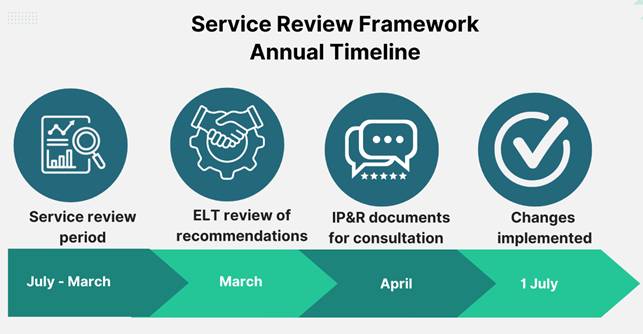
If there are significant changes proposed
to a service following a service review (such as a service reduction or service
cost increase outside of the annual budget) the recommendations will be
presented to Council for approval to exhibit with the draft Operational Plan in
April each year. Any approved changes to the service would then take effect
from 1 July with the commencement of the new Operational Plan and Budget.
Service review methodology
The focus of an individual service review
will be the consideration and assessment of the following matters:
· where are we now
– analysis of current operations, direction, service levels and costs
· what are the views
of stakeholders- analysis of feedback from stakeholders, including councillors,
staff, customers and the community
· where do we need
to be – analysis of the drivers for changes to service operations and
service levels, including community expectation
· where are the gaps
– identify the gap between current and proposed operations, service
levels and investigate options for closing the gap
· what are the
affordable service levels?
· what are the
identifiable performance measures?
Roles and responsibilities
Service reviews will use the following governance structure
to ensure a level of independence and critical thinking is applied when
reviewing Council services.
|
Area
|
Responsibilities
|
|
Elected council
|
· Endorse
Council’s Delivery program and Operational Plan including service reviews
to be undertaken in specific years
· Approval of
recommendations that involve a reduction in service or additional costs
outside of existing budget
|
|
Audit Risk Improvement Committee
(ARIC)
|
· Advisory role
· Review progress
of Service Review Program
· Monitor
improvement initiatives, programs, projects and processes
|
|
Executive Leadership Team (ELT)
|
· Endorse the
Service Review Framework
· Develop a
schedule and program
· Define scope for
each review
· Endorse
individual service review summaries and findings
· Review and
approve the service review report (where no council decision required)
|
|
Business Improvement Officer
|
· Coordinate the
service review program and internal reviews
· Collaborate with
service unit staff, service unit stakeholders and other councils to gather
relevant data including benchmarking
· Generate
insights and problem statements
· Report on
implementation progress
|
|
Manager/Director
|
· Provide
ownership of the relevant service review
· Present service
review findings to ARIC and ELT
· Implement
recommendations within agreed timeframes
|
Service Review process
In accordance with the IP&R Guidelines, the
prioritisation of reviews will be undertaken in conjunction with the
development of each new Delivery Program and Operational Plan.
Prioritisation of services to be reviews under the Framework
will generally be based on a range of factors including:
· Community
satisfaction levels
· Expenditure/cost
· Service
utilisation
· Changing/emerging
needs
· Legislative
requirements
· Staff resourcing
· Service
gaps
· Risks
Monitoring and evaluation
In March each year, the ELT and ARIC will
receive a Service Review report for each review conducted in the financial
year. The report will include an Implementation Plan outlining key findings and
recommendations. The ongoing monitoring of the implementation plan will occur
through Council’s corporate reporting system which is reported to council
on a quarterly basis.
As required by the IP&R Guidelines,
Council will report how it has progressed on the delivery of service reviews it
has committed to within the Annual Report, including the results of these
reviews and any changes made to levels of service in the areas under review.
Community
Consultation
Consultation forms an integral part of each
Service Review as identified in the framework.
No community consultation is required prior
to the implementation of the Service Review Framework.
Timing
A proposed Service Review Program will be
included in the draft Delivery Program 2025/26- 2028/29 and 2026/27 Operational
Plan and reported to Council in April 2026 for consideration.
Financial
Considerations
The implementation of a Service Review
Program will pose no financial impact on Council. The costs associated with
conducting each Service Review will be funded from annually approved
operational budgets. If there are significant changes proposed to a
service following the completion of a service review (such as a service
reduction or service cost increase outside of the annual budget) the
recommendations will be presented to Council for approval.
Governance
and Risk Considerations
The development of a Service Review
Framework and implementation of an annual Service Review Program will ensure
that Council satisfies the requirements of the Office of Local
Government’s IP&R Guidelines.
Environmental
Considerations
The implementation of an annual Service
Review Program will result in beneficial environmental outcomes for Council.
Social
Considerations
The implementation of an annual Service
Review Program will have a positive social outcome for the community.
Link to Strategy
This report relates to the Community
Strategic Plan Outcome/s and Goal/s:
6 Our
Council - A Leading Council that Engages its Community to Deliver Effective,
Efficient and Sustainable Services
6.1 Governance
6.2 Best
Value
6.3 Quality
Service
6.1.1 Ongoing
identification of initiatives to enhance transparency of Council
decision-making and performance
6.1.2 To
provide assistance to Councillors and support the organisation to operate
within its legal framework
6.2.2 Conduct
fundamental reviews of programs, implementing savings that have minimal impact
on the community
6.2.3 Foster
a strong organisational culture which strives for best practice in all
operations
6.2.4 Ongoing
integration of sustainability and climate change initiatives into
Council’s business and operations.
6.2.5 Identify
continuous improvements to Council’s governance structure, processes and
systems
6.3.1 Incorporate
customer service standards into procedures and performance management systems
and assess regularly to ensure the aspirations of the community are delivered
6.3.2 Make
it surprisingly simple to do business with Council
Louise Kerr
General Manager
Office of the General Manager
ATTACHMENTS:
|
AT‑1 View
|
Draft Service Review Framework
|
|
Available Electronically
|
Ordinary Council Meeting 19 February 2026
Establishment of a Legal
Counsel Position
Item No: 12.2
Subject: Establishment of a Legal Counsel Position
Record No: SU10015
- 8365/26
Division: Office of the
General Manager
Author(s): Louise
Kerr
Purpose
To report back to Council on investigations
related to the employment of an in-house legal counsel and to seek a Council
decision.
Executive
Summary
· A
report on the Legal Services Tender was considered at the November 2025 Council
Meeting, wherein Council amongst other matters resolved that the General
Manager investigate the employment of an in-house legal counsel and to report
back to the February 2026 Council meeting.
· Local
councils operate in an increasingly complex legal and regulatory environment,
with increased public scrutiny, changing legislative environment, and increased
risks, including legal.
· The
employment of in-house legal professionals by local councils is increasingly
growing, with many small and large metropolitan Sydney councils now employing
one or more legal professionals.
· The
investigation of the employment of an in-house legal counsel has found that the
establishment of a permanent legal counsel position will enable the provision
of timely, consistent, and strategic legal advice across Council operations,
supporting compliance, efficiency, and sound governance.
· While
external legal services will continue to be required for specialist or
high-risk matters, an internal legal capability is expected to strengthen
governance, manage legal risk, improve decision making, and reduce reliance on
external legal services.
· Accordingly,
this report recommends the establishment of an in-house Legal Counsel position
within the organisation structure.
|
RECOMMENDATION
That Council:
1. allocates
funding for the establishment of a Legal Counsel position in the current
2025/26 budget and forward budgets, and in doing so notes there will be a
reduction in the Legal Services Budget to off-set the additional salary
costs.
2. notes
that the position of Legal Counsel will report to the General Manager in the
organisation structure.
|
Background
A report on the Tender for the provision of
legal services was considered at the November 2025 Council meeting. The tender
for the provision of legal services was seeking legal providers for the
following categories:
Category 1 -Commercial and Property
· Routine
/ standard property advice and transactions
(including conveyancing
for purchase / sale, preparation of lease and licence, drafting of easements
etc.)
· Complex
property advice and transactions
· Statutory
land acquisition processes
· Crown
Land
· Commercial
and contractual matters
Category 2 – Planning and
Environmental
· Planning
and Assessment law
· Voluntary
Planning Agreements
· Environmental
law
· Heritage
law
Category 3 – Regulatory and
Administrative
· Administrative
and Governance
· Employment
and Industrial Relations
· Work
Health and Safety
· Local
Government Law
· Enforcement
and Regulation
Category 4 - inhouse legal
· Mandatory
3 hours per week onsite block time
· General
advice in relation to Categories 1, 2 and 3
Council resolved to accept tenders for the
provision of legal services for category 1, 2 and 3, but did not accept any
tenders for the provision of category 4 services.
Council, in resolving this way, noted that
neighbouring councils have engaged in-house legal counsel to provide legal
advice, to review and negotiate contracts and to provide a range of services,
in addition to undertaking other operational roles, and requested the General
Manager to investigate the employment of an in-house legal counsel.
Discussion
Investigations
related to the employment of an in-house legal counsel has found that an
internal legal capability will enable the provision of timely, consistent, and
strategic legal advice across Council operations, supporting compliance,
efficiency, and sound governance.
There are many benefits
from the employment of in-house legal counsel, that extend beyond those of
Council’s past practice of engaging an external legal firm to provide
‘inhouse support’.
Some of the benefits include:
Strengthening governance and compliance
An in-house legal counsel would:
o provide early
legal input into policy development, preparation of reports and recommendations
to Council, contracts and other council decisions
o provide
support to the elected council during Council meetings
o provide
independent and professional legal advice to the General Manager and
Councillors (through the General Manager)
o provide
advice on governance matters such as meeting procedures, conflicts of interest
and disclosure obligations, and decision-making risks which supports informed
decision-making
o reduce
reliance on late or last-minute external advice during council meetings
o identify
legal risks early
o ensure
council actions align with legislative requirements
o support
Councillors and staff to understand legal risks and obligations
o reduce
exposure to maladministration, procedural errors and legal challenge.
Cost efficiency
Whilst the establishment of a new position
with the organisation structure results in additional salary and on-costs, the
employment of an in-house legal counsel is expected to:
o reduce
expenditure on routine external legal advice, which in the past has not been
coordinated in a centralised manner
o enable more
efficient briefing and management of external solicitors when required
o minimise
overall legal costs by improved control over legal budgets.
The salary costs will be offset by an
equivalent reduction in the Legal Services budget, which at present includes
expenditure associated with the external legal ‘inhouse support’.
Improved delivery of services and
projects
An internal legal counsel will have a
strong understanding of council’s operations, priorities and risk
profile, and will work collaboratively with senior staff and staff across the
organisation, which ultimately supports efficient and compliant service
delivery.
The employment of in-house legal
professionals in local councils is increasingly growing, with many small and
large metropolitan Sydney councils now employing one or more legal
professionals, including North Sydney, Willoughby, Ku-ring-gai, Ryde, Strathfield,
Inner West, Northern Beaches, Parramatta, City of Sydney and Blacktown.
Community
Consultation
The decision to
employ an in-house legal counsel does not require community consultation.
Timing
There are no timing impediments to the
recommendations of the report.
If an in-house legal counsel position is
established, the next step would be to prepare a position description and
commence the recruitment process to fill the position. It is expected that the
position would be filled by 1 July 2026.
Financial
Considerations
A desktop review of salaries offered to
legal professional positions employed in metropolitan Sydney and regional NSW
councils indicates that salaries can range from $135,000 per annum to $300,000
per annum. The salary range is variable and is dependent on the size and scale
of the council and relevant skills and experience being sought.
It is expected that the costs associated
with the employment of an in-house legal counsel given the size and scale of
Lane Cove Council will be somewhere in order of $220,000 to $230,000.
The salary costs will be offset by a
reduction in expenditure of the existing external legal services budget, noting
that costs associated with the external ‘inhouse support’ in
2024/25 were approximately $200,000. There are also expected to be other
savings which will arise from a reduced reliance on external services and a
resultant reduction in costs.
Governance
and Risk Considerations
The employment
of an in-house legal counsel will strengthen governance, manage legal risk,
improve decision making and in the longer term is expected to reduce reliance
on external legal services and overall reduce costs.
Environmental
Considerations
The subject of this report has no
environmental implications for Council.
Social
Considerations
The subject of this report has no social
implications for Council.
Link to Strategy
This report relates to the Community
Strategic Plan Outcome/s and Goal/s:
6 Our
Council - A Leading Council that Engages its Community to Deliver Effective,
Efficient and Sustainable Services
6.1 Governance
6.2 Best
Value
6.1.1 Ongoing
identification of initiatives to enhance transparency of Council
decision-making and performance
6.1.2 To
provide assistance to Councillors and support the organisation to operate
within its legal framework
6.2.5 Identify
continuous improvements to Council’s governance structure, processes and
systems
Louise Kerr
General Manager
Office of the General Manager
ATTACHMENTS:
There are no supporting documents for this report.
Ordinary Council Meeting 19 February 2026
Governance Health Check
Item No: 12.3
Subject: Governance Health Check
Record No: SU3448
- 8721/26
Division: Office of the
General Manager
Author(s): Louise
Kerr
Purpose
The purpose of
this report is to seek Council endorsement to commence a Governance Health
Check to ensure the organisation’s governance frameworks remain
contemporary, effective, transparent, and aligned with legislative requirements
and sector best practice.
Executive
Summary
· Lane
Cove Council is committed to ensuring its governance structures, decision
making processes, and operational practices effectively support its strategic
objectives.
· Our
Community Strategic Plan, Liveable Lane Cove 2035, establishes a
long-term commitment to high standards of integrity, ethical governance,
accountability and transparency across the organisation.
· Strong
corporate governance underpins sound decision-making, effective risk
management, public accountability and community trust.
· While
Council has established governance policies, delegations and oversight
mechanisms, periodic independent reviews of these systems represent best
practice and ensures continued alignment with evolving regulatory requirements,
operational demands and community expectations.
· The
recent appointment of a new General Manager also presents a timely opportunity
to undertake an independent Governance Health Check of the organisation.
· This
report recommends the commencement of a Governance Health Check to:
o assess the
effectiveness of current governance structures and processes
o identify
opportunities to strengthen transparency, accountability and organisational
performance
o benchmark
Council’s practices against recognised best practice governance standards
o provide
clear, practical recommendations for improvement, where required.
|
RECOMMENDATION
That Council:
1. approve
the commencement of an organisational Governance Health Check to:
(a) assess
the effectiveness of governance structures and processes.
(b) identify
opportunities to strengthen transparency, accountability and organisational
performance.
(c) benchmark
Council’s practices against recognised best practice governance
standards.
(d) provide clear, practical recommendations for improvement, where
required.
2. authorise
the General Manager to engage an appropriately qualified independent
consultant to undertake the review Governance Health Check
and to facilitate the provision of information and services deemed necessary
to support the role of the consultant.
3. receive
a report back to Council outlining findings, recommendations, and an
implementation plan, where required.
|
|
|
Discussion
Good governance
in the NSW local government context ensures councils operate with
integrity, accountability, and transparency, and adhere to legislation. Key
elements include ethical decision-making, sound financial management, community
engagement, and clear roles for councillors and staff. It focuses on improving
public confidence and service delivery.
The NSW Audit
Office define good governance as “those high-level processes and
behaviours that ensure an organisation performs by achieving its intended
purpose, and conforms by complying with all relevant laws, codes and directions
while meeting community expectations of probity, accountability and
transparency”.
Ensuring good
governance within an organisation is important for many reasons, including:
Reputation
Good governance
strengthens an organisation’s reputation by demonstrating integrity,
transparency, and ethical leadership.
Accountability
to stakeholders builds confidence
Good governance
ensures that leadership is accountable to stakeholders and the community.
Increased
success
An organisation
with strong governance structures tends to perform better over time.
Reduces
risk of fraud, corruption and weak practices
Strong
governance frameworks reduce the risk of fraud, corruption, and unethical
behaviour.
Creates a
good organisational culture
Governance sets
the “tone at the top.” When leaders model ethical behaviour and
accountability, these values filter throughout the organisation.
Lane Cove
Council has established governance policies, delegations and oversight
mechanisms in place, however periodic independent reviews of existing
governance frameworks represent best practice, and ensures continued alignment
with evolving regulatory requirements, operational demands and community
expectations.
The recent
appointment of a new General Manager also presents a timely opportunity to
undertake an independent Governance Health Check of the organisation.
The proposed Governance Health Check will:
· assess the effectiveness of governance structures and processes
· identify opportunities to strengthen transparency, accountability
and organisational performance
· benchmark Council’s practices against recognised best practice
governance standards
· provide clear, practical recommendations for improvement, where
required.
The review will focus on four (4) themes:
general governance; financial governance; compliance; and major projects.
Whilst the external independent consultant
engaged to conduct the review will refine the scope of the review in
consultation with the General Manager, it is expected that the review will be
phased to include the review of existing documentation, policies, procedures
and strategic plans; consultation with Councillors, senior and any other
relevant staff, and members of ARIC; preparation of a report evaluating
Council’s performance across the four themes; and preparation of a report
and recommendations for improvement, if required.
It is proposed that the Audit Risk
Improvement Committee (ARIC) will play a key role in the review.
Community
Consultation
No community
consultation is required however the consultant who will undertake the review
will consult with Councillors, senior staff and any other relevant staff member,
and ARIC members in conducting the review.
Timing
Subject to Council approval, procurement of
the consultant who will undertake the review will commence immediately. The Governance
Health Check is expected to take approximately three to four months to complete
with a final report, including recommendations (if required) to be reported to
ARIC and Council.
Financial
Considerations
The costs associated with the Governance
Health Check are not included in the current 2025/25 budget. It is proposed
that the project be funded through savings in the current year’s budget.
Costs are expected to be under $50,000.
Governance
and Risk Considerations
Undertaking the Governance Health Check will
strengthen public confidence in Council governance and reduce possible future governance
and reputational risk. The review will enhance strategic oversight and support
compliance with legislative and regulatory requirements.
Environmental
Considerations
The subject of this report has no
environmental implications for Council.
Social
Considerations
The subject of this report has no social
implications for Council.
Link to Strategy
This report relates to the Community
Strategic Plan Outcome/s and Goal/s:
6 Our
Council - A Leading Council that Engages its Community to Deliver Effective,
Efficient and Sustainable Services
6.1 Governance
6.1.1 Ongoing
identification of initiatives to enhance transparency of Council
decision-making and performance
6.1.2 To
provide assistance to Councillors and support the organisation to operate
within its legal framework
Louise Kerr
General Manager
Office of the General Manager
ATTACHMENTS:
There are no supporting documents for this report.
Ordinary Council Meeting 19 February 2026
Delivery Program and
Operational Plan - 2025/26 Second Quarter Review
Item No: 13.1
Subject: Delivery Program and Operational Plan - 2025/26 Second Quarter
Review
Record No: SU238
- 3419/26
Division: Corporate Services
and Strategy Division
Author(s): Stephen
Golding
Purpose
The purpose of this report is to present to Council the
2025/26 Second Quarter Review of the Delivery Program and Operational Plan
Executive
Summary
· This report outlines the 2025/26 Second Quarter progress towards
achieving the projects and activities listed in the adopted 2025/26 Delivery
Program and Operational Plan.
· Council is progressing well on its Delivery Program and Operational
Plan actions.
· A
few highlights for the quarter are:
§ Food Organics rollout has commenced
§ Council received a grant in excess
of $1.2m from the Federal Government for the electrification of the Lane Cove
Aquatic Centre
§ Over 17,000
attendees at the Rotary Fair; over 2,500 attendees at Food & Wine Festival
and over 5,000 attendees at Christmas celebrations
§ 124 volunteers
logged 403.5 hours, potting 3,357 plants and propagating 42 trays
§ The NSW Audit
Office issued an unqualified opinion on Council’s financial statements.
|
RECOMMENDATION
That Council note the Second Quarter
Review of the 2025/26 Delivery Program and Operational Plan.
|
Background
The Lane Cove Council Delivery Program and
Operational Plan 25/26 were adopted by Council on 19 June 2025. The Delivery
Program is 2025/26-2028/29 and the Operational Plan is for the period of 1 July
2025 to 30 June 2026.
The Quarterly Report on
Service Performance discloses the progress of key services in the delivery of
projects and against performance measures.
Discussion
Council’s 2025/26 Delivery Program
and Operational Plan outline the strategies, actions and new initiatives
proposed to be undertaken during the period 1 July 2025 to 30 June 2026 to
advance the goals and objectives of the Community Strategic Plan: Liveable Lane
Cove: 2035.
The Second Quarter Review of the 2025/26
Operational Plan for the period 01 October 2025 to 31 December 2025 is attached
at AT-1.
The report focuses on operational projects,
capital projects, performance measures and key achievements. It also identifies
responsible work areas and includes a short progress report and action status.
Council is
progressing well against its actions in the Delivery Program and Operational
Plan.
Some highlights for the Second Quarter
include:
· Council
endorsed the LEP Review and this has been submitted to the Department of
Planning, Housing and Infrastructure,
· The Food Organics
rollout has commenced. A number of information sessions were held for the
community and separate sessions were held for the internal staff prior to the
Christmas break,
· Kindy
Cove was refreshed with new flooring and painting, improving presentation and
day-to-day amenity for children, families and staff,
· Christmas celebrations including Bluey’s annual visit, the
tree lighting ceremony, carols and performances by local bands, orchestras and
school groups, children’s activities and village activations, attracting
5,000+ people and supporting local businesses.
· International Day of People with Disability was celebrated by
delivered accessible activities including Cinema Club screenings and an Aquatic
Centre access tour, promoting inclusion and participation for people with
disability,
· The Lane Cove Literary Awards were presented in November,
celebrating local writers with 100+ attendees and sponsorship support from
local businesses,
· Libraries hosted six HSC Study Nights, supporting 210+ students with
quiet study space, wellbeing supports, therapy dogs and study resources,
· Synergy Youth Centre held an Open Day to showcase programs, with
strong participation from young people, local services and all-abilities
partners,
· A new roof was installed at the Greenwich Senior Citizens Centre,
improving weather protection and extending the life of the facility for ongoing
community use,
· Council supported the UN 16 Days of Activism against Gender-Based
Violence through hosting a Share the Dignity campaign to donate essential items
for women in need, a public minute of silence in the Plaza, information stalls,
and an author talk at Lane Cove Library featuring Dr Martine Zanggera who
shared her lived experience,
· Rotary Fair & Food and Wine by the River – two major
events were successfully delivered: the Rotary Fair attracted 17,000+ people,
and Food and Wine by the River attracted 2,500+ attendees, featuring Mudgee
wine producers plus a dog show and dog education activities,
· Mental Health Month & Reconnect – Council acknowledged
Mental Health Month through the Reconnect program, offering workshops and
social activities to help older people and community members connect, build
confidence, and learn new skills,
· A new veranda roof and restoration and repainting of the fencing and
gates at Carisbrook House, was delivered with Heritage Grant matched funding,
· Council received a grant in excess of $1.2m from the Federal
Government for the electrification of the pool and $15,000 for Australia Day
Celebrations,
· A total of 7,602 native plants were allocated for the Galuwa
Recreation Centre revegetation project,
· A
total of 124 nursery volunteers contributed 403.5 hours, resulting in the
potting up of 3,357 new plants and the propagation of 42 trays of native seed
and cutting material,
· The Harbourcare
program recorded 10 clean-up events, with 30 volunteers participating and a
total of 201.5 kg of rubbish removed, and
· The Audit Office
of NSW finalised their external audit of Council’s financial accounts,
issuing an unqualified audit opinion.
Timing
This Quarterly Operational Plan Review
meets the requirements of the Local Government Act 1993 and
Local Government (General) Regulation 2021 (section 203), namely that Council
reports at least every 6 months on the principal activities of its Operational
Plan.
Financial
Considerations
The recommendations of this report pose no
financial impact on Council.
Governance
and Risk Considerations
The Quarterly
Review meets the statutory reporting requirements for progress at the end of
the quarter i.e. implementation of the Operational Plan. It is provided to
enable informed decision making while also ensuring transparency on
Council’s governance.
Environmental
Considerations
The Quarterly Review
provides progress on implementing the Operational Plan which includes a range
of projects to protect and enhance our natural environment.
SOCIAL considerations
The report discloses progress on
implementing the Operational Plan. This includes the continued delivery of
services and capital works that support our community and economy. These
initiatives will have a positive social and economic impact on the community.
Link to
Strategy
This report relates to the Community
Strategic Plan Outcome/s and Goal/s:
6 Our
Council - A Leading Council that Engages its Community to Deliver Effective,
Efficient and Sustainable Services
6.1 Governance
6.1.1 Ongoing
identification of initiatives to enhance transparency of Council
decision-making and performance
6.1.2 To
provide assistance to Councillors and support the organisation to operate
within its legal framework
Steven Kludass
Director - Corporate Services and Strategy
Corporate Services and Strategy Division
ATTACHMENTS:
|
AT‑1 View
|
Delivery Program and Operational Plan - 2nd Quarterly
Review - 2025-2026
|
240 Pages
|
Available Electronically
|
Ordinary Council Meeting 19 February 2026
Quarterly Budget Review
- December 2025
Item No: 13.2
Subject: Quarterly
Budget Review - December 2025
Record No: SU10719 - 6796/26
Division: Corporate
Services and Strategy Division
Author(s): Don
Johnston
Purpose
The purpose of this report is to present to Council the
2025/26 Budget Quarterly Budget Review Statements as at 31 December 2025.
Executive Summary
· The
operating result (before capital grants and contributions) has improved by $891K
to a surplus for the year of $314K, primarily due to windfall income from
restorations, construction zones and crane permits together with improved
interest on investments.
· Capital
expenditure is forecast to increase by $1.6 million to $55.9 million due mainly
to adding funding to match the approved grant for the Towards Zero Safer Roads
Program and capital works forming part of restoration works.
· Capital
grants and contributions is forecast to reduce by $12.6 million, primarily due
to re-forecasting the receipt of developer contributions.
· A
net reduction in transfers to and from reserves of $13.4 million is forecast,
primarily due to the forecast reduction in developer contribution income.
· Taking
transfers to and from reserves into account, the program budget result for the
quarter is a small $4K surplus.
|
RECOMMENDATION
That Council:
1. note
the Quarterly Budget Review Statements for the period ended 31 December 2025.
2. approve
the changes forecast in the Budget Review Statements, including:
a) a reduction
in the forecast surplus from continuing operations, including capital grants
and contributions, of $11.7 million to $22 million
b) an increase
in capital expenditure of $1.6 million to $55.9 million
c) a net
reduction in transfers to and from Reserves of $13.4 million
|
Background
Council is required to prepare a
Budget Review Statement each quarter in accordance with Clause 203 of the Local
Government (General) Regulation 2021. The purpose of these reviews is to ensure
that the impacts of financial variations are reflected in the forecast of
Council’s financial position to 30 June 2026, and that it remains
satisfactory.
Discussion
The Quarterly Budget Review Statements provide an overview
of Council’s performance against its annual budget for the quarter ended
31 December 2025. Explanations of the material variations giving rise to the
budget variations recommended to Council for approval are also provided.
Income Statement
The operating result, including capital grants and
contributions, is forecast to reduce by $11.6 million to $22.2 million. Income
is forecast to decrease by $9.5 million while expenses are forecast to increase
by $2 million. The operating result, excluding capital grants and
contributions, is forecast to improve by $891K to $314K. The movements are
summarised in the table below in the ‘Recommended Changes’ column.
|
$’000
|
PREVIOUS YEAR Actual
|
2025/26 ORIGINAL Budget
|
2025/26 APPROVED Changes
|
2025/26 REVISED Budget
|
Recommended Changes
|
2025/26 PROJECTED Result
|
2025/26 YTD Actual
|
%
of
Projected
|
|
Income
|
97,804
|
102,151
|
3,370
|
105,521
|
(9,538)
|
95,983
|
61,314
|
64%
|
|
Expenses
|
68,979
|
70,453
|
1,315
|
71,768
|
2,180
|
73,949
|
34,177
|
46%
|
|
Surplus / (Deficit)
|
28,825
|
31,697
|
2,055
|
33,752
|
(11,719)
|
22,164
|
27,137
|
122%
|
|
Surplus / (Deficit) before Capital grants
|
6,904
|
(661)
|
84
|
(577)
|
891
|
314
|
23,569
|
|
Income Analysis
|
Recommended Change
$’000
|
Material
changes – Favourable / (Unfavourable)
|
|
100
|
Rates and Annual Charges
· Rates levied year to date exceed current forecasts
o Residential Rates $76K
o Business Rates $24K
|
|
2,362
|
User Charges and Fees
· Income exceeding current forecasts or new to the
budget
o Restoration charges $1.8 million relating to Air
Trunk restoration (offset by $1.4 million in expenditure – net $400K
improvement to the budget)
o Construction activity continues to drive additional
income from construction zones; crane permits and hoardings $470K
|
|
(168)
|
Other Revenue
· Income new to the budget
o Further legal cost recovery relating to 40A Cope
Street $145K
o Reimbursement of agreed cost of works by Little
Street BMC $39K (noting works were completed last financial year)
· Income not meeting budget forecasts
o Due to the cessation of ticketless infringements to
satisfy NSW Government requirements, parking fines will not achieve the
budget forecast and may need further reduction ($400K)
|
|
343
|
Grants and contributions
– operating
· New grants and contributions received
o Worker retention payments grant funding $160K
o Australia Day $15K
o Go FOGO $98K
· Grant income moved from capital budget
o Grant funding for the construction of Ventemans
Reach boardwalk has been consolidated with the decontamination works grant in
the operating budget following approval from Crown Lands $269K
· Contributions not meeting budget forecast
o Arising from the re-forecasting of receiving
developer contributions (see comments below), the associated administration
fees will decrease ($227K)
|
|
(12,610)
|
Grants and contributions
– capital
· New and additional grants and contributions received
o New grant funding has been received for River Road
shared path design and Dorrit St raised pedestrian crossing while additional
funding has been approved for the Toward Zero Road Safety program $363K
o Grant funding of $1.14 million has been approved for
the Aquatic Centre electrification to be spent over two financial years on a
dollar-for-dollar basis. It is anticipated that $227K of this grant will be
recognised in 2025/26
· Grant income moved from the capital budget
o Grant funding for the construction of Ventemans
Reach boardwalk has been consolidated with the decontamination works grant in
the operating budget following approval from Crown Lands ($269K)
· Developer contributions less than current forecast
o The original budget forecast of developer
contributions related to four developments in each of the LGA Wide and St
Leonards South Plans. Two of these were paid in 2024/25 after the budget was
prepared and four have been pushed out to 2026/27. A further contribution,
originally anticipated for 2024/25, is now forecast to be received this year.
In total, contributions are now forecast to be less than originally budgeted
($12.9 million)
|
|
315
|
Interest and investment
income
· Higher returns and larger portfolio
|
|
119
|
Other income
· New and additional income
o Appointment of SSMG as operator of Galuwa has
resulted in additional rental income, net of reduced golf course rent $140K
o Civic Risk Mutual surplus distribution $129K
· Income reductions
o Changes in tenancies, opening delay, rent reductions
and refund of overpaid rent have all contributed to a reduction in rent
income ($139K)
|
|
(9,538)
|
Total income variance in
the quarterly review
|
Expense Analysis
|
Recommended Change
$’000
|
Material
changes – Favourable / (Unfavourable)
|
|
(3)
|
Employee benefits and
on-costs
· Additional budget provisions and budget transfers
o Budget for worker retention payments at Kindy Cove
($160K)
o Budget for short-term secondment to assist with
Galuwa ($62K)
o Budget transfers to temp staff to cover short-term
vacancies $218
|
|
(1,740)
|
Materials & Services
· Additional and unforeseen expenditure requirements
o Air Trunk restoration maintenance works ($477K)
o Ventemans Reach budget transferred from capital
budget ($269K)
o Tree contract works ($245K)
o Transfer from employee benefits budgets to temp
staff to cover short-term vacancies ($218K)
o Expenditure associated with additional grant or
other income ($169K)
o Additional budget required to complete
Little Street / Pottery Lane pedestrian crossing lighting upgrades, partly
offset by reduction in capital expenditure ($145K)
o Retrospective electricity expense following meter
clarification at St Leonards car park together with increased consumption,
partly due to EV charging ($119K)
o IT costs associated with complex security upgrades
currently underway ($87K)
o Legal costs ($70K)
o Burns Bay Reserve Masterplan ($40K)
· Expenditure savings
o Infringement processing savings have arisen from a
reduction in the number of fines issued due to cessation of ticketless fines
$133K
|
|
13
|
Other expenses
· Minor net reduction in expenditure
|
|
(450)
|
Net Loss from disposal of assets
· Sale of Morrice Street drainage reserve not
proceeding ($450K)
|
|
(2,180)
|
Total operating expenditure variance in the quarterly
review
|
Further details of all proposed variations are included in
the Quarterly Budget Review Statements in Attachment 1.
Capital Budget Statement
Capital expenditure is forecast to increase by $1.6 million
to $55.9 million
|
$’000
|
PREVIOUS YEAR Actual
|
2025/26 ORIGINAL Budget
|
2025/26 APPROVED Changes
|
2025/26 REVISED Budget
|
Recommended Changes
|
2025/26 PROJECTED Budget
|
2025/26 YTD Actual
|
%
of
Projected
|
|
New works
|
54,985
|
42,175
|
1,776
|
43,951
|
910
|
44,861
|
14,066
|
31%
|
|
Renewals
|
17,120
|
7,839
|
2,458
|
10,297
|
726
|
11,023
|
1,705
|
15%
|
|
Total
|
72,105
|
50,014
|
4,234
|
54,248
|
1,636
|
55,885
|
15,771
|
122%
|
Proposed variations to the capital budget are also included
in Attachment 1 and include:
· Air Trunk
restoration capital works ($925K)
· Towards Zero Safer
Roads program matching funding ($770K)
· River Road shared
path matching funding ($184K)
· Dorrit Street
raised pedestrian crossing ($130K)
· Reinstatement of
Playgrounds capital budget to facilitate renewal of both Majorie York and
Charlish Park playgrounds as envisaged in the original budget ($150K)
· Consolidation of,
and reduction in, Aquatic Centre budgets to align with revised forecast
expenditure in 2025/26 $237K
· Transfer of
Ventemans Reach capital budget to decontamination operating budget $269K
Transfers to and from Reserves
The table below summarises the
Reserve movements proposed in the review.
|
Operating Budget
|
$’000
|
|
Transfers to
Reserves:
|
|
|
S7.11 Reserves – reduced
transfer due to re-forecasting developer contribution receipts
|
(12,856)
|
|
Land Sales Proceeds Reserve
– removal of transfer due to Morrice Street drainage reserve sale not
proceeding
|
(450)
|
|
Transfers from
Reserves:
|
|
|
Land Sales Proceeds Reserve
– removal of transfer from reserve which was funding the demolition of
347A Burns Bay Road and 14 Gay Street, now being funded from general revenue
|
250
|
|
Sustainability Levy Reserve
– funding for additional expenditure required for the Reducing Urban
Heat in Lane Cove West project
|
(14)
|
|
Net Operating Budget
transfers to/(from) Reserves
|
(13,070)
|
|
Capital Budget
|
|
|
Transfers from
Reserves:
|
|
|
S7.11 (LGA Wide) Reserve
– matching funding for Towards Zero Safer Roads program
|
(701)
|
|
Aquatic Centre Reserve
– reduced transfer from Reserve due to revised forecast of 2025/26
expenditure
|
518
|
|
Carryover Works Reserve
– to partially match Aquatic Centre electrification works grant
|
(54)
|
|
Market Square Capital
Replacement Reserve – funding for temporary AC during AC replacement
|
(27)
|
|
Other transfers from
Reserve
|
(25)
|
|
Net Capital Budget
transfers from Reserves
|
(289)
|
|
Net Total transfers
to/(from) Reserves
|
($13,359)
|
Timing
The Quarterly Budget Review Statements are required to be
reported to Council within two months of the end of each quarter, except the
fourth quarter. Following the report to Council the report and a data return
are to be sent to the Office of Local Government which, for the December
quarter, are due on 28 February.
Financial
Considerations
The operating result
(before capital grants and contributions) has improved by $891K to a surplus for
the year of $314K, primarily due to windfall income from restorations,
construction zones and crane permits together with improved interest on
investments.
Capital expenditure
is forecast to increase by $1.6 million to $55.9 million due mainly to adding
funding to match the approved grant for the Towards Zero Safer Roads Program
and capital works forming part of restoration works.
Capital grants and
contributions reducing by $12.6 million, primarily due to re-forecasting the
receipt of developer contributions.
A net reduction in
transfers to and from reserves of $13.4 million due mainly to the forecast
reduction in developer contribution income.
Taking transfers to and from reserves into
account, the program budget result for the quarter is a small $4K surplus.
Governance and
Risk Considerations
The attached Quarterly Budget Review Statements meet a
statutory reporting obligation, summarising Council’s financial
performance at the end of the quarter. It is provided to enable informed
decision-making while also ensuring transparency on Council’s governance.
Environmental
Considerations
The recommendations in this report maintain environmental
outcomes by providing funding for the delivery of relevant services and
projects identified in Council’s Operational Plan.
Social
Considerations
The recommendations in this report maintain social outcomes
for the community by providing funding for the delivery of relevant services
identified in Council’s Operational Plan.
Link to Strategy
This report relates to the Community Strategic Plan
Outcome/s and Goal/s:
6 Our
Council - A Leading Council that Engages its Community to Deliver Effective,
Efficient and Sustainable Services
6.2 Best
Value
6.2.1 Ensure
long term financial sustainability through effective short and long term
financial management
Steven Kludass
Director - Corporate Services and Strategy
Corporate Services and Strategy Division
ATTACHMENTS:
|
AT‑1 View
|
Quarterly Budget Review Statements - December 2025
|
|
Available Electronically
|
Ordinary Council Meeting 19 February 2026
Draft Public Forum
Guidelines
Item No: 13.3
Subject: Draft Public Forum Guidelines
Record No: SU837
- 6220/26
Division: Corporate Services
and Strategy Division
Author(s): Stephen
Golding
Purpose
The purpose of
this report is to seek adoption of Draft Public Forum Guidelines that will provide
a clear and consistent framework for how monthly Public Forums are conducted.
Executive
Summary
· The
Office of Local Government (OLG) has issued Model Public Forum Rules which
serve as best practice guidelines for NSW Councils.
· The
Draft Public Forum Guidelines (AT-1) are based on the NSW OLG Model
Public Forum Rules and have been tailored to reflect our community’s
expectations and established public forum practices, providing an effective
platform for community members to address Council on matters that will be
considered at a Council meeting.
· It
is also proposed to update the recently adopted Code of Meeting Practice,
Section 4, Public Forums, to reflect the Public Forum Guidelines and to amend
the Council meeting commencement time to 7:00 pm (from March
2026), with Public Forums to be held at 7.00pm on the Monday prior to the
Council Meeting.
|
RECOMMENDATION
That Council:
1. adopt the Draft Public Forum Guidelines (AT-1).
2. note
the Code of Meeting Practices has been updated to reflect the Draft Public
Forum Guidelines.
3. note
Council Meetings will commence at 7:00 pm from March
2026, with Public Forums to be held at 7.00pm on the Monday prior to the
Council Meeting, in accordance with the Draft Public Forum Guidelines
(Section 2 – General, Clause 2.3).
|
Background
The OLG advised
Council of the release of the Model Public Forum Rules (AT-2) on
the 22 January 2026, through the Council
Circular 26-02 2025 Model Meeting Code –Supplementary guidance and
updated FAQs.
The Public Forum
Guidelines are designed to establish a clear and consistent framework for
conducting public forums. They ensure that community members have a fair and
accessible opportunity to speak to the Council, while promoting order, respect,
and efficiency.
The guidelines
detail procedures for registration, speaking, use of supporting materials, and
expected conduct, helping public forums serve as an effective platform for
community engagement and informed decision-making.
Discussion
The draft Public
Forum Guidelines are based on the NSW OLG Model Public Forum Rules and
have been tailored to reflect our community’s expectations and
established public forum practices, providing an effective platform for
community members to address Council.
At the 11
December 2025 Ordinary Council meeting Council resolved, resolution 266/25
to
adopt the
proposed Ordinary Council Meeting Schedule for 2026.
At the Ordinary
Council Meeting of 18 September 2025, it was resolved, Resolution 202/25, that:
Council endorse the proposal to conduct Public Forums immediately prior to
Ordinary Council Meetings with a commencement time of 6.30pm and a conclusion
time of 7.30 pm.
The NSW OLG Code
of Meeting Practice requires public forums to be held prior to council
meetings. The NSW OLG Model Public Forum Rules further state that, in the
interests of informed decision-making, there should be a gap between the
public forum and the meeting to allow Councillors sufficient time to properly
consider matters raised and, where necessary, seek additional information from
staff before making a decision.
The draft Public
Forum Guidelines support the above. As per Section 2 General, 2.3 states
2.3 Public
forums will be held on the Monday of the week of each Ordinary Council Meeting,
normally the third Monday of each month. Public Forums will commence at 7.00 pm
and will be limited to a maximum duration of two (2) hours.
Based on the revised date and time of the
Public Forum, it is recommended that Council Meetings commence at 7:00 pm, as
has been historically the case.
Timing
It is recommended that these Draft Public
Forum Guidelines be adopted prior to the next Public Forum to be held in March
2026.
Financial
Considerations
The recommendations of this report pose no
additional financial impact on Council as funds are allocated within the
operating budget for the delivery of this administrational function of Council.
Governance
and Risk Considerations
The adoption of the Draft Public forum
Guidelines pose no governance or risk concerns.
Environmental
Considerations
The subject of this report has no
environmental implications for Council.
Social
Considerations
The Public Forum Guidelines provide a clear
and consistent framework for the conduct of public forums, supporting an
inclusive and effective platform that enables all community members to address
Council.
Link to Strategy
This report relates to the Community
Strategic Plan Outcome/s and Goal/s:
6 Our
Council - A Leading Council that Engages its Community to Deliver Effective,
Efficient and Sustainable Services
6.1 Governance
6.1.1 Ongoing
identification of initiatives to enhance transparency of Council
decision-making and performance
Steven Kludass
Director - Corporate Services and Strategy
Corporate Services and Strategy Division
ATTACHMENTS:
|
AT‑1 View
|
Draft Public Forum Guidelines (based on the NSW OLG
model public forum rules)
|
8 Pages
|
Available Electronically
|
|
AT‑2 View
|
NSW OLG - Model Public Forum Rules (January 2026)
|
11 Pages
|
Available Electronically
|
Ordinary Council Meeting 19 February 2026
Proposed amendments to
the Managing Conflicts of Interest for Council Related Development Policy
Item No: 13.4
Subject: Proposed amendments to the Managing Conflicts of Interest for
Council Related Development Policy
Record No: SU241
- 4369/26
Division: Corporate Services
and Strategy Division
Author(s): Stephen
Golding
Purpose
The purpose of
this report is to present proposed amendments to Council’s Managing
Conflicts of Interest for Council Related Development Policy and to seek
Council adoption of the amended Policy.
Executive
Summary
· Council
adopted the Managing Conflicts of Interest for Council Related Development
Policy on 20 July 2023.
· A
review of the current Policy has been conducted to strengthen management
controls and strategies related to compliance and enforcement actions for
Council Related Developments to ensure there is oversight by the General
Manager and Executive Leadership Team and there is referral to external
agencies for oversight to manage conflicts of interest where significant
breaches to law have occurred.
· An
opportunity has also been taken to make some minor amendments to management
strategies related to the assessment and determination of development
applications.
· In
addition, an opportunity has been made to update the Policy to reflect recent
changes announced by the NSW Department of Planning, Housing and Infrastructure
that from 16 January 2026 the determination of applications that were
previously the responsibility of the Sydney and Regional Planning Panels are
transferring to Local Planning Panels.
|
RECOMMENDATION
That Council:
1. endorse the amendments to
the Managing Conflicts of Interest for Council-related Developments Policy (AT-1).
2. inform the community of the
adoption of the amended Policy as per Council’s Community Engagement
Strategy, including via Council’s website and e-newsletter.
|
Background
The Managing
Conflicts of Interest for Council Related Development Policy was adopted by
Council on 20 July 2023 (resolution 127/23) in response to the Environmental
Planning and Assessment Amendment (Conflict of Interest) Regulation 2023 which commenced
on 3 April 2023.
The Regulation
required all Councils to adopt a policy for the management of any potential
conflicts that may arise in relation to Council-related development where
Council is the consent authority. This also extends to enforcement and
compliance action for Council related development.
A
Council-related development application is defined as a development application
for which the Council is the consent authority, that is –
a) made by or on behalf of the Council,
or
b) for development of land –
i. of which the council is an
owner, a lessee or a licensee, or
ii. otherwise vested in or under
the control of the council. Land vested in or under the control of the Council
includes public land within the meaning of the Local Government Act 1993.
Council’s
Policy Framework requires all policies to be reviewed once per Council term, or
more frequently where material changes occur, such as legislative amendments,
Council resolutions, or changes to Council’s strategic direction. This
review satisfies the Policy Framework requirements.
Discussion
A review of the
current Managing Conflicts of Interest for Council Related Developments Policy
has been conducted to strengthen management controls and strategies
related to compliance and enforcement actions for Council Related Developments
to ensure there is oversight by the General Manager and Executive Leadership
Team and referral to external agencies for oversight to manage conflicts of
interest where significant breaches to law have occurred.
In particular, the following
additions are proposed to strengthen the enforcement and compliance
responsibilities:
· The
Manager Development Assessment will oversee all compliance and enforcement
activities related to council-related development and will provide regular
updates on these activities to the General Manager and Executive Leadership
Team.
· Where a
non-compliance is identified (for example a breach of a development consent
condition or failure to comply with the terms of a development control order),
the matter will be escalated to the Director Corporate Services and Strategy
for review and consideration of appropriate action. This may include engaging
external consultants in order to undertake investigations and/or peer review
recommendation of council staff.
· Where a matter is
considered to be a significant breach of law, the non-compliance will be
referred by the Director Corporate Services and Strategy to the compliance
staff of the Department of Planning, Housing and Infrastructure for advice and
action as appropriate.
· Any legal
proceedings in relation to enforcement and compliance matters for council
-related development to be conducted by external legal providers who are to
engage third party consultants to provide exert advice if required.
There are also
some other minor additions proposed to management strategies related to the
assessment and determination of development applications as follows:
· For all
council-related development, other than low-risk applications, council’s
development assessment staff will ensure that written records are kept of all
communications with the applicant (whether or not they are council staff) and
applicant representatives (whether council staff or external consultants).
Substantial discussions must only occur in the context of a formal meeting, and
written records of such meetings are to be kept. Directors are responsible for
ensuring that staff follow strict communication protocols in relation to
council-related development.
· All
council-related development applications will be publicly exhibited for a
minimum of 28 days. The management strategy for the proposal will be publicly
exhibited with the application and will remain publicly available on the NSW
Planning Portal and council’s website.
· Where a
Council-related development becomes the subject of any proceedings before the
Land and Environment Court, external legal representatives and consultants will
be engaged to conduct the matter.
· The management
strategy in relation to the regulation of council-related development (other
than low risk) is that all certification, including the issue of construction
certificates and occupation certificates will be undertaken by a private
certifier.
In addition, an
opportunity has been made to update the Policy to reflect changes announced by
the NSW Department of Planning, Housing and Infrastructure that from 16 January
2026 the determination of applications that were previously the responsibility of
the Sydney and Regional Planning Panels are transferring to the Local Planning
Panels.
The amendments
have been tracked, in red, within the Draft Managing Conflicts of
Interests for Council-related Developments Policy (AT-1).
consultation
It is not proposed to exhibit the
proposed changes to the Policy as the changes address current risk areas and
will strengthen governance procedures, however the community will be informed
of the revised Policy, and it will be published on Council’s website.
Timing
Council’s Policy Framework requires
all policies to be reviewed once per Council term. The amended Policy will come
into effect upon adoption by Council.Financial Considerations
Governance
and Risk Considerations
The amendments proposed to the Managing
Conflicts of Interest for Council-Related Developments Policy will strengthen compliance,
risk management and governance practices by strengthened controls for the
identification and management of conflicts of interest and complies with
Council’s Policy Framework.
Environmental
Considerations
There are no
environmental considerations arising from the amendments to the Policy.
Social Considerations
There are no social considerations arising
from the amendments to the Policy.
Link to Strategy
This report relates to the Community
Strategic Plan Outcome/s and Goal/s:
6 Our
Council - A Leading Council that Engages its Community to Deliver Effective,
Efficient and Sustainable Services
6.1 Governance
6.1.2 To
provide assistance to Councillors and support the organisation to operate
within its legal framework
Steven Kludass
Director - Corporate Services and Strategy
Corporate Services and Strategy Division
ATTACHMENTS:
|
AT‑1 View
|
Draft - Policy ES -10 Managing Conflicts of Interest for
council-related development
|
9 Pages
|
Available Electronically
|
Ordinary Council Meeting 19 February 2026
Draft Audit, Risk and
Improvement Committee Minutes - 9 December 2025
Item No: 13.5
Subject: Draft Audit, Risk and Improvement Committee Minutes - 9 December
2025
Record No: SU740
- 6137/26
Division: Corporate Services
and Strategy Division
Author(s): Stephen
Golding
Purpose
The purpose of this report is to provide Council
with the Draft Minutes of the Audit, Risk and Improvement Committee (ARIC)
meeting held on 9 December 2025.
Executive
Summary
· In
accordance with the ARIC Terms of Reference, the Minutes of ARIC Meetings are
forwarded to Council for their information, and action, where necessary.
· The
draft Minutes of the ARIC meeting held on 9 December 2025 are now presented to
Council.
· There
are no actions sought from Council resulting from the ARIC Meeting, held 9
December 2025.
|
RECOMMENDATION
That Council note:
1. the Draft Minutes of the
Audit, Risk and Improvement Committee meeting held on 9 December 2025.
2. the Draft Minutes do not seek action from Council.
|
Background
Council adopted the ARIC Terms of Reference
in July 2024. The Terms of Reference specify that Minutes from ARIC Meetings
should be forwarded to Council for their notation, and action, if appropriate.
Discussion
The Audit, Risk and Improvement Committee
provides a pivotal role providing Council with independent assurance and advice
in the areas of internal audit, financial management, risk management,
compliance and control, and organisational performance and improvement, along
with external accountability responsibilities.
The Draft Minutes (attached as AT-1)
of the ARIC meeting held on 9 December 2025 have been confirmed by the ARIC Chairperson
and are due to be adopted by the Committee at its meeting of 31 March 2026.
Council will note that the minutes now include a brief description of the
discussion points raised during the course of the meeting, in addition to the
Determinations of the Committee.
Timing
The timely consideration of ARIC Meeting
Minutes enables Council to note the progress of ARIC matters and is considered
good governance.
Financial
Considerations
The recommendations of this report pose no
financial impact on Council.
Governance
and Risk Considerations
There are no material governance or risk
considerations associated with adopting the Minutes of the ARIC Meeting, held
09 December 2025.
Environmental
Considerations
The subject of this report has no
environmental implications for Council.
Social
Considerations
The subject of this report has no social implications
for Council.
Link to Strategy
This report relates to the Community
Strategic Plan Outcome/s and Goal/s:
6 Our
Council - A Leading Council that Engages its Community to Deliver Effective,
Efficient and Sustainable Services
6.1 Governance
6.1.1 Ongoing
identification of initiatives to enhance transparency of Council
decision-making and performance
Steven Kludass
Director - Corporate Services and Strategy
Corporate Services and Strategy Division
ATTACHMENTS:
|
AT‑1 View
|
Draft ARIC Meeting Minutes - 09 December 2025
|
|
Available Electronically
|
Ordinary Council Meeting 19 February 2026
Councillor Training -
Mastering Motions and Notices of Motion for Councillors
Item No: 13.6
Subject: Councillor Training - Mastering Motions and Notices of Motion for
Councillors
Record No: SU2520
- 3202/26
Division: Corporate Services
and Strategy Division
Author(s): Lorie
Parkinson
Purpose
To seek approval from Council for the
Mayor, Councillor Southwood and other interested Councillors to participate in
the training course Managing Motions and Notices of Motions for Councillors.
Executive
Summary
· Local Government NSW (LGNSW) is facilitating a half day course
for Councillors “Managing Motions and Notices of Motions for
Councillors” in March and June 2026.
· This report seeks Council’s endorsement for the Mayor,
Councillor Southwood to undertake the course in March 2026. Other interested Councillors that wish to attend the training can nominate at the
Council Meeting.
· The Councillor Training Expenses Budget currently contains
sufficient funds to accommodate all Councillors attending the course.
|
RECOMMENDATION
That Council:
1. endorse
the request by Councillor Southwood to undertake the Local Government NSW
program Managing Motions and Notices of Motions for Councillors in
March 2026.
2. if
required, determine nominations from other interested Councillors to
undertake this program in March or June 2026.
3. fund
Councillor attendance of $462 per person from the Councillor
Training Expenses Budget.
|
Background
Local Government NSW (LGNSW) has developed
a new half-day program Managing Motions and Notices of Motions for
Councillors, where participants will learn to:
· explain the
purpose and function of Motions and Notices of Motion within NSW local government.
· identify
legislative requirements, meeting procedures, and governance expectations
relevant to the Notice of Motion process.
· draft clear,
actionable, and compliant Notices of Motions, including supporting rationale,
resolutions, and background information.
· differentiate
between operational and strategic matters to ensure Motions remain within the
role of the councillor and the responsibilities of the council.
· assess the
potential implications and impacts of proposed Motions, including legal,
financial, and organisational considerations, and
· make all motions
achieve the best outcome.
The course is currently
scheduled on two days: Tuesday 24 March 2026 and Wednesday 10 June 2026, from
9am – 12.30pm.
The training will be
held vis an Interactive webcast and the cost to attend is $462 per person.
Discussion
Creating clear and
appropriate Motions and Notice of Motions and engaging in their debate are core
activities of all Councillors, therefore participation in training to enhance
understanding and skills is highly beneficial.
Council’s Payment
of Expenses and Provision of Facilities to Councillors Policy allows
councillors to attend conferences, training and development and similar
functions by Council resolution. Where it is not practical to submit a report
to Council prior to the event, such requests can be approved by the Mayor and
General Manager.
The Councillor
Training Expenses Budget currently contains sufficient funds to accommodate
the training requests of all Councillors, should they wish to attend the
course.
Timing
This report needs to be determined at this
meeting to provide sufficient time for Councillor Southwood to register to
attend the program in March 2026.
Financial
Considerations
Funding to support the attendance of
Councillor Southwood and other councillors is available in the Councillor
Training Expenses Budget.
Governance
and Risk Considerations
The course would be beneficial for all
councillors in mitigating potential risks associated with motions that may
expose Council and will provide valuable insights into good governance when
preparing motions.
Environmental
Considerations
The subject of this report has no
environmental implications for Council.
Social Considerations
The recommendations in this report will
have positive social outcomes for the community as attendance at this program
will enhance the skills of Councillors to develop Motions and thus assist
Councillors represent the community.
Link to Strategy
This report relates to the Community
Strategic Plan Outcome/s and Goal/s:
6 Our
Council - A Leading Council that Engages its Community to Deliver Effective,
Efficient and Sustainable Services
6.1 Governance
6.1.2 To
provide assistance to Councillors and support the organisation to operate
within its legal framework
Steven Kludass
Director - Corporate Services and Strategy
Corporate Services and Strategy Division
ATTACHMENTS:
There are no supporting documents for this report.
Ordinary Council Meeting 19 February 2026
Council Response to the
Bondi Beach Attack
Item No: 14.1
Subject: Council Response to the Bondi Beach Attack
Record No: SU6250
- 6622/26
Division: Community and
Culture Division
Author(s): Stephanie
Kelly
Purpose
This report documents the actions
undertaken by Council in response to the Bondi Beach attack. It also seeks
Council’s approval to sign the NSW Multicultural communities pledge on
behalf of the Lane Cove community.
Executive
Summary
· The 14 December
2025 Bondi Beach attack had a significant and ongoing impact on the Jewish
community and the broader NSW community, including residents and staff of Lane
Cove Council.
· Council responded
promptly with clear, compassionate and trauma-informed communication aligned
with NSW Government guidance.
· Actions included
public statements, sharing mental health and support services, visible
solidarity measures, civic representation, and support for staff and young
people.
· Council’s
response reinforced values of inclusion, rejected antisemitism, hate and
violence, and promoted community care, reflection and acts of kindness
(mitzvah).
· This report seeks Council support to sign the NSW Multicultural
communities pledge on behalf of this community.
|
RECOMMENDATION
That Council:
1. notes
the actions undertaken by Lane Cove Council in response to the December 2025
Bondi Beach attack, as outlined in this report.
2. acknowledges the
ongoing impact of the attack on affected communities and reaffirms
Council’s commitment to safety, inclusion, compassion and social
cohesion.
3. approves signing the
Multicultural NSW pledge to support Jewish Australians and oppose
antisemitism.
|
Background
On 14 December
2025, a violent terrorist attack occurred at Bondi Beach, targeting members of
the Jewish community. The incident resulted in loss of life and caused
widespread distress across New South Wales. The impacts of the event extended
beyond the immediate location, affecting Jewish communities and the broader
public, including residents and staff within Lane Cove.
Local
government as a sector was called upon to provide calm leadership, clear
communication and visible community support, in alignment with NSW Government
guidance.
Discussion.
This report
documents the chronology of actions undertaken by Lane Cove Council in response
to the Bondi Beach attack.
Immediate
Council Response (15 December 2025)
Following the
incident, Lane Cove Council issued a public statement on 15 December 2025
across Council’s website and social media channels. The statement
expressed condolences to the victims, their families, first responders and the
wider community, acknowledged the distress, fear and grief caused by the event,
and expressed solidarity with the local Jewish community. It reaffirmed that
antisemitism, hate and violence have no place in the community, encouraged
residents to look out for one another, and provided information on where people
could seek support, including Lifeline, Beyond Blue and the NSW Mental Health
Access Line.
At the request
of the Prime Minister and in accordance with Commonwealth protocol, Council
also lowered the Australian National Flag to half-mast across Council buildings
on 15 December 2025 as a mark of mourning and respect.
Ongoing
Communication and Support (16 December 2025)
Council
communications throughout this period were guided by NSW Government advice and
trauma-informed best practice, including the “Three Rs” framework
– Reassure, Respond, Refer. Messaging was kept clear, simple and
practical, prioritised victims and affected communities, avoided amplifying
perpetrators, encouraged responsible online behaviour, and discouraged the
sharing of distressing images or misinformation. Communications were aligned
with NSW Government and other authoritative sources to ensure consistency and
accuracy.
Recognising the
impact of the event on staff and Councillors, Council shared information about
the Employee Assistance Program (EAP) with all staff, provided support
resources to young people engaged through Council services including Synergy,
and acknowledged the emotional toll of the event through internal
communications, encouraging staff to access support as needed.
Visible
Expressions of Solidarity (17–22 December 2025)
On Sunday 21
December 2025, Council illuminated the main street and key civic buildings in
yellow to collectively mourn the victims and show solidarity with their
families and the Jewish community. The colour yellow was selected to reflect
the candlelight of Chanukah, symbolising light, faith and resilience. The Mayor
and some Councillors attended the lighting. From 21 to 22 December 2025,
Council also displayed a menorah image on the large screen at The Canopy each
evening, turning off around 8pm. This coincided with the Festival of Light and
provided a visible and respectful expression of support for the Jewish
community. A supporting website update and social media post were published.

Civic
Representation and Advocacy (18 December 2025)
The Mayor and
General Manager represented Lane Cove Council at the civic memorial organised
by Waverley Council on the 18 December 2025 and laid a floral tribute on behalf
of the Lane Cove community. This event was also attended by other NSW councils.
The Mayor also
wrote formally to the Mayor of Waverley, conveying condolences and offering
support on behalf of Lane Cove Council and its community. Council continued to
liaise with NSW Government messaging and guidance throughout this period.
Community
Vigil – Risk-Managed Response (19 December 2025)
Council became
aware via social media that a community-organised candle vigil was planned for
Lane Cove Plaza on the evening of 19 December 2025. The event was not
organised, approved or promoted by Council, and no formal application to use
the Plaza had been submitted. Council adopted a measured and respectful
approach, recognising the community’s desire to come together while
maintaining appropriate safety and governance responsibilities. North Shore
Police were notified of the planned gathering and advised they would attend if
resources permitted, and a Council Ranger was present in the vicinity during
the event. Council deliberately avoided promoting the event in the absence of
approvals and safety planning, while ensuring the gathering was not prevented
from proceeding.
Community
Engagement and Social Media (15 December – 24 January)
Council shared
a “Mitzvah” message on Facebook and Instagram, encouraging small
acts of kindness and solidarity as a positive response to the tragedy. The post
drew on NSW Government wording, with the call to action placed prominently.
Council deliberately scheduled this messaging ahead of routine end-of-year
content, including office closures and seasonal messaging, to ensure
appropriate tone and focus.
Council’s
social media messaging achieved strong reach and engagement across both
Instagram and Facebook, indicating high community awareness and interaction
with Council communications during this period. The level of views, reach,
reactions, shares and clicks demonstrates that messages of support, solidarity
and community care were widely seen and actively engaged with. Audience
insights showed that there was a total reach of 90,542 and total views of 144,176.
Instagram (3 posts)
|
Views
|
Reach
|
Likes
|
Shares
|
Follows
|
Comments
|
Saves
|
|
25,105
|
11,278
|
351
|
58
|
10
|
13
|
14
|
Facebook (4 posts)
|
Views
|
Reach
|
Engagement
|
Reactions
|
Comments
|
Shares
|
Clicks
|
|
119,073
|
79,264
|
1,096
|
993
|
78
|
25
|
7,546
|
National Day
of Mourning (22 January 2026)
On 22 January
2026, Lane Cove Council participated in the National Day of Mourning and
Reflection held to honour the victims of the Bondi Beach attack and acknowledge
the ongoing impact on affected communities. As part of this observance, flags
were flown at half-mast on Council buildings, candles were displayed in the
Civic Centre reception at sunset as a quiet symbol of remembrance, and Council
issued supportive messaging across its media channels. The messaging encouraged
community reflection, compassion and care, reinforced solidarity with the
Jewish community, and promoted small acts of kindness (mitzvah), while
also reminding residents of available support services. These actions were
undertaken to provide a respectful opportunity for collective reflection and to
reaffirm Council’s commitment to inclusion, safety and social cohesion.
NSW
Multicultural Pledge to support Jewish Australians
Following the
antisemitic attack at Bondi in December 2025, the NSW Government requested that
community leaders and local governments sign the Multicultural NSW pledge to
support Jewish Australians and reaffirm commitment to a peaceful and harmonious
NSW.
The pledge
outlines commitments to support victims, stand against antisemitism, racism and
hate, promote social cohesion, and work collaboratively across cultural,
linguistic and religious differences to uphold democratic values. The pledge
concludes with the statement, “We are stronger together.”
The statement reads:
“In the wake of the
unspeakable attack on our Jewish community at Bondi Beach, we come together
across cultural, linguistic and religious differences to make a unified
pledge:
· We
collectively mourn for victims and their families and pledge our support and
solidarity for the Jewish community in NSW.
· We
pledge to stand up and stand united against antisemitism, racism and hate and
to support all victims of racism, hate and religious intolerance.
· We
pledge to protect and promote the rights and responsibilities of all the people
of NSW in a cohesive and multicultural society.
· We
pledge to work in unity across cultural, linguistic and religious
differences to uphold our democratic values and freedoms.
· We
are stronger together.”
Lane Cove Council continues to share
accurate information and support services with the community, promote safety,
inclusion and social cohesion, reject antisemitism, hate and violence in all
forms, and support staff, Councillors and residents affected by the events, and
it is recommended that Council sign the Multicultural
NSW pledge to support Jewish Australians and oppose antisemitism.
Timing
This action is not time sensitive.
Financial
Considerations
The recommendations of this report pose no
financial impact on Council
Governance
and Risk Considerations
The actions related to the Bondi Beach
Attack are now complete, and risk mitigation was effective. There are low reputational
or community risks in agreeing to sign or not to sign the commitment. Overall,
these risks are low and signing the statement is appropriate as the statement
aligns with Council’s adopted commitments to community cohesion,
inclusion, anti-racism and local wellbeing.
Environmental
Considerations
The subject of this report has no
environmental implications for Council.
Social
Considerations
The recommendations in this report will have positive social
outcomes for the community through reinforcing safety, inclusion and social
cohesion; supporting affected communities; promoting respectful,
trauma-informed communication; and demonstrating Council leadership in
rejecting antisemitism, hate and violence while encouraging compassion,
understanding and community connection.
Link to Strategy
This report relates to the Community
Strategic Plan Outcome/s and Goal/s:
3 Our
Society - An Inclusive, interconnected, active and resilient community
3.1 Community
Connections
3.1.6 Reduce
discrimination and increase acceptance and inclusion in the community
Stephanie Kelly
Director - Community and Culture
Community and Culture Division
ATTACHMENTS:
There are no supporting documents for this report.
Ordinary Council Meeting 19 February 2026
Future of Jean Mitchell
Lucretia Baths
Item No: 14.2
Subject: Future of Jean Mitchell Lucretia Baths
Record No: SU8705
- 6671/26
Division: Community and
Culture Division
Author(s): Stephanie
Kelly
Purpose
The purpose of this report is to seek
Council endorsement of a revised strategic direction for the Jean Mitchell
Lucretia Baths (Lucretia Baths) site which is focused on the removal of the
baths structure and foreshore rewilding.
Executive
Summary
· Lucretia
Baths have been closed and unusable since February 2023 due to advanced
structural deterioration, with multiple Council reports confirming the site is
no longer safe or viable for use.
· The
timber baths structure has reached end-of-life, creating ongoing safety and
navigational risks, and Transport for NSW (TfNSW) has directed Council to
remove unsafe elements as a safety measure.
· Extensive
investigation and consultation have shown that rebuilding or reinstating the
baths is not financially or operationally sustainable, given high capital
costs, approval complexity and long-term maintenance liabilities.
· This
report recommends endorsement of a revised strategic direction for the site
which is focused on removal of the dilapidated baths structure, re-wilding the
site as a naturalised foreshore environment, providing passive recreation,
sensory benefits for residents, and reduced long-term risk and cost exposure.
· In
parallel, it is recommended that Council should progress a heritage
interpretation and oral history project to preserve and share the social and
cultural significance of Lucretia Baths, responding to strong community
feedback and time-sensitive heritage risk.
|
RECOMMENDATION
That Council:
1. note
the long-term closure of Jean Mitchell Lucretia Baths since February 2023 and
the outcomes of previous investigations.
2. endorse
a revised strategic direction for the site which is focused on foreshore
re-wilding.
3. make
budget provision for foreshore rewilding in the 26/27 budget.
4. support
the development of a heritage interpretation and oral history project for the
site.
|
Background
Lane Cove Council assumed responsibility
for the lease of the Lucretia Baths, located at Woodford Bay, Dunois Street,
Longueville, under a Deed of Lease dated 18 August 1992. The lease covers an
area of approximately 590 sqm and extends to adjoining Maritime Services Board
(now Transport for NSW) land.
The Lucretia Baths are currently in a state
of significant disrepair, with substantial funding required to return the
structure to a safe and operational standard. Previous Council reports and
community consultations have generally indicated community interest in
restoring the baths and returning them to their former condition where
feasible. However, subsequent technical investigations, cost analysis and risk
assessments have identified increasing challenges associated with
reinstatement.
Council has considered the future of the
baths through several reports and consultations, including on 24 November 2022,
23 February 2023, 23 May 2023, 21 September 2023, 21 March 2024 and 20 June
2024. The most recent resolution in June 2024 was that Council:
1. Receive and note the report; and
2. Bring the matter back to the 2025 Corporate Planning
Weekend to discuss budget placement and timing within the 2025/26 Budget
planning process.
The site has not been usable since February
2023, following confirmation that the timber structure had reached the end of
its serviceable life and posed safety risks. Since closure, Council has
undertaken further community engagement on future options, commissioned
condition and safety assessments, liaised with TfNSW regarding closure and
navigational safety, and reported regularly to Council on feasibility, cost,
heritage constraints and risk considerations.
The baths’ structure has continued to
deteriorate, resulting in escalating constraints. These include advanced
degradation across concrete, metal, plastic and timber components, increasing
safety risks to users - initially associated with the boardwalk and fencing,
and more recently extending to vessels, as structural debris has entered
surrounding waters and boating routes. Any reinstatement or repair would
involve significant cost and extended timeframes due to complex marine,
environmental and heritage approval requirements, alongside substantial capital
investment and ongoing maintenance obligations. Consequently, Council faces
increasing exposure to liability and unplanned expenditure should the structure
remain in its current condition.
In October 2025, TfNSW formally directed
Council to remove unsafe elements of the structure to address navigational and
public safety risks. To facilitate this, Council has commenced the planning
process required to secure the necessary development approvals for the removal
of the structire.
Discussion
The purpose of this report is to recommend a revised
strategic direction for the Lucretia Baths site, acknowledging its long-term
closure, ongoing safety constraints, extensive prior investigation, and
community feedback. The report proposes a shift away from reinstating the baths
structure toward re-wilding the site as a natural foreshore environment,
alongside a parallel heritage interpretation and oral history project.
Council officers have considered a range of options,
including full reconstruction of the baths, alternative structures such as a
pontoon, and complete site removal and rehabilitation.
Each option has been assessed against safety, cost, approval
pathways, environmental impacts, heritage considerations and long-term
sustainability. Collectively, this work indicates that reinstating a built
bathing structure is unlikely to represent best value or deliver the best
overall outcome for the community. Despite extensive investigation, no option
has been identified that is both technically feasible and financially
sustainable within Council’s broader asset and infrastructure priorities.
While the original intent of the project was to rebuild the
Lucretia Baths, further investigation has demonstrated that this outcome is no
longer viable. Detailed research has confirmed that no external grant funding
is currently available to support reconstruction of the baths, and that
estimated costs are significantly higher than originally anticipated due to the
advanced deteriorated condition of the structure and the complexities of
working in a marine environment.
Marine structures are inherently expensive to construct and
maintain, requiring ongoing inspection, repair and renewal to address
corrosion, tidal exposure and environmental impacts. These ongoing maintenance
obligations would place a significant and recurrent financial burden on
Council, which cannot be sustainably accommodated within existing budgets.
In addition, the Lane Cove foreshore already provides
alternative swimming opportunities, including Greenwich Baths, which offers
managed access and partial patrols during the swimming season. In this context,
committing to the long-term reconstruction and maintenance of an additional
marine bathing structure cannot be justified, particularly given the
significant financial pressures across Council’s broader facilities and
asset portfolio.
It is therefore the view of staff that rebuilding the baths
would not represent prudent financial management or best value for the
community when assessed against competing infrastructure priorities and service
needs.
Community
Consultation
Statement of Intent
Given the significant engagement related to
the future of the Lucretia Baths site that has occurred in recent years, it is
proposed to inform the community of the Council’s decision. If Council
supports the recommendation of this report, the community will be advised of
the proposed removal of the Bath Structure and the proposed rewilding of the
site.
The community will be advised of the
opportunity that they will have to shape the public domain design and plans for
the rewilding and amenity at the new foreshore park area, alongside a call for
interest in participating in the heritage interpretation and oral history
project. All feedback received will be documented and reported back to Council
to inform its final decision-making on the public domain plan.
Council will deliver a clear, coordinated
and proactive communication approach to support the consultation and
implementation phases. This will include direct notification to nearby
residents, on-site signage, updates through Council’s website and Have
Your Say platform. Communication will clearly explain the safety-driven nature
of the works, the reasons for the revised strategic direction, and the
opportunities for community involvement, supporting transparency, consistency
and community confidence throughout the process.
Method
|
Level of Participation
|
Inform
|
Consult
|
|
Form of Participation
|
Open
|
Open
|
|
Target Audience
|
Lane Cove community and community groups
|
Lane Cove community
|
|
Proposed Medium
|
eNewsletter
|
Public exhibition and Council website
|
Timing
The development application and proposed
demolition of the baths will need to be completed as soon as possible to
address the safety concerns raised by TfNSW. The heritage interpretation
project and rewilding of the site are to be included in the draft budget for
2026/2027.
Financial
Considerations
The total estimated cost of the rewilding
project is up to $185,000. Funding of $35,000 has been allocated in the current
financial year to complete the development approval process for the demolition
of a heritage item, including the required marine, environmental and heritage
studies. Funding for the associated cultural and heritage interpretation
program is proposed to be sought through the Sustainability Levy in the 2026/27
financial year at a cost of $30,000.
Council officers will actively seek to
identify efficiencies and savings within the overall project scope to reduce
costs where possible and ensure the total expenditure remains within the
$150,000 budget envelope.
Governance
and Risk Considerations
Council has a statutory obligation to
manage public land and assets in a manner that ensures public safety,
environmental protection and prudent financial management. The Lucretia Baths
structure has reached the end of its serviceable life and presents ongoing
safety and navigational risks which, if not addressed, expose Council to
increased liability, potential regulatory intervention and unplanned
expenditure.
Continued deferral of a strategic decision
would also increase reputational risk, particularly given the site’s
long-term closure and the number of reports previously presented to Council.
While earlier consultations reflected community interest in rebuilding the
baths, subsequent investigations have confirmed that no external grant funding
is available, capital costs are substantially higher than originally
anticipated due to the marine environment and structural condition, and the
ongoing maintenance burden would be significant. These factors, combined with
the availability of alternative swimming locations and competing demands across
Council’s broader facilities portfolio, limit the financial
sustainability of reinstating the baths.
The recommended approach addresses
immediate safety obligations in response to TfNSW direction, reduces long-term
asset and financial risk, and provides a clear and transparent governance
pathway aligned with Council’s risk-based asset management framework and
infrastructure priorities.
There remains some reputational risk, as
sections of the community may question a revised strategic direction given
earlier consultation outcome, however, Council must balance community
aspirations with its governance responsibilities, including safety, financial
sustainability, environmental stewardship, regulatory compliance and long-term
asset management.
Consideration of these factors alongside
community feedback supports a responsible and evidence-based decision-making
approach.
Environmental
Considerations
The proposed actions in this report will
result in a beneficial environmental outcome by restoring a naturalised
foreshore environment, improving habitat and biodiversity, and reducing ongoing
disturbance associated with maintaining built marine structures.
Social
Considerations
The recommendations in this report maintain
positive social outcomes for the community by ensuring the foreshore remains
accessible for public use, providing a high-quality natural space where the
community can gather and enjoy the waterfront. Importantly, the revised
approach also enables Council to redirect limited financial resources to other
community facilities that are more accessible to a broader range of residents,
supporting equitable access and improved community benefit across the wider
facilities portfolio.
The proposed local history and oral history
project has emerged directly from community consultation and reflects the
strong social bonds and deep local knowledge associated with the Lucretia Baths
site. By recording and sharing the memories of long-term residents and users,
the project will preserve intangible heritage, strengthen intergenerational
connections, and reinforce community identity and belonging. This approach
ensures that the social and cultural significance of the site is retained and
shared, even as its physical form changes.
Link to Strategy
This report relates to the Community
Strategic Plan Outcome/s and Goal/s:
2. Our
Built Environment - A well designed, liveable and connected area
2.3 Assets,
Infrastructure & Public Domain
2.3.3 Investigate
opportunities to improve the public domain to enhance public lifestyle
Stephanie Kelly
Director - Community and Culture
Community and Culture Division
ATTACHMENTS:
There are no supporting documents for this report.
Ordinary Council Meeting 19 February 2026
Draft Submission to NSW
Parliamentary Inquiry into the Music and Art Economy in NSW
Item No: 14.3
Subject: Draft Submission to NSW Parliamentary Inquiry into the Music and Art
Economy in NSW
Record No: SU5276
- 6912/26
Division: Community and
Culture Division
Author(s): Stephanie
Kelly
Purpose
The purpose of this report is to present a
draft Council submission to the NSW Parliamentary Inquiry into the Music and
Art Economy in NSW and seek Council’s endorsement to formal submission to
the Inquiry.
Executive
Summary
• This report
presents a draft submission to the NSW Parliamentary Inquiry into the Music and
Art Economy in NSW, including the NSW Contemporary Music Strategy and Vibrancy
Reforms.
• The draft
submission acknowledges demonstrated local economic and social benefits that
are generated through live music and performance activation.
• The
submission highlights Council’s direct investment in performance
infrastructure, venues and cultural programming and identifies structural
funding, compliance and delivery challenges faced by local government, but also
highlights the importance of youth pathways and accessible programming,
• Council
endorsement of the draft submission with the Inquiry is recommended.
|
RECOMMENDATION
That Council:
1. endorse
the Lane Cove Council submission to the NSW Parliamentary Inquiry into the
Music and Art Economy in NSW.
2. authorise the General Manager to finalise Council’s
submission and to submit to the NSW Parliamentary Inquiry.
|
Background
The New South Wales Legislative Council Standing Committee
on Social Issues is undertaking an Inquiry into the Music and Art Economy in
NSW, examining:
· progress
under the NSW Contemporary Music Strategy,
· implementation
of Vibrancy Reforms,
· policy
options to support the long-term sustainability of the live music sector.
Local governments play a significant role in enabling live
performance through infrastructure provision, event programming, compliance
oversight and partnerships with creative practitioners and advocacy and making
a formal submission to the Inquiry is relevant and important for Lane Cove
Council.
Discussion
Council has prepared a response to this Inquiry as local
government plays a direct and practical role in enabling live music and
performance through the provision of venues, public programming, partnerships,
regulatory oversight and community activation. Council has direct experience
delivering contemporary music outcomes at a local level and is therefore well
placed to contribute evidence-based insights to the Inquiry.
The draft submission outlines Council’s investment in
live music infrastructure and programming, the demonstrated economic and social
benefits of live performance in suburban centres, and the challenges councils
face in delivering these outcomes sustainably. It also highlights the
importance of youth music pathways and accessible programming and identifies
regulatory and operational considerations relevant to the implementation of
State strategies at a local government level.
Council’s role in supporting live music
is part of the Create Lane Cove: Cultural Plan. Council has made
sustained investments in cultural infrastructure and programming, including:
· delivery
of the Pottery Lane Performance Space (2025), a purpose-built venue supporting
contemporary performance,
· ongoing
activation of The Canopy - Lane Cove as a community performance and live music
destination,
· partnership
investment in the Sydney Fringe Festival to support artists and broaden local
access to contemporary performance.
These initiatives
align with State priorities around access, participation and cultural vibrancy.
Council appreciates the economic benefits of
live music performances and analysis of credit card expenditure data indicates
that on nights featuring live performance activations, local economic activity
nearly doubled compared to non-event periods. This demonstrates that live music
contributes positively to hospitality and retail sectors, evening vibrancy, and
community participation in the village centres.
There are operational and financial challenges
that impact sustainability and live music which will hinder the delivery of the
state government vision for the sector including:
• logistic costs production, insurance and compliance costs continue
to rise
• the need for specialist curation and promotion to multicultural
communities require dedicated resources
• rate-capping constraints limit Council’s ability to expand
cultural programming
• volunteering in arts and culture is declining, increasing reliance
on paid coordination
Council is currently reviewing its events
portfolio to ensure financial sustainability, which may result in fewer events
and performers without additional funding support.
Youth music pathways are a priority for Council,
and the organisation supports youth engagement through a range of initiatives
including
• Battle of the Bands initiatives
• rehearsal and band studio access through Synergy
• performance development programs
Support is also provided for music
organisations including Synergy Youth Centre and Lane Cove Music and Culture.
These provide critical development opportunities; however, opportunities remain
constrained by venue availability and staffing capacity.
Council supports the intent of Vibrancy
Reforms but notes local governments retain responsibility for safety,
compliance and community amenity. Clearer operational guidance would assist
implementation, shared learning frameworks across local government would
improve consistency.
In summary the draft submission recommends:
1. Targeted
operational funding to support councils delivering live music.
2. Recognition
of the economic value of free and ticketless programming.
3. Greater
support for youth music development pathways.
4. Funding
models that address staffing and compliance costs.
5. Policy
settings acknowledging the constraints of rate-capped councils.
Lane Cove Council plays an important role in enabling access
to live music and performance. However, financial and operational constraints
limit the capacity of local government to sustain and expand programming
without additional support.
Endorsing this submission will enable Council’s
experience to inform State policy development.
Community
Consultation
The submission reflects:
· observed
participation trends,
· economic
data analysis,
· outcomes
from Council’s cultural programming.
Given the council is responding to the NSW Parliamentary
Inquiry no community consultation was required.
Timing
Submissions to the Parliamentary Inquiry
are due on 27 February 2026.
Financial
Considerations
There are no direct financial implications
arising from lodging the submission. However, the submission highlights ongoing
funding pressures impacting cultural programming.
Governance
and Risk Considerations
There are no direct financial, legal or
operational risks arising from lodging the submission. The submission is
evidence-based, aligns with Council’s adopted strategies and policy
positions.
Environmental
Considerations
The subject of this report has no
environmental implications for Council.
Social
Considerations
The recommendations in this report support
positive social outcomes for the community by advocating for accessible live
music and arts programming that strengthens social connection, inclusion and
participation. Live music and performance create shared community experiences,
activate public spaces and contribute to a sense of place, particularly in
suburban centres. The submission also emphasises the importance of youth music
pathways, which support skill development, confidence, wellbeing and creative
expression for young people. By promoting sustainable funding and delivery
models, the recommendations aim to ensure these social benefits can be
maintained over the long term.
Link to Strategy
This report relates to the Community
Strategic Plan Outcome/s and Goal/s:
4 Our
Culture - Fostering an inclusive community rich in culture with a strong
identity
4.1 Creative
Expression
4.1.2 Encourage
equitable access to cultural activities
Stephanie Kelly
Director - Community and Culture
Community and Culture Division
ATTACHMENTS:
|
AT‑1 View
|
Lane Cove Council Submission Inquiry into the Music and
Art Economy in NSW
|
|
Available Electronically
|
Ordinary Council Meeting 19 February 2026
Post Exhibition - Civic
Centre Grand Piano Hire
Item No: 14.4
Subject: Post Exhibition - Civic Centre Grand Piano Hire
Record No: SU1438
- 7445/26
Division: Community and
Culture Division
Author(s): Stephanie
Kelly
Purpose
The purpose of this report is to provide
the outcomes of the public exhibition of the proposed fees and charges for the piano
hire and seek approval of the commencement of the piano hire program.
Executive
Summary
· Council at the
October 20205 Council meeting resolved to exhibit proposed fees and charges
associated with the public hire of the piano in the foyer of the Lane Cove
Civic Centre.
· Public exhibition
of the proposed fees and charges as required by the Local Government Acy 1993
commenced on 10 November 2025 and concluded on 21 December
2025.
· No submissions
were received in relation to the proposed fees and charges for public hire and
survey feedback on the piano hire program were very positive.
.· It is
recommended that Council adopt the proposed fees and charges as exhibited and
commence the Civic Centre piano hire program.
|
RECOMMENDATION
That Council:
1. note
the outcomes of the public exhibition of the proposed fees and charges and
the community engagement.
2. adopt the piano hire
fees as exhibited in accordance with Sections 608 and 610F of the Local
Government Act 1993 (NSW).
3. endorse the
commencement of the Piano Hire Program.
|
Background
A report on the commencement of a Civic
Centre piano hire program to expand cultural access, activate an underused
civic space, and recognise Judy Bailey’s long-standing advocacy for the
use and care of the piano was considered at the October 2025 Ordinary Council
meeting. The following was resolved:
That Council:
1. adopt the proposed fees and
charges for piano hire, in accordance with Section 608 of the Local Government
Act 1993 (NSW), as follows:
a) $40 per hour - Commercial hire
b) $10 per hour – Community/Individual hire.
2. place the proposed fees on
public exhibition for a period of 28 days in accordance with Section 610F of
the Local Government Act 1993 (NSW), and invite public submissions during this
period; and
3. receive a further report
following the public exhibition period to consider any submissions received.
Public exhibition of the proposed fees and
charges and public hire program took place from 10 November 2025 to 21 December
2025. Five submissions were received during the consultation period, with no
objections being received to the fees and charges. Strong positive community
feedback was provided about the commencement of the piano hire program.
Discussion
Community consultation on the proposed Civic Centre grand
piano hire attracted 131 visits to the project page and five formal submissions
during the exhibition period (10 November–21 December 2025). While
submission numbers were modest, feedback was consistently positive, with no
objections raised to the proposal or the proposed fee structure.
Respondents highlighted the limited availability of
affordable venues with well-maintained grand pianos locally, particularly for
rehearsals, student performances, and small concerts. Comparisons with
significantly higher commercial venue costs reinforced support for Council
providing a reasonably priced community option that supports cultural
participation.
There was also positive sentiment regarding the intention to
name the piano in honour of Judy, recognising her long-standing advocacy for
maintaining and using the instrument and adding a meaningful community
dimension to the initiative.
Parents and music educators emphasised the benefits for
student development through increased access to a high-quality instrument
beyond regular lessons. Additional informal feedback through Council’s
social media channels echoed this support and reinforced the perceived value of
activating an existing cultural asset.
Overall, consultation indicates clear community support for
the initiative, minimal risk of community concern, and strong alignment with
Council’s objectives to maximise use of existing facilities while
expanding accessible cultural opportunities.
Timing
The launch of the service will commence on
Monday 16 March 2026.
Financial
Considerations
The adopted fees will support ongoing
tuning, maintenance and administration of the piano hire program, while
remaining affordable and accessible:
· Commercial hire: $40 per hour
· General hire: $20 per hour
· Community hire: $10 per half hour
The program is expected to be cost-neutral,
but if there is strong demand for use of the piano there may be some modest
revenue generated.
Governance
and Risk Considerations
The proposed piano hire program has been
developed in accordance with Council’s governance, fees and charges, and
community facility use frameworks. The adoption of hire fees has followed the
public exhibition requirements under the Local Government Act 1993 (NSW),
ensuring transparency and procedural compliance.
Risks associated with the program are
considered low and manageable. Key risks relate to potential damage or misuse
of the piano and are mitigated through controlled access, a booking system,
defined usage conditions, and existing CCTV coverage in the foyer. Eligibility
requirements, time limits on use, and restricted operating hours further reduce
the likelihood of damage or disruption.
Overall, the program presents minimal
governance or operational risk and aligns with Council’s objective to
maximise the use of existing assets while maintaining appropriate controls.
Environmental
Considerations
The proposed piano hire program does not
give rise to any adverse environmental impacts. By maximising the use of
existing facilities, the program supports principles of resource efficiency and
sustainable asset utilisation.
Social
Considerations
The recommendations in this report will
have a positive social outcomes for the community as the piano hire program
will deliver positive social outcomes by expanding access to cultural and
creative opportunities within the community. It supports music education,
lifelong learning, and creative expression, particularly for residents living
in apartments or smaller dwellings who may not have access to an acoustic piano
at home. The initiative also contributes to the activation of civic spaces,
encourages community participation, and recognises Judy Baily’s contribution
through the naming of the piano, strengthening social connection and community
pride.
Link to Strategy
This report relates to the Community
Strategic Plan Outcome/s and Goal/s:
4 Our
Culture - Fostering an inclusive community rich in culture with a strong
identity
4.1 Creative
Expression
4.1.2 Encourage
equitable access to cultural activities
Stephanie Kelly
Director - Community and Culture
Community and Culture Division
ATTACHMENTS:
There are no supporting documents for this report.
Ordinary Council Meeting 19 February 2026
Public Exhibition -
Draft Sustainability Action Plan 2026-2030 and Outcomes Report for the
2022-2025 Sustainability Action Plan
Item No: 15.1
Subject: Public Exhibition - Draft Sustainability Action Plan 2026-2030 and
Outcomes Report for the 2022-2025 Sustainability Action Plan
Record No: SU10235
- 1580/26
Division: Planning and
Sustainability Division
Author(s): Bernadette
Riad; Anastasia Baldwin
Purpose
The purpose of this report is to seek
Council endorsement to the public exhibition of the draft Sustainability Action
Plan (SAP) 2026-2030 and to present an Outcomes Report for the 2022-2025
Sustainability Action Plan.
Executive
Summary
· Council
adopted the first Sustainability Action Plan (SAP) in 2005 and received
approval from IPART in 2007 to introduce a Sustainability Levy to support the
implementation of this Plan.
· The
Sustainability Levy remains in place and has continued to support the
implementation of projects to deliver against the SAP goals and actions.
· An
Outcomes Report (attachment 1) has been prepared to report to the community the
activities delivered under the current SAP, which covered the period from
2022-2025 and has seen the implementation of over 395 initiatives.
· A
Draft SAP for 2026-2030 has been developed following a strategic review and
community engagement.
· The
next SAP will guide the delivery of initiatives and programs and the allocation
of Sustainability Levy Funding through the period of 2026-2030.
|
RECOMMENDATION
That the Draft Sustainability Action
Plan 2022-2025 Outcomes Report and Draft Sustainability Action Plan 2026-2030
be placed on public exhibition for a period of 28 days with the outcome of
the public exhibition reported to Council.
|
Background
Council adopted its first Sustainability
Action Plan (SAP) in 2005. Following this, an application was made to IPART to
introduce a Sustainability Levy to support the delivery of actions within the
Sustainability Action Plan. The Levy was approved in 2007 and has continued to
support the implementation of projects to deliver against the SAP goals and
actions.
Council has made significant progress
in incorporating sustainability into our programs and activities and responding
to the challenges presented to our environment and our communities.
Our most
recent SAP covered the period between 2022 and 2025 and saw the implementation
of over 395 activities and programs. As part of the closure of this Plan,
Council undertook a review of the actions implemented, and our progress towards
achieving our adopted goals. The results of this review are presented in the
2022-2025 Sustainability Action Plan Outcomes Report attached to this report (AT-1).
The Draft
Sustainability Action Plan 2026-2030 (AT -2) has been developed to build
on the achievements and learnings of our previous plans and provides the
framework from which Council will continue to lead by example and support our
community in taking collective action towards sustainability.
The 2026-2030
Plan retains our three key themes; Livability, Community and Environment, and reflects
Council’s quadruple bottom line approach ensuring all decisions consider
a balance of economic, environmental, social and governance to enhance the
quality of life in Lane Cove.
Discussion
The Draft Sustainability Acton Plan
2026-2030 has been developed to guide the implementation of programs and initiatives
to help us create a more liveable and sustainable Lane
Cove.
Specifically, the Plan aims to:
· Maximise the integration of sustainability across Council’s
operations
· Identify directions for initiatives to improve sustainability
outcomes for Council and our community
· Guide the direction of sustainability levy funding to deliver best
practice sustainability outcomes.
The Plan includes our adopted emissions and
water use targets of:
· 80% reduction in emissions (FY16/17 baseline) by 2036
· Net Zero Emissions for Council by 2028
· Net Zero Emissions for the Lane Cove Local Government Area by 2040
· No net increase in water use (FY16/17 baseline)
It also introduces the following waste
related targets in line with the NSW Waste and Sustainable Materials (WASM)
Strategy:
· 80% diversion of waste from landfill by 2030 (FY15/16 baseline)
· 10% reduction in waste generation per person by 2030 (FY 15/16
baseline)
The Plan retains our three key themes;
Livability, Community and Environment, with each theme
supported by three goals that describe the desired outcomes and set the overall
sustainability direction of actions under that goal.
The actions under each goal identify the
priority activities Council will undertake to work towards that goal, focusing
on areas of high importance and high impact, and where Council can meaningfully
engage the community.
|
Environment
|
Community
|
Liveability
|
|
Goal 1:
Healthy waterways, bushland and wildlife
|
Goal 4: An engaged
community
|
Goal 7: A
community with access to quality affordable facilities, services and housing
|
|
Goal 2: A circular
community
|
Goal 5: A healthy,
safe and resilient community
|
Goal 8:
Green, comfortable and vibrant urban spaces
|
|
Goal 3: A community
powered by renewable energy
|
Goal 6: A diverse,
connected, and inclusive community
|
Goal 9: A
thriving local economy
|
Progress will be tracked through
indicators, which provide a clear and transparent way to measure outcomes over
time.
Development
of the DRAFT Plan
The development of the draft SAP has
involved a multi-stage approach. The first stage involved a detailed
review of our progress towards achieving our emissions and water use targets as
well as our broader sustainability goals. This included a review of the actions
implemented under the 2022-2025 SAP to understand what had been achieved, what
actions were no longer relevant, and what needed further attention.
The next phase involved a strategic review of broader
sustainability frameworks and best practice
at the local, state, federal and global levels. As part of this
process, Council reviewed a range of comparable work by other councils, the NSW
government, and international organisations.
Alongside this strategic review, Council engaged with a
range of internal and external stakeholders to inform the development of this
SAP. Our consultative approach provided community and staff with an opportunity
to identify sustainability priorities for the next four years and provide
insights on key issues, needs, and opportunities for sustainability in Lane
Cove. This feedback has directly informed the actions and strategies
incorporated into this SAP.
Community
Consultation
Statement of Intent
The consultation is designed to elicit any
feedback members of our community may have on the matter and report that
feedback back to Council for its consideration.
Method
|
Level of Participation
|
Consult
|
|
Form of Participation
|
Open
|
|
Target Audience
|
Lane Cove Community
|
|
Proposed Medium
|
Public
Exhibition and Website Exhibition
|
Timing
It is proposed that the Draft
Sustainability Action Plan 2026-2030 and 2022-2025 Sustainability Action Plan
Outcomes Report be placed on public exhibition for a period of 28 days, and
that a further report be brought a Council meeting outlining any submissions
received and presenting the final Plan for endorsement.
Financial
Considerations
Implementation of the plan will be funded
through a combination of internal budgets (including the Sustainability Levy),
external grants, and state and federal partnerships. Each department will be
responsible for seeking and applying for funding to deliver on their actions,
where needed.
Governance
and Risk Considerations
The Draft Plan presents minimal governance
or operational risk and aligns with Council’s vision of a connected,
inclusive, sustainable community.
It is proposed that the Draft Plan be
placed on public exhibition to ensure transparency and alignment with community
values.
Environmental
Considerations
The proposed actions in this report will
result in a beneficial environmental outcome through the enhancement of local
environments and ecosystems, the reduction of resource use, the lowering of
emissions, the increase in resource recovery, and the transition to a more
circular community.
Social
Considerations
The recommendations in this report will
have positive social outcomes for the community through the enhancement of
local environments and ecosystems, the reduction of resource use, the lowering
of emissions, the increase in resource recovery, and the transition to a more
circular community.
Link to Strategy
This report relates to the Community
Strategic Plan Outcome/s and Goal/s:
6 Our
Council - A Leading Council that Engages its Community to Deliver Effective,
Efficient and Sustainable Services
6.2 Best
Value
6.2.4 Ongoing
integration of sustainability and climate change initiatives into
Council’s business and operations.
Mark Brisby
Director - Planning and Sustainability
Planning and Sustainability Division
ATTACHMENTS:
|
AT‑1 View
|
DRAFT Outcomes Report for the 2022-2025 Sustainability
Action Plan
|
48 Pages
|
Available Electronically
|
|
AT‑2 View
|
DRAFT Sustainability Action Plan 2026-2030
|
38 Pages
|
Available Electronically
|
Ordinary Council Meeting 19 February 2026
Public Exhibition -
Draft Electric Vehicle Charging Infrastructure Policy
Item No: 15.2
Subject: Public Exhibition - Draft Electric Vehicle Charging Infrastructure
Policy
Record No: SU10235 - 582/26
Division: Planning and
Sustainability Division
Author(s): Bernadette
Riad
Purpose
The purpose of this report is to seek
Council’s endorsement to commence the public exhibition of the draft
Electric Vehicle Charging Infrastructure Policy.
Executive
Summary
· The
draft Electric Vehicle Charging Infrastructure Policy (the Policy) guides the
establishment of publicly accessible electric vehicle charging infrastructure
(EVCI) to encourage electric vehicle adoption in Lane Cove whilst maintaining
local amenity and services.
· The
draft Policy outlines the key site selection and design criteria guidelines
that will ensure installations meet safety, accessibility, environmental, and
community requirements.
· The draft Policy has been developed with the intention of supporting
the delivery of EVCI on public land so that it integrates effectively with the
local context and provides guidance to providers of EVCI on the selection of
locations and associated requirements.
|
RECOMMENDATION
That the draft Electric Vehicle
Charging Policy be placed on public exhibition for a period of 28 days and
report on the outcomes of the public exhibition be reported to Council.
|
Background
The transport sector is the second largest
contributor to greenhouse gas emissions from the Lane Cove LGA, making up
approximately 29% of community emissions. This is due to the emissions produced
from combustion of fossil fuels in petrol, diesel and gas vehicles.
A key opportunity to reduce community
emissions is the transition from using fossil fuels to electricity from a
renewable source. Electric vehicles (EV) and other electric transport modes
provide a pathway to decarbonise the transport sector when the electricity
comes from a renewable resource. In addition to this, EVs assist in reducing
local noise and air pollution.
EV ownership also provides ongoing cost of
living benefits, with households in NSW saving approximately $1,500 a year when
using electricity rather than petrol.
EV uptake is rising rapidly and now
accounts for 8.6 per cent of new light vehicle sales to date in 2025, up from
just 0.7 per cent in 2020[1].
Uptake within the Lane Cove Local Government Area (LGA) has also been strong,
with registration data from December 2025 showing 1,421 EVs registered in the
LGA[2].
While most EV charging will be done at
home, approximately 1 in 3 drivers across NSW do not have access to off-street
parking to charge an EV. With more than 60% of Lane Cove residents living
in a multi-unit dwelling, the provision of public charging infrastructure is
critical to supporting the transition to EVs.
Discussion
The NSW Government amended the State
Environmental Planning Policy (Transport and Infrastructure) 2021 (SEPP). These
amendments set out the circumstances where EVCI would be permissible with or
without consent.
The draft EVCI Policy has been developed
with consideration of this SEPP to help support the uptake of EV’s within
the Lane Cove LGA and broader region through the provision of well-placed local
charging infrastructure.
The draft Policy
sets out how Lane Cove Council will manage the installation, operation, and use
of EVCI on Council land and road reserves so that it is fair, safe, and
accessible. It has been developed with the intent to support the delivery of EVCI on public land so that it integrates
effectively with the local context and provide guidance to providers of EVCI on
the selection of locations and associated requirements.
DEVELOPMENT
OF THE DRAFT POLICY
The development of the draft Policy has
incorporated learnings from earlier work conducted by Stantec on behalf of the
Northern Sydney Regional Organisation of Councils (NSROC) on Policies and
Controls to Facilitate EV Charging infrastructure (Attachment 2), as well as
learnings from Council’s who have adopted or are developing similar
policies, including; North Sydney, Northern Beaches, Ryde, City of Sydney,
Waverley, Randwick, Woolahra, and Inner West.
The development of this Policy also
involved input from Council’s Traffic, Strategic Planning, and Commercial
Operations staff.
Community
Consultation
Statement of Intent
The consultation is designed to elicit any
feedback members of our community may have on the matter and report that
feedback back to Council for its consideration.
Method
|
Level of Participation
|
Consult
|
|
Form of Participation
|
Open
|
|
Target Audience
|
Lane Cove Community
|
|
Proposed Medium
|
Public
Exhibition and Website Exhibition
|
Timing
It is proposed that the Draft Policy be
placed on public exhibition for a period of 28 days, and that a further report
be brought back to a Council meeting outlining any submissions received and
presenting the final draft Policy for endorsement.
Financial
Considerations
The recommendations of this report do not
impose a financial cost to Council.
Fees for the
installation of EVCI on Council Land will be presented to Council for their
consideration with the Fees and Charges for 2026/27.
Governance
and Risk Considerations
The Draft Policy has been developed in
accordance with Council’s Policy Framework.
It is proposed that the Draft Policy be
placed on public exhibition to ensure transparency and procedural compliance.
The Draft Policy presents minimal
governance or operational risk and aligns with Council’s goal to reduce
emissions and support the transition to sustainable technologies.
Environmental
Considerations
The proposed Policy supports
Council’s adopted Sustainability Action Plan and will result in a
beneficial environmental outcome by supporting the transition to low emission
transport through electric vehicles.
Social
Considerations
The recommendations in this report will
have a positive social outcomes for the community by ensuring the placement of
EVCI has minimal impact on amenity or high demand parking, and supporting the
transition to EVs which will result in reduced traffic noise and air pollution.
Link to Strategy
This report relates to the Community
Strategic Plan Outcome/s and Goal/s:
2. Our
Built Environment - A well designed, liveable and connected area
2.1 Sustainable
Development
2.1.3 Focus
infrastructure planning and management on supporting sustainable ‘local
living’ to meet the 2036 Energy Emissions and Water Use Reduction Targets
and improve resilience to climate change
Mark Brisby
Director - Planning and Sustainability
Planning and Sustainability Division
ATTACHMENTS:
|
AT‑1 View
|
DRAFT Electric Vehicle Charging Infrastructure Policy
|
|
Available Electronically
|
|
AT‑2 View
|
STANTEC REPORT - EV Controls Policy Framework
|
|
Available Electronically
|
Ordinary Council Meeting 19 February 2026
Draft Sydney Plan - Public
Exhibition
Item No: 15.3
Subject: Draft Sydney Plan - Public Exhibition
Record No: SU10979 - 3195/26
Division: Planning and
Sustainability Division
Author(s): Golrokh
Heydarian; Christopher Pelcz
Purpose
The purpose of this report is to present
Council’s draft submission to the draft Sydney Plan which has recently
been released by the NSW Department of Planning, Housing and Infrastructure.
Executive
Summary
· The
Draft Sydney Plan (AT-1) is the NSW Government’s 20-year strategic
land use plan for the Sydney region. The Plan outlines the short-term land use
planning related action, provides a framework for how state and local
government can respond land use planning to address emerging challenges and
optimise opportunities in the region.
· The
Plan is currently on public exhibition and submissions close on 27 February
2026. Once finalised, it will replace the Greater Sydney Region Plan
– A Metropolis of Three Cities (2018) and the North District
Plan.
· This report reviews the plan and provides an analysis on how it will
affect Lane Cove Council. The report includes:
o A review of The Sydney Plan
– Priorities, Responses and Actions
o Implications for Lane Cove
Council
o Key Positions: Support /
Concerns
o Recommended submission
comments
· Overall,
the draft Plan is a policy statement of current actions already being (or have
been) undertaken by the State Government. The draft Plan would potentially
benefit from a few more actions that are future focused.
|
RECOMMENDATION
That Council endorse the draft
submission to the Draft Sydney Plan (attachment 14) and submit to the NSW
Department of Planning, Housing and Infrastructure.
|
Background
The draft Sydney Plan (AT-1) is the NSW Government’s 20-year
strategic land use plan to direct future growth in the Sydney region. It covers
33 local government areas and lays out a plan for housing, infrastructure,
jobs, sustainability and vibrant communities. The aim of the plan is to provide
guidance on how the NSW Government manages growth in the Sydney region over the
next 20 years. This
Plan is aimed to guide:
· State and local
strategic planning and assessments
· Infrastructure
planning and prioritisation
· Public and private
investment decisions.
Compared to the Greater Sydney Region Plan, the draft Plan
is more focused on the land use challenges and opportunities in the Sydney
region. The draft plan includes actions for implementation
over the next 5 years that are aligned with the 20-year direction for
Sydney’s growth.
The draft Plan is released alongside A new approach to
strategic planning – discussion paper (AT-12) that outlines
state land use priorities and a statewide Industrial Lands Policy (AT-13).
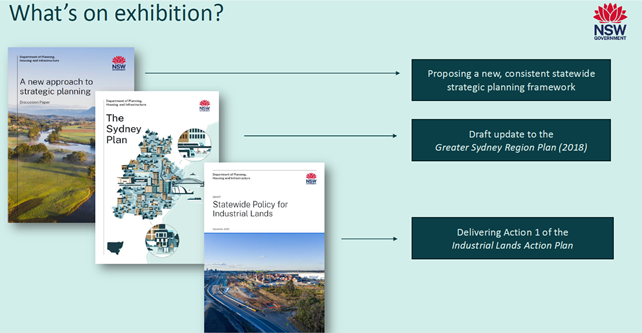
Figure 1: Documents on
exhibition
The technical appendices (AT-2 to AT-11)
provide guidance, principles and information for Government, Councils and
proponents to implement the plan. These will be updated in line with changes in
Government policy and announcements.
The draft Plan outlines priorities and
responses that then inform actions for NSW Government and Councils, as well as
guidance for practitioners. As a single response may address multiple
priorities, the plan uses icons to identify which priorities apply to each
response. Responses will be updated regularly or as needed to align with
evolving circumstances without full document revisions. Responses focus on
interventions to support Sydney’s growth and development.
The plan includes 7 statewide land
use priorities which also apply to the Sydney context:
1. Aboriginal
outcomes: Embedding co-design to recognise Country
in planning outcomes. Success means that land use plans recognise Country and
custodianship to support use and benefit opportunities for Aboriginal
landowners to achieve social, cultural, environmental and economic self-determination.
2. Housed:
Delivering affordable, diverse housing in accessible
locations. Success means more homes are built faster, close to jobs and
transport.
3. Prosperous:
Growing resilient, innovative economies. Success means
land use decisions help create jobs, supports emerging and diverse industries,
and strengthens supply chains.
4. Connected:
Linking communities with efficient transport systems.
Success means homes, jobs, and services are easier to reach and more
accessible.
5. Resilient:
Supporting a sustainable environment and biodiversity
to help achieve net zero and build climate resilience. Success means
communities can better withstand hazards and environmental pressures.
6. Liveable:
Building vibrant places that support quality of life.
Success means more public spaces, better urban design, and stronger social
cohesion.
7. Coordinated:
Aligning land use with infrastructure delivery. Success
means major infrastructure investments directly support planned growth areas.
These priorities
are addressed with specific policy and planning responses for Sydney,
including:
· implementing
Sydney housing targets
· increasing
housing diversity and choice
· securing
the supply of affordable housing
· growing
well-located jobs
· aligning
infrastructure to planned growth
· creating
a more vibrant Sydney
· growing
and connecting public open space
· securing
an ongoing pipeline of productive industrial lands
· minimising
the impact of natural hazards on communities
· sequencing
planned growth in greenfield areas within the urban footprint
· managing
land uses beyond the urban footprint
· protecting
and enhancing the natural environment.
Figure 2. Priorities and
Responses
The
main points of the draft Plan can be summarised as follows:
1) Housing supply and choice
· Mandate the 5-year
housing targets and encourages Councils to consider policies to increase
dwelling mix and housing choice.
· Support delivery
of the NSW target of 377,000 new homes between 2024-2029 to meet the demands of
population growth and change.
· Rebalance
housing growth in areas with the capacity for greater density and strong access
to jobs, services and public transport.
· Give effect recent
housing reforms that increase housing supply and diversity, particularly in
well-located areas including the Low and Mid-Rise Housing
Policy, Transport Oriented Development program, and in-fill
affordable housing settings under the Housing SEPP.
· Increasing the
supply of affordable housing in priority locations under the Transport Oriented
Development Program. The Transport Oriented Development Accelerated Precincts
each have a base rate requirement for 3% of housing provided to be affordable.
On key sites within these precincts and based on feasibility, higher rates of
up to 18% affordable housing are required. This affordable housing is required
to be delineated in perpetuity and managed by a registered community housing
provider. In other Transport Oriented Development Areas, the NSW
Government has introduced a 2% mandatory affordable housing contribution in
perpetuity for development projects with a minimum gross floor area of 2,000
sqm.
2) Jobs
and services
· Provide
jobs guidance to support economic and population growth with a well-located and
connected network of centres with a highly accessible public transport enabling
businesses to specialise more effectively, improve job matching, and
collaborate to drive innovation and productivity.
3) Liveability,
open space and services
· Access to open
space infrastructure and services is essential for communities and creating
great places to live. Providing additional open space within infill
developments can be challenging due to the land constraints and the high cost
of land acquisition. It demands innovative solutions to providing open space
such as integrating open space into development.
4) Employment
and Industrial Land
· Secure
productive industrial lands to support economic activity and implement the
draft Statewide Industrial Lands Policy. The draft statewide
policy aims to:
o respond to the
changing needs of industry
o support the
diversification, adaptation and intensification of industrial lands.
· It
includes three categories of industrial lands:
o State significant industrial
lands are critical infrastructure of state or national significance. Examples
include Port Botany, Sydney and Western Sydney Airports.
o Regionally significant industrial
lands are essential to supply chains and broader city functions such as waste.
Examples include Silverwater, Kurnell and Alexandria.
o Locally significant industrial
lands serve the local area and support local uses urban services such as
mechanics or last-mile delivery.
5) Resilient and sustainable
· Promote the
Resilient and sustainability land use and infrastructure planning to minimise
the impact of natural hazards to communities and built environment.
It is understood that Councils will use The Sydney Plan
as a key state strategic framework to review and update their Local Strategic
Planning Statements, local housing and employment strategies and to assess the
planning proposals. Broadly, the focus for Lane Cove would be housing supply,
protection of employment and industrial land, and the sequencing and
prioritisation of infrastructure, open space and resilience measures.
Discussion
This Plan does not significantly differ from the previous
Greater Sydney Region Plan, A Metropolis of Three Cities and North District
Plan overall but it is more concise and more focused with less
detailed guidance on implementation for councils. However, there are issues
with some aspects of the draft Plan as follows:
· The draft Plan proposes that every council must have an
affordable housing contribution scheme in place by 2027. Preparing an
affordable housing scheme requires a comprehensive feasibility and costing
study, along with consultation and statutory steps needed to implement
it. The proposed timeframe would be challenging without early release of
the toolkit and additional resources for Council’s while the draft Plan
is still on public exhibition until 27 February 2026 and expected to be
finalised later in 2026.
· The timeframe for many of the actions in the draft Plan are proposed
for 2026 and 2027, which is a short timeframe given the scale of work required
for each action.
· Previously the North District Plan adopted a comprehensive approach
to environmental sustainability—addressing issues such as the protection
and enhancement of Sydney Harbour and local waterways, conservation of bushland
and biodiversity, preservation of scenic and cultural landscapes, improved
management of rural areas, expansion of urban tree canopy and Green Grid
connections, delivery of high-quality open space, reduction of carbon
emissions, efficient management of energy, water and waste, and adaptation to
urban and natural hazards and climate change—the draft Plan has a more
limited focus. Its sustainability objectives are largely centered on clean air
and water, access to green and blue spaces, and the overall wellbeing of
residents, with less emphasis on broader ecological systems, climate
resilience, and resource management at a district scale.
Given
Council’s history of achieving award winning sustainability outcomes,
this approach is considered as a backward step. It does not build upon the work
that Councils have already done and/or are in the process of doing. For
example, Council’s Local Environmental Plan review includes a number of
new sustainability measures and outcomes and is currently with the Department
for a Gateway Determination. Further sustainability measures in the draft Plan
should be encouraged and included.
· As it is shown in the figure below, the statewide discussion paper
notes that Aboriginal outcomes are to be addressed across all six priority
areas, however the plan lacks a clear narrative explaining how these outcomes
will be embedded, implemented, and measured.
There is also no
mention of the Connecting with Country framework which is used by large
developments to incorporate Aboriginal knowledge into the built form landscape.
It is recommended that an action be included in the draft Plan that involves
the Connecting with Country framework and its implementation.
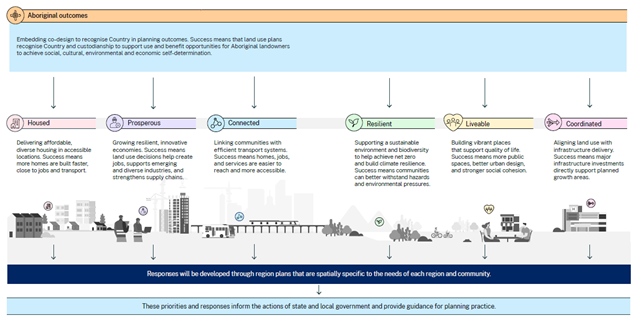
Figure 3:
Priorities listed in AT-12
· As shown in Appendix E (Jobs Guidance) (AT-6),
the draft Plan provides guidance for job growth ranges for UDP areas and
centres. In this draft plan, St Leonards is identified as the area with a high
job density by 2044. However, majority of the properties within this area have
already been rezoned for seniors housing and build-to-rent (this is explained
in greater detail in the Comments section and in Figure 6). This existing
planning context is required to be considered in the finalisation of this Plan.
· There is no mention or consideration of the
impact of new housing developments on waste management and other
infrastructure. It is considered a strategic issue in relation to waste
management, as disposal of waste correlates with greenhouse gas emissions.
Potentially more dwellings means more need for waste disposal, more disposal
may lead to greater need for more frequent trips for waste service vehicles
– thus increasing the amount of emissions from vehicles. While water and
sewer infrastructure is generally planned by other agencies there still needs
to be a coordinated effort to deliver this infrastructure to serviceable
levels, particularly to deliver the housing proposed by the State Government.
This is not just a local issue, but a regional one that all
Councils in Sydney must face. In this regard, Council supports the comments
made by Northern Sydney Regional Organisation of Council’s (NSROC) in its
submission.
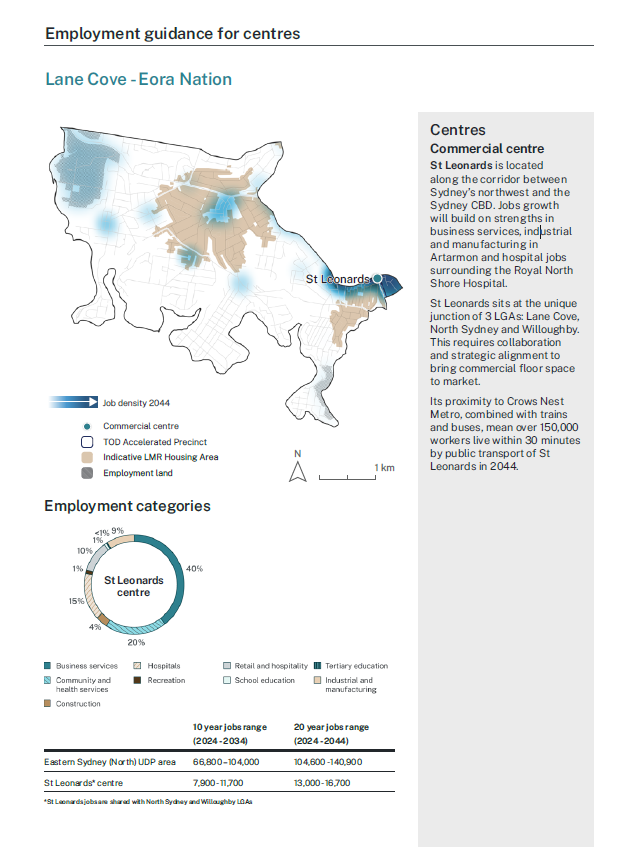
 Figure 4: Employment guidance for centres
COMMENTS
The following section outlines the actions in the Sydney
Plan that are relevant to Lane Cove with accompanying comments.
|
Council
|
1.4
|
Review and update
local strategic planning and local environmental plans to align with the
Sydney Plan and provide sufficient feasible capacity to meet housing targets
|
2027 and ongoing
|
Comment:
As part of the previous plan, Council was required to
demonstrate that it had enough zoned land capacity to deliver between
3,000-3,500 dwellings up to 2026. The Strategy confirmed that there was enough
zoned land.
The State Government then revised the St Leonards/Crows Nest 2036 Plan to the
Crows Nest TOD plans to incorporate more dwellings.
The release of the National Housing Accord confirmed that
Lane Cove (for a five year period) has to deliver 3,400 dwellings by 2029. The
Department of Planning confirmed this would be split between Planned and
Projected growth. The St Leonards South Urban Precinct will deliver 2,000
dwellings which was classed as the Planned growth, the Crows Nest TOD will
deliver 1,400+ dwellings and was included in the Projected growth.
The recent introduction of the Housing Delivery Authority
has allowed further dwellings on top of what was already Planned and Projected.
Council is well-placed to exceed the Housing Accord target numbers by a
considerable margin. It will be the third consecutive time that Council has
exceeded the housing targets that it has been given by the State Government.
In any event, Council will still need to review its Local
Housing Strategy to consider the impact of the Low and Mid-rise Housing reforms
in the longer term.
Further, Council will need to review and update the Local
Strategic Planning Statement (LSPS) in 2027 to ensure alignment with The
Sydney Plan. Council has already reviewed the Lane Cove Environmental Plan
(LEP) recently and confirms it is consistent with the plan and no amendments to
the LEP is requited at this stage. The timeframes provided for
local councils in the Plan are shown in this figure.
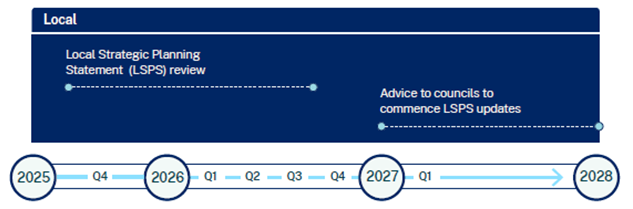
Figure 5: The timeframe
provided for The Sydney Plan to implement the framework
|
Council
|
2.6
|
Review local
environmental plans, local contribution plans and development control plans
relating to Low and Mid-Rise Housing Areas designated under the Low and
Mid-Rise Housing Policy
|
2026
|
|
Council
|
2.7
|
Identify areas
outside Low and Mid-Rise Housing Areas that can accommodate more diverse
housing choice based on public transport connections to stations
|
2026-27
|
|
Council
|
2.8
|
Review minimum lot
size requirements for dual occupancies outside Low and Mid-Rise Housing Areas
|
2026-27
|
|
Council
|
2.9
|
Consider more ways to
provide high density development around stations and other transit hubs,
where appropriate and feasible
|
2027 and ongoing
|
Comment:
Action 2.6 does not require any action at this stage from
Council as most of our planning controls are fairly consistent and conducive to
the Low and Mid-rise (LMR) reforms. However, this can change if further reforms
are announced.
Action 2.7 is problematic because most of the land connected
to stations is already designated as a Low and Mid-rise area. Areas on the
peninsulas of Lane Cove do not have access to public transport and are
therefore unstable for further increased densities – this is explained in
Council’s Local Strategic Planning Statement.
In terms of minimum lot sizes for dual occupancies, Council
currently has lot sizes in the Local Environmental Plan. It is 750 m2
for attached and 900 m2 for detached dual occupancies. These lot
sizes are fairly similar to what exists in the LMR areas. However, further
detailed work would need to be done as part of a revised Local Housing
Strategy.
As per Action 2.9, Council has already rezoned areas most
suitable for high density residential around the St Leonards train station and
town centre (through LMR reforms). As a result, there are no further feasible
areas to rezone for high density.
|
Council
|
3.3
|
Prepare and adopt an
affordable housing contribution scheme
|
2027
|
|
3.4
|
Identify surplus
Council-owned land for affordable housing
|
2027
|
Comment:
According to the Plan, State Government will be developing
an Affordable Housing Contribution Scheme toolkit. This is to assist Councils
in fast-tracking the preparation and adoption of an Affordable Housing Scheme.
This toolkit is expected to be released to Council’s in late 2026.
Current Affordable Housing Contributions are based on
completion of a comprehensive study to support a scheme. While Council does not
have a current scheme, it proposing to develop a policy in the first half of
this year. Given the impending release of this toolkit no further work (in
relation to a scheme) is to be undertaken. Once the toolkit is released,
Council can start work to prepare and ultimately adopt a contributions scheme.
In terms of surplus Council-owned land for Affordable
Housing, most Council-owned land comprises bushland or public open space which
results in limited land available for affordable housing. However, the Civic
Centre (Council offices) would be an opportunity to provide significant
affordable housing and potentially community facilities.
|
Council
|
4.3
|
Review and update
planning controls for E1 and E2 zones within the identified Low and Mid-Rise
Housing Areas to increase floor space for goods and services to meet the
needs of new residents and to consider shop top housing
|
2027
|
|
|
4.4
|
Investigate and
implement revised statutory provisions to enable new jobs in and out of
centres, including responding to infrastructure availability
|
2026 and ongoing
|
Comment:
Action 4.3 is problematic for the E2 Commercial Core zone
because a number of these sites have been converted to residential use. Figure
6 below shows the E2 zone sites in St Leonards which have been (or in the
process of being) converted to either Seniors Housing, Build-to-Rent (BTR) or
Residential apartments.
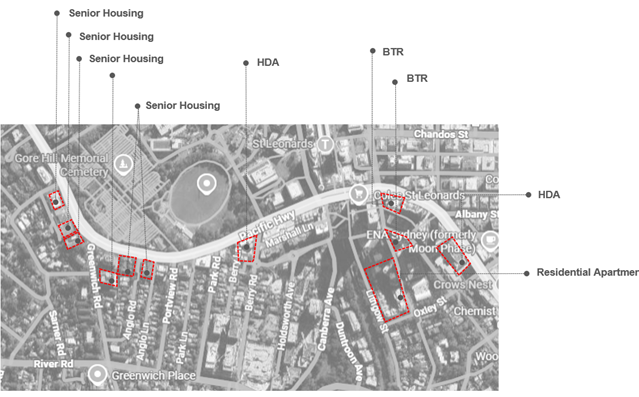
Figure 6: Sites in St Leonards
already converted to residential
The only sites available for commercial development are the
set of shops directly adjoining Wadanggari Park and 29-57 Christie Street. One potential
reason for these developments could be the proximity of the E2 zoned land to
the Royal North Shore Hospital.
As per the E1 Local Centre zone, this zone already has shop
top housing as a permissible land use so no further action is needed.
|
Council
|
7.4
|
Review
Council’s existing and future open space provision and identify local
opportunities to align with NSW Government’s open space outcomes
|
2027-29
|
Comment:
Council can support this action because it currently has an
Open Space Plan that is due for review. The Plan should be revised having
regard to the recent Low and Mid-rise reforms and other developments.
|
Council
|
8.7
|
Review locally
significant industrial lands in line with the draft statewide policy and
incorporate into future local planning
|
2026 and ongoing
|
|
Council
|
8.8
|
Update local zoning
of industrial lands to be consistent with the statewide policy
|
2026-27
|
Comment:
Staff attended separate workshops on the proposed Industrial
Lands policy which has been released with the Draft Sydney Plan – the
Policy is supported.
It designates the Lane Cove West Industrial Area as
Regionally Significant industrial land and the land at the Greenwich Refinery
as State Significant industrial land (see Figure 7).
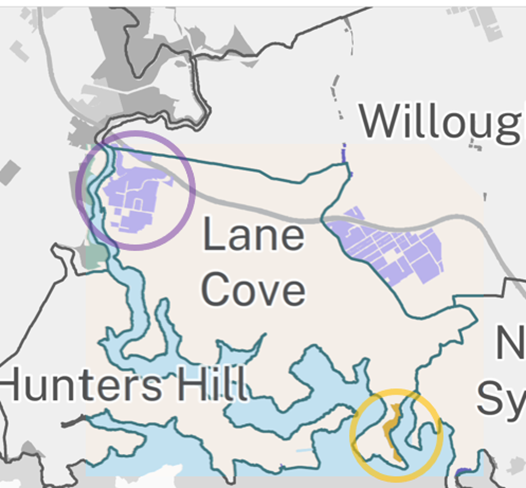
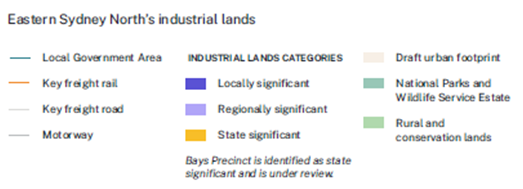
Figure 7: Map of Industrial
Lands
State Significant land under the policy is defined as:
“Areas that include or
are directly linked to critical state or nationally significant infrastructure
such as nationally significant airports, ports, intermodals and defence
facilities. These areas are protected from incompatible land uses to give certainty
around allowed activity that are crucial to national and state supply
chains” (page 7 of AT-13).
Regionally Significant land under the policy is defined as:
“Areas of scale that
contribute significantly to regional economies and the broader city function or
provide infrastructure that supports the region through employment and economic
contribution. They support a broad range of industries and employment
opportunities and have strategic network importance. They generally exclude
major retail and commercial uses that are ordinarily located in a centre”
(page 7 of AT-13).
In planning terms, these categorisations are important
because it determines what land uses are appropriate in these areas. In terms
of State Significance, it:
“grants strong
protections against any threat of encroachment from incompatible land uses.
This designation is granted to critical infrastructure and does not permit any
alternative land uses” (page 13 of AT-13).
For Regional significance, it:
“grants lands of high
economic and employment contribution strong protections against encroachment
from incompatible land uses while providing pathways for high-quality,
alternative employment land uses to be developed. This makes sure that these lands
are retained for employment and does not compromise industrial land uses, while
enabling innovation and change that responds to economic conditions”
(page 13 of AT-13).
In short, they provide good protection against the rezoning
of these sites for inappropriate land uses. Council supports this approach.
As the first action relates to locally significant
industrial land, this will not apply to Lane Cove. As per the second action, it
is envisaged that this would occur over time, and no further work is needed at
this stage. It needs to be mentioned that this could change based on State
Government policies.
|
Council
|
12.3
|
Develop locally
appropriate canopy and greening targets
|
2026-30
|
Comment:
Previously the State Government implemented the State Policy
on Sustainable Buildings in 2023. As part of this, Council reviewed its entire
Development Control Plan and created (the award-winning) Part S Environmental
Sustainability along with other amendments.
One of those amendments was the introduction of tree canopy
targets (amongst other things) for the Local Government Area. These changes
were incorporated into Part J and were adopted in September 2023 and have been
in place for nearly 3 years.
As a result, Council has already completed this action as
part of its Sustainability Development Control Plan amendments, and no further
work is required.
Timing
The Plan is on public exhibition until 27
February 2026. Although it has not yet been finalised, many of the actions
outlined in the Plan indicate a timeframe extending to 2026. This is not
considered realistic as the draft Plan is likely to be adopted in mid-2026.
It is expected that most (if not all) of
these deadlines mentioned in the Plan will change slightly.
Financial Considerations
As a result of some of the actions, Council
may be required to do some studies which will demand additional funds because
of The Sydney Plan being adopted. However, this cannot be confirmed
until the Plan is adopted.
Governance and Risk Considerations
While there are no governance or risk
implications, some of the actions in the Draft Sydney Plan will require Council
to commit to certain items i.e. Affordable Housing Strategy, Local Strategic
Planning Statement, Local Housing Strategy etc.
Some of these actions also have deadlines
attached to them which may potentially impact on the delivery of other
projects.
Environmental Considerations
The subject of this report has no
environmental implications for Council.
The resilience priorities will have an
impact on council’s local environment. One criticism is that the Plan does not appear to have a big focus on the environment.
Social Considerations
The recommendations in this report maintain
social outcomes for the community.
The recommendations in this report maintain
social outcomes for the community as they provide diversity and job
opportunities.
Link to Strategy
This report relates to the Community
Strategic Plan Outcome/s and Goal/s:
2. Our
Built Environment - A well designed, liveable and connected area
2.2 Housing
2.2.1 Ensure
planning controls require a diverse range of housing types and encourage
housing that is adaptable, accessible and affordable
Mark Brisby
Director - Planning and Sustainability
Planning and Sustainability Division
ATTACHMENTS:
|
AT‑1 View
|
The Sydney Plan - draft (2025-26)
|
69 Pages
|
Available Electronically
|
|
AT‑2 View
|
Appendix A: Using the technical appendices
|
3 Pages
|
Available Electronically
|
|
AT‑3 View
|
Appendix B: Summary of actions
|
6 Pages
|
Available Electronically
|
|
AT‑4 View
|
Appendix C: Glossary
|
6 Pages
|
Available Electronically
|
|
AT‑5 View
|
Appendix D: Pipeline of State rezonings
|
5 Pages
|
Available Electronically
|
|
AT‑6 View
|
Appendix E: Jobs guidance
|
40 Pages
|
Available Electronically
|
|
AT‑7 View
|
Appendix F: Public open space provision
|
4 Pages
|
Available Electronically
|
|
AT‑8 View
|
Appendix G: Blue-green grid
|
9 Pages
|
Available Electronically
|
|
AT‑9 View
|
Appendix H: Sydney industrial land categorisation - draft
|
7 Pages
|
Available Electronically
|
|
AT‑10 View
|
Appendix I: Flood planning principles
|
3 Pages
|
Available Electronically
|
|
AT‑11 View
|
Appendix J: Urban footprint policy guidance
|
11 Pages
|
Available Electronically
|
|
AT‑12 View
|
A new approach to strategic planning – Discussion
Paper
|
41 Pages
|
Available Electronically
|
|
AT‑13 View
|
Statewide Policy for Industrial Lands - draft
|
34 Pages
|
Available Electronically
|
|
AT‑14 View
|
Draft submission
|
10 Pages
|
Available Electronically
|
Ordinary Council Meeting 19 February 2026
Adoption - St Leonards
South Section 7.11 Plan Review
Item No: 15.4
Subject: Adoption - St Leonards South Section 7.11 Plan Review
Record No: SU10575 - 3907/26
Division: Planning and Sustainability
Division
Author(s): Golrokh
Heydarian; Christopher Pelcz
Purpose
The purpose of this report is to seek
adoption of the St Leonards South Section 7.11 Plan following review by the
Independent Pricing and Regulatory Tribunal (IPART) and approval by the
delegate of the Minister for Planning.
Executive
Summary
· The
St Leonards South (SLS) 7.11 Contribution Plan was adopted by Council on 19
April 2022 and came to effect on 20 April 2022, following review and
recommendations of IPART.
· One
of the IPART requirements was for Council to review the plan within 3 years to
include updated information on planning, assumptions, scope and cost of land
and works in the plan.
· Council completed this review and submitted a revised SLS 7.11 Plan
to IPART for assessment in July 2025.
· IPART reviewed the updated plan and released its Final Report on 7
October 2025, which included five recommendations.
· On 20 January 2026, the Department of Planning,
Housing and Infrastructure, as delegate of the Minister for Planning reviewed
the Contribution Plan and IPART’s review of the revised plan and
recommendations, and accepted most of the recommendations, as detailed in Table
1.
· The Section 7.11 Contribution Plan has now been updated in
response to comments provided by both the Department of Planning, Housing and
Infrastructure and IPART and is submitted to Council for adoption.
|
RECOMMENDATION
That Council adopt the amended Section
7.11 Contributions Plan (AT-3) and publish it on its website as soon
as practicable.
|
Background
Council’s original application to
IPART for assessment of the SLS Section 7.11 Plan was lodged in June 2021.
IPART’s review of the SLS Section
7.11 Plan was completed in December 2021.
Council adopted the plan on 19 April 2022,
and it became active on 20 April 2022.
The Plan was due for review in 2025 and at
the November 2024 Council meeting the following was resolved:
3. amendments
to the plan (if any) be tabled for the approval of Council before submission of
the amended plan to IPART
The 7.11 Contributions Plan was updated in June 2025 to
reflect revised information on planning assumptions, scope and cost of land and
works included in the Plan. The revised plan was publicly
exhibited from 21 June to 18 July 2025 prior to lodgment with IPART. In July
2025, the revised Contributions Plan was lodged with IPART for review.
The revised Plan outlines the progress over
3 years since the adoption of the Plan including:
· development approvals that have been granted, and construction that
has commenced at development sites throughout the precinct.
· the scheduled installation of a new stormwater system in Canberra
Avenue, Holdsworth Avenue, Berry Road and Park Road that have been completed.
· council commenced acquiring properties for the Local Park and has
now settled on four of the ten lots (up to June 2025) for the new local park at
the previous rate mentioned in the plan.
On 7 October 2025,
the final assessment report (AT-1) was published by IPART, indicating
that the revised St Leonards South Precinct Contribution Plan (SLS CP) met most
of the assessment criteria. However, IPART made five recommendations relating
to the indexation of land and works costs and to updating the SLS CP to reflect
recent land acquisitions and the staging of works.
Discussion
On 20 January 2026, Lane Cove Council
received a letter (AT-2) from the Department of Planning, Housing and
Infrastructure (acting in the capacity as delegate for the Minister of
Planning) which stated that they had accepted the majority of IPART’s
recommendations, however Council was required to make some final changes to the
plan prior to adoption. The comments from IPART and the Department of Planning,
Housing and Infrastructure are shown in Table 1.
Table 1. Response
to IPART review and DPHI Correspondence dated 20 January 2026
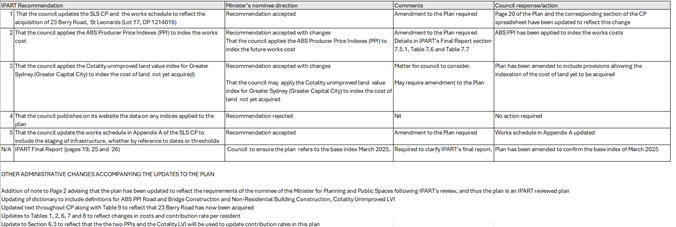
The updated plan
addresses the comments provided by both IPART and the Department of Planning,
Housing and Infrastructure.
In response,
Council has amended its Contributions Plan (see AT-3) as follows:
· The plan has been updated to reflect the acquisition of 23 Berry
Road, St Leonards. The plan also shows properties to be acquired following plan
finalisation.
· The previous references (and costs) to consumer price indices (CPI)
have been removed and replaced with Producer Price Indexes (PPI), where
relevant.
· The previous reference to ABS Established House Price index has been
removed and replaced with the Cotality unimproved land value index for Greater
Sydney.
· No action is required to publish any data, as it has been rejected
by the Department of Planning, Housing and Infrastructure.
· The works schedule in Appendix A has been updated to reflect
relevant applicable infrastructure thresholds and staging requirements.
Appendix B (Detailed Cost estimates) have been removed from the document and
will be placed on the website separately. These have been clarified in the plan
where applicable.
A breakdown of all Section 7.11
Contributions received so far have been attached to this report in AT-4.
Timing
Adoption of this plan is essential to
finalise delivery of essential infrastructure in the SLS precinct.
Financial
Considerations
Adoption of this plan is essential to
finalise the purchase and embellishment of essential infrastructure in the SLS
precinct.
Governance
and Risk Considerations
The adoption of a contemporary development
contributions plan is best practice and ensures appropriate governance in the
management of levying and collection of developer contributions.
Environmental
Considerations
The subject of this report has no
environmental implications for Council.
Social
Considerations
The recommendations in this report will
have positive social outcomes for the community through providing public
infrastructure in a timely manner.
Link to Strategy
This report relates to the Community
Strategic Plan Outcome/s and Goal/s:
2. Our
Built Environment - A well designed, liveable and connected area
2.3 Assets,
Infrastructure & Public Domain
2.3.4 Investigate
opportunities to create more open space
2.3.5 Identify
innovative funding and partnerships to provide for new and upgraded assets and
infrastructure
Mark Brisby
Director - Planning and Sustainability
Planning and Sustainability Division
ATTACHMENTS:
|
AT‑1 View
|
Final IPART Assessment
|
37 Pages
|
Available Electronically
|
|
AT‑2 View
|
Letter to Council - Section 7.11 Plan for St Leonards
South
|
2 Pages
|
Available Electronically
|
|
AT‑3 View
|
Contributions Plan - for adoption
|
48 Pages
|
Available Electronically
|
|
AT‑4 View
|
Section 7.11 Information Report
|
1 Page
|
Available Electronically
|
Ordinary Council Meeting 19 February 2026
Planning Proposal 47 - Heritage
Amendment - 3 Austin Crescent
Item No: 15.5
Subject: Planning Proposal 47 - Heritage Amendment - 3 Austin
Crescent
Record No: SU10933 - 3171/26
Division: Planning and
Sustainability Division
Author(s): Golrokh
Heydarian; Christopher Pelcz
Purpose
A Planning
Proposal (AT-1) for 3 Austin Crescent, Lane Cove has been submitted for
consideration. The Planning Proposal seeks to remove the property at 3 Austin
Street, Lane Cove from Schedule 5 of the Lane Cove Local Environmental Plan
2009 (LEP).
Executive
Summary
· The Planning Proposal (PP) was prepared by Urbanism Pty Ltd and
includes a Heritage Assessment prepared by Three+One Heritage, which concludes
that the property no longer demonstrates historic significance at either the
local or state level.
· Council
engaged an independent heritage consultant to review all material supplied with
the Planning Proposal. Overall, the advisor is of the opinion (AT-4)
that the “proposal to remove the heritage listing from No.3 Austin
Crescent is supported, and it is recommended that the item, and the adjacent
house at No.1 Austen Crescent, be removed from Schedule 5”.
· Planning
Proposal 47 was reported (AT-6) to the Lane Cove Local Planning Panel
(LPP), for advice on 18 December 2025. In accordance with section 9.1 of the
EP&A Act, staff prepared an assessment report with recommendations in
relation to the Planning Proposal including whether or not the proposal should
be forwarded to the Minister for a Gateway Determination.
· The
LPP advice was that Planning Proposal 47 (AT-7) be supported as it
satisfies both the strategic and site-specific merit tests.
The Panel
also noted that it was not in a position to address the request to delist 1
Austin Crescent as no Planning Proposal was before the Panel in relation to
that property but had one been lodged the Panel noted that it would have
supported delisting.
|
RECOMMENDATION
That Council:
1. endorse the planning proposal for 3 Austin Street,
Lane Cove at Attachment 1 to this Report (Planning Proposal) for forwarding
to the Department of Planning, Housing and Infrastructure for a Gateway
Determination under section 3.34 of the Environmental Planning and
Assessment Act 1979.
2. publicly exhibit the Planning Proposal in accordance with any
Gateway Determination.
3. submittors to the consultation of the Planning Proposal be advised
of Council’s decision
|
Background
The property known as 3 Austin Crescent, Lane Cove is
located on the eastern side of Austin Crescent, in an angle formed by the
junction between Austin Crescent and Austin Street. The Site is zoned R3 Medium Density Residential and has a site area of 600 sqm.
The subject site is listed as a local heritage item in Part
1 of Schedule 5 of the Lane Cove LEP 2009 as “House”, 3 Austin
Crescent, Lane Cove (item no. I152).

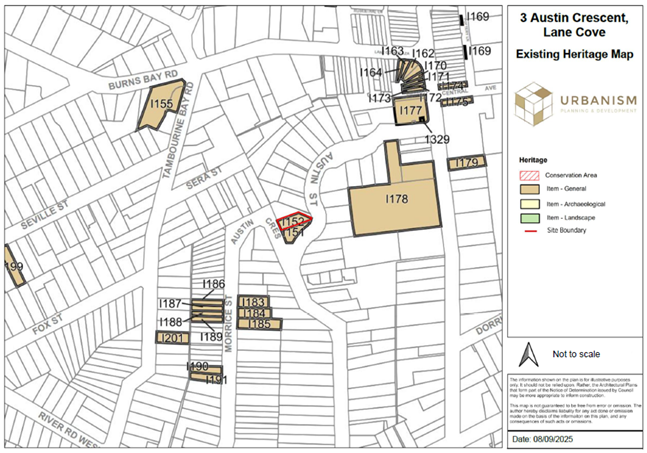
Figure
1: Heritage Map - Existing
The Planning Proposal (AT-1) seeks
to amend the Lane Cove Local Environmental Plan 2009 (LCLEP) to remove the
property located at 3 Austin Crescent, Lane Cove as a heritage item from
schedule 5 of the Local Environmental Plan (LEP).
SITE
The property adjoins the neighbouring residential development
along its northern and southern boundaries, with the property’s western
boundary (principal) fronting Austin Crescent.
The subject site is located adjacent to “House”,
1 Austin Crescent, Lane Cove (listed on the LEP as a local heritage item no.
I151), and in close proximity to “Lane Cove Public School”,
145–153 Longueville Road (item no. I178).
The site is not located within or in proximity to a local
Heritage Conservation Area (HCA).
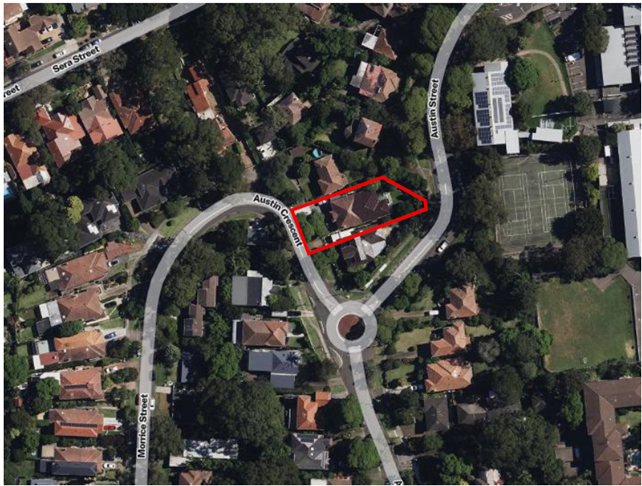
Figure 2: Aerial image of the local area with subject site
outlined in red (Source: NSW Spatial Explorer, 2025).
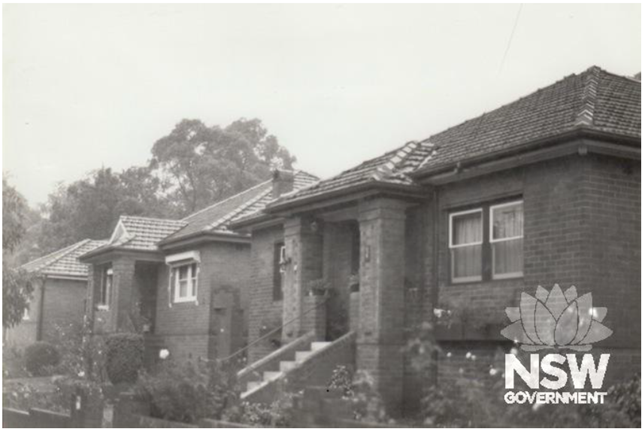
Figure 3: From left to right: no. 5, no. 3,
and no.1 Austin Crescent in 1987, Lane Cove Council. (Source: NSW State
Heritage Inventory
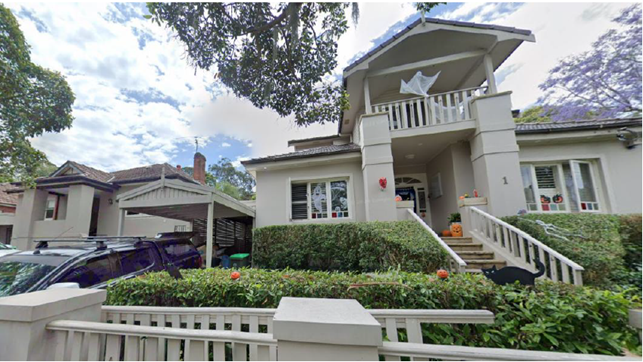
Figure 4: No. 3 (left) and no. 1 (right) Austin Crescent in
October 2024. (Source: Google Street View)
HISTORY
According to the applicant’s study (AT-2), the
subject site appears to have been constructed prior to 1941 in a simple,
austere style, typical of its era with brick constructed and hipped terracotta
roof profiles.
The site also is bounded to the north by No. 5 Austin
Crescent and to the south by No. 1 Austin Crescent. It is noted that No. 1
Austin Crescent is also identified as a local heritage item under Schedule 5 of
the Lane Cove Local Environmental Plan 2009 (LCLEP 2009), whereas No. 5 Austin
Crescent is not heritage-listed.
The immediate context is therefore characterised by a mix of
heritage and non-heritage residential properties within a low-density suburban
setting. Historical imagery suggests that these three (3) dwellings were
constructed at a similar time (c. 1941) and at one stage reflected the same
architectural features, being single-storey, late Interwar era dwellings,
constructed in a simple, austere style, typical of its era with brick
construction and hipped terracotta roof profiles.
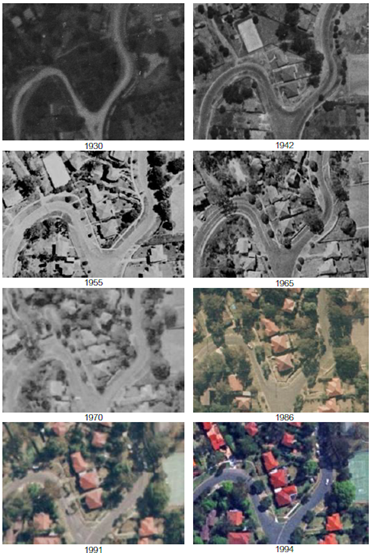
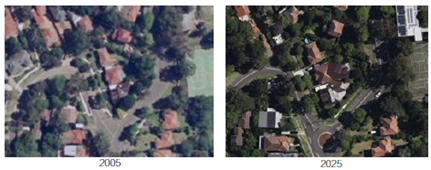
Figure 5: Historical aerial imagery of no. 1, 3, and 5 Austin
Crescent from 1930-2025 (Source: 1943-2005, NSW Historical Imagery Viewer;
2025, NSW Spatial Explorer)
According to the applicant’s argument (AT-2),
the site at 5 Austin Crescent, is not listed as a heritage item. However, the
dwelling was constructed in the same period as the neighbouring dwellings of 1
and 3 Austin Crescent (between 1930-1942). The dwelling presents as an example
of development in the late Interwar period with a face brick finish, simple
tile clads hipped roof, and minimal decorative detailing. The site appears
relatively intact from its principal elevation on Austin Crescent.
Dwelling Exterior
The subject dwelling is a single-storey, late Interwar era
dwelling, constructed in a simple, austere style, typical of its era of
construction but with a modified appearance. The dwelling is slightly elevated
above ground level.
The building is of brick construction to which a modern,
cement render has been applied. Its medium-pitched hipped roof is clad with
terracotta tile.
A central covered porch projects from the façade in
front of the entrance; its roof is supported by square masonry piers and topped
with a small decorative street-facing gablet. The façade on either side
of the porch is punctuated by timber sash windows.
A garage is attached to the northern side of the building.
The site does not feature a front garden, but the yard is instead paved
extensively in concrete, accommodating a driveway and external car spot. The
same design is continued at the rear, with a hipped roof and cement-rendered
perimeter walls, part of a later rear addition.
The rear of the property features an ample yard with
numerous plantings.
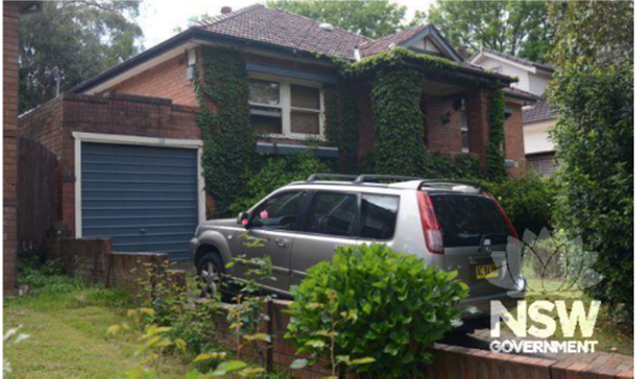
Figure 6: Number 3 Austin Crescent in 2013. (Source: State
Heritage Inventory Database, “House”, 3 Austin Crescent, Lane Cove)
The exterior has
been modified with the following:
|
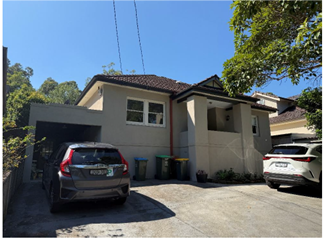
|
· Modern,
cement-rendered brick finish to principal façade
· Projecting porch
entryway with masonry piers
· Tile-clad hipped
roof of medium pitch
· Street-facing
gablet
· Sash windows
· Concrete-paved
yard
|
|
Figure 7: Street-facing façade of 3 Austin Crescent,
Lane Cove (Source: Three + One Heritage, 11/04/2025)
|
|
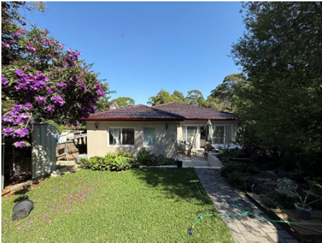
|
· Cement-rendered
external walls
· Tile-clad hipped
roof of medium pitch
· Ample yard with
numerous plantings
|
|
Figure 8: Rear of 3 Austin Crescent, Lane Cove (Source: Three
+ One Heritage, 11/04/2025)
|
Dwelling Interior
Inside the dwelling there are five bedrooms, two bathrooms
and one small kitchen and dining space that gives way to a larger open plan
dining and kitchen space at the rear of the property.
This rear portion, which covers approximately half of the
entire floor-space of the dwelling, is a later addition and has been designed
in a sympathetic manner, echoing original features of the dwelling.
The original kitchen and dining area, once separate rooms,
have been unified through the removal of the partition wall, as evidenced by
the retained bulkhead.
Bedroom floors are covered in low-pile grey carpet, while
the corridors, living and kitchen areas feature timber floorboards throughout.
The main bedroom contains a painted brick-faced fireplace.
The interior has been modified with the
following:
|
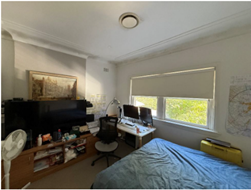
|
· Street-facing
sash windows
· Painted brick
fireplace and rendered chimney breast (behind furniture, at left of image)
· Simple
decorative plaster cornice mouldings
|
|
|
Figure 9: Main bedroom (Source: Three + One Heritage,
11/04/2025)
|
|
|
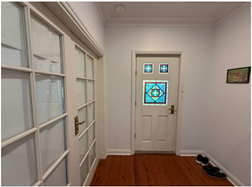
|
· Timber flooring
· Simple skirting
and architraves
· Non-original
front door
· Non-original
multi-pane doors
· Simple
decorative plaster cornices
|
|
Figure 10: Front hallway (Source: Three + One Heritage,
04/07/2025)
|
|
|
· Non-original
tile wall and floor finishes
· Modern fixtures
· Frosted glass
awning window with simple architrave
· Plaster cornices
with corner
|
|
Figure 11: Front bathroom (Source: Three + One Heritage,
04/07/2025)
|
|
|
· Retained
bulkhead of removed partition wall
· Bulkhead and
plaster moulded ceiling cornices delineating boundaries of individual rooms
· Timber
floorboards
· View into modern
extension
|
|
Figure 12: Original kitchen and dining rooms unified into
combined open space (Source: Three + One Heritage, 11/04/2025)
|
|
|
· Timber flooring
· Painted render
walls
· Modern kitchen
fixtures
· Double timber
framed sash windows
· Plaster cornices
with corner ventilators
|
|
Figure 13: Kitchen (Source: Three + One Heritage, 04/07/2025)
|
|
|
· Contemporary
rear extension
|
|
|
Figure 14: Contemporary rear extension (Source: Three + One
Heritage, 11/04/2025)
|
|
|
|
|
|
Discussion
STRATEGIC MERITS
This section will review and outline the
strategic planning documents relevant to this Planning Proposal in order to
provide an overall response at the end of the section.
Greater Sydney Region Plan
In relation to this Planning Proposal, the
relevant objective and strategy is as follows:
· Objective 13:
Environmental heritage is identified, conserved and enhanced.
· Objective 39:
A collaborative approach to city planning.
North District Plan
In relation to this Planning Proposal, the
relevant priority and action from the Plan is as follows:
· Planning
Priority N2: Working through collaboration
o Objective 5: Benefits
of growth realised by collaboration of governments, community and business.
· Planning
Priority N6: Creating and renewing great places and local centres,
and respecting the district’s heritage
o Objective 12: Great
places that bring people together.
o Objective 13: Environmental
heritage is identified, conserved and enhanced.
Local Strategic Planning Statement
In relation to this Planning Proposal, the
relevant priority is as follows:
· Planning
Priority 6: Create and renew public spaces and facilities to improve our
community’s quality of life.
The above policy contains a
section dedicated to “Embracing Heritage”, noting:
“A
variety of local heritage items and heritage streetscapes form part of the
character of centres throughout the North District and Lane Cove.”
Therein, it further states:
“Heritage
identification, management and interpretation are required so that heritage
places and stories can be experienced by current and future generations.”
The term “interpretation”
is considered to be directly applicable to this Planning Proposal. In this
context, the interpretation of heritage items relates not only to their
understanding and presentation but also to the process of their designation.
Accordingly, a Heritage Statement
has been prepared for the subject property and is enclosed with this proposal.
This report provides an assessment of the property and offers an interpretation
of its heritage value.
The cumulative effects of
additions and alterations to the subject property over the past few decades
have rendered its original heritage value to be considerably diminished.
Local Housing Strategy
Section 6 of the strategy relates to Housing Priorities
within the LGA. Therein, section 6.2.7 refers specifically to “Preserving
and enhancing character and heritage”. This strategy recognises that
character and heritage should be evolving, interpretive concepts that support
innovation and contemporary community needs. Specifically, the strategy states
that:
“Incorporating character
and heritage can be interpretive, rather than strict repetition, encouraging
new housing to build upon existing values and adapt new trends into building
design and structure.”
In this context, retaining the heritage listing of 3 Austin
Crescent, despite its lack of remaining heritage significance, risks
constraining thoughtful and innovative development that could better reflect
current and future housing needs. The proposed removal of the listing allows
for the opportunity to create a new built form that is respectful of local
character, while embracing the strategy’s call for adaptation to “the
trends of the day.”
Moreover, the Strategy also recommends “routine
heritage reviews are undertaken”, where deemed necessary. We consider
this especially relevant in this instance, with this planning proposal intended
to begin the process of requesting Council to reconsider the subject local
heritage item.
The intent of the Strategy is to
maintain and strengthen Lane Cove’s valued character—not to impose
heritage listings that no longer serve their original purpose. As the Strategy
makes clear:
“Future
character and heritage controls [should] seek to preserve and enhance character
while also encouraging innovation and adaptation of the trends of the
day.”
The removal of the subject
property from Part 1 of Schedule 5 of the LCLEP 2009 will facilitate future
innovation and adaption of the site. It is considered that that a local
heritage designation on the subject property is unduly restrictive in the context
of the above guidance, particularly given that the site is no longer an
exemplar of an Interwar Californian Bungalow.
SITE-SPECIFIC MERITS
The criteria for assessing heritage
significance consider seven (7) matters as follows:
· Criterion A – Historical Significance;
· Criterion B – Historical Associations;
· Criterion C – Aesthetic Values;
· Criterion D – Cultural Associations;
· Criterion E – Cultural or Natural Research Value;
· Criterion F – Rarity;
· Criterion G – Representativeness;
The applicant has already provided an
assessment against each of the seven criteria in AT-5.
These will be reviewed with additional comments where relevant.
Criterion A
The applicant provides the following in
terms of criterion A:
“The subject dwelling,
constructed c.1941, is associated with the pattern of residential subdivision
and generally modest housing development in Lane Cove during the late Interwar
and early Postwar period. Its original construction reflects the economic
austerity of the era, evidenced by its modest scale, restrained detailing, and
readily available materials. However, the dwelling has undergone a number of
external alterations, including changes to its original materials and
detailing, which have diminished its ability to effectively demonstrate this
historical phase in a legible or representative way. Due to the extent of these
modifications, the dwelling is not considered to retain sufficient integrity to
meet Criterion (A) – Historic Significance at a local level.
This item is not considered to
be of Historic Significance at a State or Local level.”
In response, Council can confirm
these comments through the development applications it has received for the
various external alteration, including changes to its original materials and
detailing.
Criterion
B
The applicant provides the following in
terms of criterion B:
“The subject dwelling is
not known to be associated with any person or group of note.
This item is not considered to
be of Associative Significance at a State or Local level.”
In response, Council can confirm
the above comment.
Criterion
C
The applicant provides the following in
terms of criterion C:
“The subject dwelling
presents as a modified example of a late Interwar dwelling evidenced by its
overall form, opening patterns, and simple austere design utilising materials
common in the period. The building is not considered to demonstrate any particular
aesthetic, creative, or technical achievement, and is more an example of a
building approach common at the time of construction. Recent modifications to
the building have impacted the building’s ability to fully demonstrate
this aspect of the building as a type, particularly the rendering of the
exterior which has obscured its original brick materiality, and minor
decorative components including verandah pier detailing.
This item is not considered to
be of Aesthetic Significance at a State or Local level.”
In
response, Council can confirm the building is now not considered to demonstrate
any particular aesthetic, creative, or technical achievement, and is more an
example of a building approach common at the time of construction.
Notwithstanding, modifications to the building have impacted the
building’s ability to fully demonstrate this aspect.
Criterion
D
The applicant provides the following in
terms of criterion D:
“The subject dwelling
has not been identified as having strong or special association with a
particular community or cultural group in the Lane Cove area for social,
cultural or spiritual reasons.
This item is not considered to
be of Social Significance at a State or Local level.”
In
response, Council can confirm the subject dwelling has not been identified as
having strong or special association with a particular community or cultural
group in the Lane Cove area for social, cultural or spiritual reasons.
Criterion
E
The applicant provides the following in
terms of criterion E:
“The subject site
provides limited potential for further research.
This item is not considered to
be of Technical / Research Significance at a State or Local level.”
In
response, Council can confirm the subject site now provides limited potential
for further research.
Criterion
F
The applicant provides the following in
terms of criterion F:
“Most of the development
of Lane Cove occurred during the Interwar and Post-WWII eras, 37 with many
intact examples from these periods still evident throughout the streetscapes of
the suburb and the wider LGA. The subject dwelling, while constructed during
this broader period of growth, is not considered rare or uncommon within this
context. It does not demonstrate any defunct customs, rare design features, or
construction techniques that are at risk of being lost.
This item is not considered to
meet the threshold for Rarity at the State or Local level.”
In
response, council can confirm this dwelling type is not considered rare in
nature, with similar building types present throughout the Land Cove LGA.
Criterion G
The applicant provides the following in
terms of criterion G:
“The subject dwelling
was originally a good example of the austere late Interwar housing style,
representative of the type of modest residential development that characterised
much of Lane Cove’s growth during this period. However, subsequent
alterations particularly the application of modern cement render to the
exterior and later additions have compromised the dwelling’s integrity
and reduced its ability to clearly demonstrate the characteristic features of
its type. Internally, while some elements of simple Interwar/Postwar decorative
detailing remain, changes to configuration and finishes have further diminished
its representative value.
This item is not considered to
be Representative at the State or Local level.”
According
to the document provided by the applicant, Butler (1992) notes that a defining
characteristic of Interwar Californian Bungalows in Australia was their
regional adaptation, often reflected in the use of local materials—such
as red brick in Melbourne, liver-coloured brick in Sydney, and limestone in
South Australia.
In
response, council confirms the subject swelling no longer retains this
characteristic feature and is therefore no longer representative of the late
interwar housing style.
INDEPENDENT HERITAGE CONSULTANT ADVICE
Council provided all material supplied with
this proposal to its independent heritage consultant for review. In response to
the heritage assessment and proposal, they provide the following comments (see AT-4):
In response to the heritage assessment by the applicant, the
consultant comments are:
“The Heritage Assessment
is comprehensive and provides detailed historic information, information about
the changes to the dwelling and its pair, a comprehensive comparative analysis
and assessment against the NSW Standard Criteria for the assessment of heritage
significance”.
The consultant is of the opinion that the
proposed de-listing of 3 Austin Crescent has been adequately justified for the
following reasons:
“The
house was listed in 1987 as part of a pair of intact, simple, austere cottages
that reflected suburban development in the post- WWII period, with simple brick
detailing. At some time between 2013 and 2025, the house was rendered and
painted, and the front garden area paved with concrete for carparking. Due to
these changes, the house is no longer intact and does not present as a simple,
austere, post -WWII suburban dwelling.
Furthermore,
its pair at No.1 Austin Crescent has undergone substantial changes that have
completely altered the presentation of the dwelling, including the addition of
a second storey, new concrete roof tiles, and, like No. 3 Austin Crescent, the
original face brickwork has been rendered and painted. As a result, the houses
no longer read as a pair, and neither house is considered to be intact.
Accordingly, the significance of the houses as a pair of intact, simple,
austere cottages from the post-war era has been lost”.
Overall, the advisor is of the opinion that
the “proposal to remove the heritage listing from No.3 Austin
Crescent is supported, and it is recommended that the item, and the adjacent
house at No.1 Austen Crescent, be removed from Schedule 5”.
Based on the comments above and considering
the cumulative impacts of development that have occurred on site, there appears
to be sufficient justification for de-listing of No.3 Austin Street from the
heritage item and the potential impacts of the proposed de-listing have been
adequately addressed.
RESPONSE
TO NOTIFICATION
This Proposal
was (informally) publicly exhibited from Monday 24 November to Friday 5
December 2025. Two submissions were received. These submissions are summarized
below.
|
Comment
|
Response
|
|
Both
submissions supported the planning proposal and requested the delisting of
No. 1 Austin Crescent due to extensive alterations and external modifications
for both properties.
|
Noted.
|
Community
Consultation
Statement of Intent
The consultation is designed to elicit any
feedback members of our community may have on the matter and report that
feedback back to Council for its consideration.
Method
|
Level of Participation
|
Consult
|
Consult
|
|
Form of Participation
|
Open
|
Targeted
|
|
Target Audience
|
Lane Cove Community
|
Affected Owners and surrounding
properties
|
|
Proposed Medium
|
Website
Exhibition
|
Letter
|
CONCLUSION
According to the heritage assessment
provided by the applicant and independent heritage consultant’s review,
the property at No.3 Austin Crescent and its adjoining pair at no. 1 have been
significantly modified due to substantial alterations undertaken over time.
Both dwellings have lost the intact,
austere post-war character for which they were originally listed, and no longer
read as a pair of heritage significance.
Council considers the applicant’s
heritage assessment to be thorough and supports the proposal to remove No. 3
Austin Crescent from the heritage schedule. However, while the independent
heritage advice notes that No. 1 be de-listed for the same reasons – this
aspect is not supported at this time.
Even though the owners of 1 Austin Crescent
support their property being de-listed as well, the Planning Proposal only
contains a thorough assessment for 3 Austin Crescent not No.1 Austin Crescent.
It is inappropriate to consider a heritage de-listing for a separate property
which has yet to be properly assessed.
The Lane Cove Local Planning Panel, at its
meeting on 18 December 2025, advised of its support for the Planning Proposal,
noting that it satisfies both the strategic and site-specific merit tests.
However, the Planning Panel noted that it
was not able to address the request to delist 1 Austin Crescent as no Planning
Proposal was before the Panel in relation to that property but had an
application been lodged the Panel noted that it would have supported delisting.
Timing
A public exhibition period will be required
if the Planning Proposal is given a Gateway Determination. The timeframe for
future consultation will be set out on the Gateway Determination.
Financial
Considerations
The recommendations of this report pose no
financial impact on Council.
Governance
and Risk Considerations
Not applicable.
Environmental
Considerations
The subject of this report has no
environmental implications for Council.
Social
Considerations
The recommendations in this report maintain
social outcomes for the community
As the subject dwelling has not been
identified as having strong or special association with a particular community
or cultural group in the Lane Cove area for social, cultural or spiritual
reasons.
Link to Strategy
This report relates to the Community
Strategic Plan Outcome/s and Goal/s:
2. Our
Built Environment - A well designed, liveable and connected area
2.2 Housing
2.2.1 Ensure
planning controls require a diverse range of housing types and encourage
housing that is adaptable, accessible and affordable
Mark Brisby
Director - Planning and Sustainability
Planning and Sustainability Division
ATTACHMENTS:
|
AT‑1 View
|
Planning Proposal - 3 Austin Crescent
|
21 Pages
|
Available Electronically
|
|
AT‑2 View
|
Heritage Assessment - 3 Austin Crescent
|
45 Pages
|
Available Electronically
|
|
AT‑3 View
|
Merged Maps - 3 Austin Crescent
|
2 Pages
|
Available Electronically
|
|
AT‑4 View
|
Independent Heritage Review
|
5 Pages
|
Available Electronically
|
|
AT‑5 View
|
Assessing heritage significance - NSW Heritage Criteria
|
55 Pages
|
Available Electronically
|
|
AT‑6 View
|
Local Planning Panel Report - Thursday, 18 December 2025
|
17 Pages
|
Available Electronically
|
|
AT‑7 View
|
ADVICE - 3 Austin Crescent - Local Planning Panel
|
3 Pages
|
Available Electronically
|
Ordinary Council Meeting 19 February 2026
Post Exhibition - Road
Naming Proposal
Item No: 15.6
Subject: Post Exhibition - Road Naming Proposal
Record No: SU10859 - 3831/26
Division: Planning and Sustainability
Division
Author(s): Christopher
Pelcz
Purpose
The purpose of the report is to determine a
suitable name for the new road in St Leonards that will connect Park Road and
Berry Road.
Executive
Summary
· Council
at the October 2025 Council meeting resolved to seek
ideas from the community to name a new road being delivered as part of the St
Leonards South Precinct (between Berry Road and Park Road) for a period of
6-weeks.
· Community
ideas for the name of the new road were sought between 6 November and 18
December 2025.
· A
total of 11 survey responses were received, and all name suggestions have been
considered against the NSW Geographical Names Boards requirements and the road
naming evaluation tool.
· From
this review, three names have been deemed to be appropriate, however the
preferred name of ‘Lumen’ as it is the most appropriate name and is
consistent with the NSW Geographical Names Board requirements.
|
RECOMMENDATION
That Council:
1. endorse
the name ‘Lumen Lane’ for the new road connecting Park Road and
Berry Roads, St Leonards.
2. forward
the road naming proposal to the NSW Geographical Names Board for
consideration and approval.
|
Background
A new road is being delivered as part of
the St Leonards South precinct on sites known as Areas 22 and 23. The precinct
plan shows the delivery of a new public road connecting Berry Road and Park
Road.
The respective Development Application for
Sites 22 and 23 was approved on 3 August 2023 and construction of the
development is well advanced. The developer approached council seeking a name
to be assigned to the new road (see Figure 1) and this report seeks to
conclude the naming process.
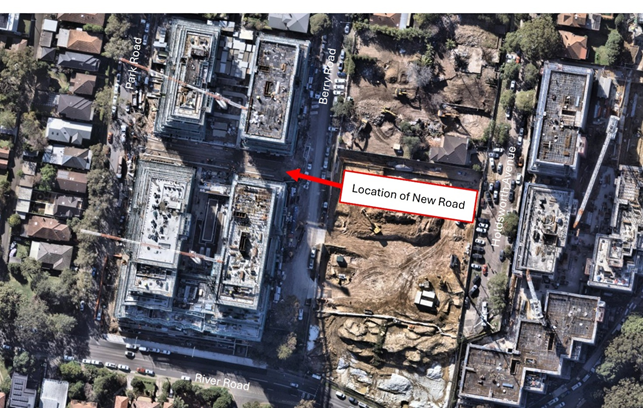
Figure 1: Location of new road
When seeking ideas from the community and
ultimately approving a new road name, Council should follow the guidelines set
down in the Geographical Names Board’s NSW Addressing Policy.
Some key criteria for determining road
names includes:
· Road names are not to be duplicated, or be too similar to, existing
names within a 10 km radius.
· The GNB's Road Name Evaluation website can be used to check for
eligibility.
· Road names should have relevance to the local heritage, culture,
environment or industry.
· Road names with a local Aboriginal dimension are encouraged but must
be supported by the local Aboriginal community.
· For road names commemorating a person:
o The
person should have contributed significantly to the area.
o The
person must have been deceased for at least 12 months.
o An
effort should be made to gain consent from family members of the person.
The Road Naming process is also subject to
requirements under the Roads Act 1993, Roads Regulation 2018 and the NSW
address Policy and User manual.
Discussion
Council officially sought name suggestions
from the public from 6 November to 18 December 2025 and the public exhibition
included an accompanying survey. The following road name suggestions have been
received:
· William Tunks
· Lumen
· Jacaranda Blue
· Parkberry
· Streety McStreetface
· Banksia
· Link
· Perry or Parry
· Cycle
· Leafy
There was one further name suggestion
received which is not included in the report as the name would be considered to
meet the as offensive language criteria as defined by the Geographical Names
Board and has been removed from consideration.
All the other name suggestions have been
checked against the Road Name Evaluation tool of the NSW Geographical Names
Board. The following names are not considered suitable as they breach the
criteria set by the NSW Geographical Names Board:
· William Tunks – while Mr Tunks was a very important local
figure in St Leonards (being the first Mayor of St Leonards), both names
‘William’ and ‘Tunks’ are existing roads within a 10km
radius.
· Jacaranda Blue – there is a similar road in Cabarita.
· Parkberry – combination of existing roads ‘Park’
and ‘Berry’ would cause conflict.
· Streety McStreetface – contains the words ‘Street’
within the name.
· Banksia – a number of different roads within 10kms are named
Banksia already.
· Link – A link is a type of road under GNB’s policies and
cannot be used.
· Perry or Parry – combination of Pacific Highway and Berry
Road. Both roads are already in existence in multiple locations within 10kms.
Based on the above assessment, the
following three names are considered appropriate for consideration:
· Lumen – the name derives from the
Latin word meaning ‘light’ and was considered a measure of light as
far back as Roman times. The term is also associated with architectural
knowledge and design. This would be considered appropriate as the St Leonards
South precinct was designed and reviewed by architects and urban designers at
both local and state government level. According to the road naming evaluation
tool there are 2 similar sounding roads (Lumsden and Lumeah) within 10kms of
the precinct.
· Cycle – the name refers to
cycleways and shared user paths that will exist in the precinct upon
completion. Whilst this is not a strong connection to the area, the road naming
evaluation tool found that there were no issues associated with this name.
· Leafy – the name refers to the
leafy surrounds and the desired future character of the precinct. The road
naming evaluation tool highlights 3 similar sounding roads (Lea) within a 10km
radius.
It is recommended that council proceed with
‘Lumen’ because of its association with light and design. As stated
above, the precinct’s history includes architectural design input from
both local and state Government levels – including the NSW Government
Architect. The potential conflicting road names mentioned above are considered
extremely minor.
Following endorsement of the final name by
Council, the proposed road name will be submitted to the Geographical Names
Board (GNB) for consideration and approval.
Timing
Once Council submits its approved road
name, the NSW Geographical Names Board will review. If approved the name will
be reserved until the developer provides the final survey showing the
boundaries and location of the new road.
Financial
Considerations
The recommendations of this report pose no
financial impact on Council.
Governance
and Risk Considerations
The recommendations of this report pose no
governance considerations.
In terms of risk, the NSW Geographical
Names Board can reject the proposal which may require re-exhibition. However,
Council can choose an alternative name listed in this report.
Environmental
Considerations
The subject of this report has no
environmental implications for Council.
Social
Considerations
The subject of this report has no further
social considerations for Council.
Link to Strategy
This report relates to the Community
Strategic Plan Outcome/s and Goal/s:
4 Our
Culture - Fostering an inclusive community rich in culture with a strong
identity
4.3 Celebrating
Cultural Identity
4.3.1 Encourage
activities which foster the community’s connection to Lane Cove and
complement these with Council-led initiatives
Mark Brisby
Director - Planning and Sustainability
Planning and Sustainability Division
ATTACHMENTS:
There are no supporting documents for this report.
Ordinary Council Meeting 19 February 2026
Response to Notice of
Motion - Enhancing infrastructure for dogs in Lane Cove - Update
Item No: 16.1
Subject: Response to Notice of Motion - Enhancing infrastructure for dogs in
Lane Cove - Update
Record No: SU1247 - 6158/26
Division: Open Space and
Infrastructure Division
Author(s): Millie
Allsopp
Purpose
The purpose of this report is to provide Council
with an update on actions arising from Resolution 283 of the December 2025
Ordinary Council Meeting and seek a Council decision to commence improvement
works at Turrumburra off-leash dog area this financial year.
Executive
Summary
· Investigations
related to the carrying out of a range of measures to improve dog parks in the
Lane Cove LGA as required in Resolution 283 have been carried out. Such
measures include improvements to drainage, repair of turf, fencing
modifications, increased maintenance and installation of turf reinforcement
mesh at Blackman Park.
· The
improvements and proposed cost of carrying out work at Blackman Park are
included in the report and, given extensive costs, are provided for
Council’s future consideration as part of the preparation of the draft
2026/27 budget.
· Site
investigation and proposed improvements to Turrumburra Park enclosed off-leash
dog area have also been identified and are able to be carried out this
financial year through funds available in the current (2025/26) maintenance
budget.
|
RECOMMENDATION
That Council:
1. receive and note the report.
2. consider the improvement works
at the Blackman Park off-leash dog area when considering the draft 2026/27
budget.
3. endorse the recommended
improvement works for the Turrumburra off-leash dog area to be carried out
this financial year (2025/26).
|
Background
At the December 2025 Council Meeting, the
following was resolved:
|
283
|
1. receive
a report for consideration ahead of the finalisation of the 2026/27 budget on
the indicative cost to improve dog parks in Lane Cove including:
a) improving drainage at the
Blackman dog park to bring it to the same or similar quality of drainage as
the adjacent field;
b) fixing twisted wire,
broken latches etc that may cause injuries to people and their dogs at dog
parks across the LGA;
c) increasing routine
mowing/weed maintenance within dog park areas across Lane Cove LGA;
d) installing improved
ground surfacing options, such as turf reinforcement mesh or mulch in
high-traffic areas within dog park areas across Lane Cove LGA;
e) removing broken glass,
building debris and other dumped material within Turrumburra dog park; and
2. as an interim
measure, investigate options to safely store a shovel to allow dog park users
at Blackman to fill in holes as they see them; including inquiring with the
Puppy Tail Cafe about the potential of storing a shovel.
|
Discussion
Blackman Park Enclosed Off-Leash Dog
Area improvements
Existing
dog areas and sports fields at Blackman Park
Drainage improvements and turf repair



 Council has investigated the process and cost of installing the same
drainage system that is in our sports fields, into the off-leash dog area at
Blackman Park. Sports field drainage consists of sand slit drains spaced at
regular 2m to 2.5m intervals that intercept surface water to drain it away. Due
to the spatial constraints of the off-leash dog area, to achieve this outcome
in this area, our specialised drainage contractor has advised that the standard
process for installing these drains into this area will not be able to be used.
Council has investigated the process and cost of installing the same
drainage system that is in our sports fields, into the off-leash dog area at
Blackman Park. Sports field drainage consists of sand slit drains spaced at
regular 2m to 2.5m intervals that intercept surface water to drain it away. Due
to the spatial constraints of the off-leash dog area, to achieve this outcome
in this area, our specialised drainage contractor has advised that the standard
process for installing these drains into this area will not be able to be used.
The standard method for installing sand slit drainage into a
sports field uses large, automated machinery that cuts long straight drainage
trenches, installs the drainage aggregate, lays the ag lines, backfills the
trench with sand and captures the spoil for disposal all in one process. This
process was used at Blackman Park in 2019 and Bob Campbell Oval in 2025. As
this machinery will not fit into the off-leash dog area, this automated process
cannot be used. Our contractor has stated that the works will need to be
undertaken using a more manual process with a 3m drainage spacing.
The off-leash dog area at Blackman Park also has a number of
constraints consisting of structures and a high-pressure gas main that runs
through it. The gas main has 5m buffer zone around it where no excavation is
permitted and thus no sand slit drains will be able to be constructed in this
buffer zone. Navigating around the structures will further add to the costs of
installing the sand slit drainage lines.
Obstructions to
drainage extent, with various facilities (pink) such as shelters and
high-pressure gas main (orange)
Following the installation of the sand slit drainage the
off-leash area will need to remain closed for up to 2 months to allow for the
turf to recover and establish sufficiently. These works should achieve a
comparable outcome to the drainage on the sports fields, however as discussed,
the methodological changes required in this setting will result in increased
costs compared to similar works being undertaken on a sports field where there
are no spatial constraints.
The indicative cost for the drainage
upgrade and turf repairs is $187,700.
Repair of fencing and gates
Frequently the entry gates are subject to
damage due to heavy usage and forceful closures. Council has continued to
repair these damaged gates, including the gate latches referred to in the
resolution. A more robust solution, to suit the park’s conditions, is
currently being investigated with Council’s fence supplier. As also
outlined in the resolution, a portion of fencing dividing the large off-leash
area from the adjacent cricket nets is deteriorating due to wear and tear from
heavy use. Work has been scheduled to repair and strengthen these fencing
panels around the cricket nets, to improve safety. The present maintenance
budget (2025/26) will be used to fund these repair costs.
Additionally, it has been identified that
cricket balls are escaping the cricket nets and are landing in the off-leash
dog area. To improve safety of users around the cricket nets it is recommended
to extend the roofing of the cricket nets to prevent cricket balls from
entering the off-leash dog area, further improving safety to dogs and their
owners. This is expected to cost $15,515 and is recommended for consideration
in the 2026/27 maintenance budget.
Mowing and maintenance of grass
The off-leash dog park currently receives
regular cutting and tidying by Council staff, and occasional weed spraying by a
contractor. To increase grass-cutting to a weekly occurrence in high-growth
periods would necessitate adding this area to Council’s park mowing
contract. Using our current mowing rates would incur an additional cost of
$6,300 per annum. This cost will be included for consideration in the 2026/27
maintenance budget.
Increasing weed and pesticide spraying is
not expected to have a significant cost implication to Council’s budget.
It should be noted that any additional
mowing and spraying visits will result in more frequent closures of the
off-leash dog area. Historically the need for users to vacate this space for
Council to conduct its current level of maintenance activities has been a
barrier.
Surfacing for high-wear areas
Main wear areas in
Blackman dog park (above) and turf reinforcement product (right)
The high volume of dogs and their owners
using the off-leash dog area has resulted in compaction and wearing of the
surface, and the entry points of the off-leash area have consistent issues with
turf failure due to the high use. In this setting, application of mulch will
not alleviate mud or exposure of bear ground.
Installation of a reinforcement mesh  in the turf may assist in reducing the compaction from high volumes
of foot traffic and prevent dogs from digging holes. Council investigated
reinforced turf products that are suitable for off-leash dog areas. One
supplier was found that had a product suitable for dogs however, this was a
light duty product and the supplier recommended against, using it for our
purpose as it was designed for a residential setting and would not be able to
withstand the volume of traffic in a dog off-leash area. Instead, they
recommended a high-grade plastic mesh with precedent use in settings such as
public venues, golf greens and car parks. It is recommended that the reinforced
mesh product to be applied to the entry points, where the highest wear of turf
is present. The product will be secured in place by the insertion of steel pegs
in the ground. Supply of this extent of turf reinforcement is estimated to cost
$13,680, which will be included for consideration in 2026/27 maintenance
budget.
in the turf may assist in reducing the compaction from high volumes
of foot traffic and prevent dogs from digging holes. Council investigated
reinforced turf products that are suitable for off-leash dog areas. One
supplier was found that had a product suitable for dogs however, this was a
light duty product and the supplier recommended against, using it for our
purpose as it was designed for a residential setting and would not be able to
withstand the volume of traffic in a dog off-leash area. Instead, they
recommended a high-grade plastic mesh with precedent use in settings such as
public venues, golf greens and car parks. It is recommended that the reinforced
mesh product to be applied to the entry points, where the highest wear of turf
is present. The product will be secured in place by the insertion of steel pegs
in the ground. Supply of this extent of turf reinforcement is estimated to cost
$13,680, which will be included for consideration in 2026/27 maintenance
budget.
Turrumburra Enclosed Off-Leash Dog
Area improvements
Site investigations
Following the description of building
materials at Turrumburra park, risk management consultants Prensa were engaged
to inspect Turrumburra off-leash dog area. A desktop review and site inspection
of the park was completed by the consultants on 12 January 2026, with
objectives to evaluate the presence of Asbestos Containing Material (ACM), find
evidence of any other contamination, evaluate a likely source of ACM, and
recommend if further assessment or remediation is required following this
investigation.
While the consultant found minor waste
items such as plastic, glass, and construction debris on site, no ACMs or other
signs of contamination were observed. The report (AT‑1) conclusion had no recommendations for further sampling,
investigation and/or remediation at this stage.
Proposed works to Turrumburra
The current condition of the off-leash dog
area are a result if its geographical characteristics: sloping grounds and
shade from substantial canopy cover. The frequency of run-off and erosion
events have worn the topsoil, further exposing tree roots, declining grass
cover and exposing waste objects as identified by the community.
A selection of interventions and additional
maintenance visits can address some of the least desired conditions. Council
proposes to remove loose debris and leaf litter buildup, before importing new
topsoil to areas most affected by erosion (particularly on the low side of the
park). Additionally, edging such as coir logs, will be installed to reduce soil
displacement from the enclosed area and delineate between turfed and mulched
ground. The existing turf will be repaired, new turf will be installed to the
newly imported topsoil and areas where turf continue to fail due to substantial
canopy cover, will be mulched. Additional maintenance activity,
particularly the removal of rubbish and excess leaf litter, will assist in
improving the condition of this off-leash area.
The cost for these improvements can be
funded by existing maintenance budgets and are scheduled to take place this
financial year (2025/26).
Timing
Blackman Park Enclosed Off-leash Dog
Area
Repairs to gate latches have been conducted
and repairs to fencing are scheduled. Upgrade to the drainage and turf, if
funds are provided in the draft 27/27 budget, would commence early spring of
the 2026/27 financial year. With the initial works of drainage installation and
turf repair, it is expected that the entire enclosed area will be closed to the
public for a month. Following the work, the area will require closure for a
further two-month period, to enable the growth and establishment of turf. This
is subject to additional periods of closure, dependent on the success of the
turf establishment.
Turrumburra Enclosed Off-leash Dog Area
Improvement interventions will commence
during this financial year (2025/26), likely in autumn. It is expected that the
enclosed area will require closure from the public for the duration of works
and following for turf establishment. Additional maintenance attendance will
commence this financial year and will continue to be ongoing.
Financial
Considerations
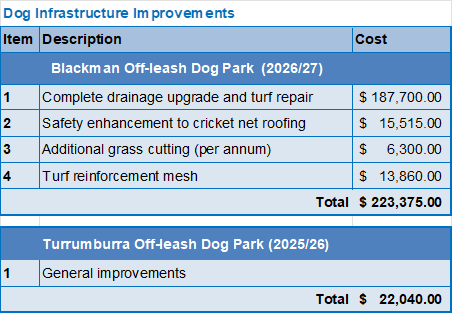
An opinion of cost has been developed to
assess the financial implications of improvements to both of the two off-leash
dog areas.
As shown above, the estimated cost of
installing sand slit drainage in the Blackman Park off-leash dog area is
$187,700 noting that the drained area is approximately 2,000m2. By
comparison Council recently installed sand slit drainage at Bob Campbell Oval
which has an area of over 7,000m2 for $220,000.
The total improvements for the Blackman
Park off-leash dog area, estimated at $223,375, are not included in existing
budgets, with additional funds to be requested for consideration in the 2026/27
budget.
Turrumburra Dog Park improvements of
$22,040 are able to be funded within the existing maintenance budget.
Governance
and Risk Considerations
Turf reinforcement mesh products have not
been installed elsewhere in the LGA, particularly in the setting with heavy dog
use. The potential safety risks are unknown at this stage, for instance; the
possibility of its metal pins being unearthed by dogs digging, and the plastic
material may damage dog claws or be incidentally consumed.
Environmental
Considerations
While some turf reinforcement mesh
products, such as high-density polyethylene (HDPE) are advertised as durable,
there are both immediate and long-term environmental implications. At the end
of its lifespan (which is not known for this setting), it will contribute to
landfill as it is not a recyclable material.
Link to Strategy
This report relates to the Community
Strategic Plan Outcome/s and Goal/s:
2. Our
Built Environment - A well designed, liveable and connected area
2.3 Assets,
Infrastructure & Public Domain
2.3.3 Investigate
opportunities to improve the public domain to enhance public lifestyle
Martin Terescenko
Director - Open Space and Infrastructure
Open Space and Infrastructure Division
ATTACHMENTS:
|
AT‑1 View
|
Site Inspection of Turrumburra Park - Report by Prensa
|
17 Pages
|
Available Electronically
|
Ordinary Council Meeting 19 February 2026
Tender for the Provision
of Tree Pruning and Removal and Stump Grinding Services
Item No: 16.2
Subject: Tender for the Provision of Tree Pruning and Removal and Stump
Grinding Services
Record No: SU10848 - 7115/26
Division: Open Space and
Infrastructure Division
Author(s): Ted
Webster
Purpose
To provide a report on the outcomes of a
tender for the provision of tree pruning, tree removal and stump grinding
services and to endorse a panel of Tree Service providers for a five-year
period.
Executive
Summary
· Council
invited tenders via VendorPanel to establish a contract for the provision of
tree pruning, tree removal, and stump grinding services across the Lane Cove
Local Government Area for a period of up to five (5) years, comprising an
initial three (3) year term with two (2) optional twelve‑month extensions
at Council’s discretion.
· This
report summarises the tender process and the outcomes of the evaluation and
recommends the appointment of a panel of suitably qualified service providers.
· The
evaluation identified several suppliers that demonstrated strong technical
capability, relevant experience in delivering arboricultural services within a
local government context, well‑developed safety and environmental
management systems, and competitive pricing.
· The
establishment of a panel arrangement will provide Council with operational
flexibility, resilience, and ongoing competitive tension at the work‑order
level, supporting value for money and continuity of service delivery over the contract
term.
· Approval
is sought to establish the panel and delegate authority to the General Manager
to execute the necessary contractual documentation and manage the ongoing
administration of the panel.
|
RECOMMENDATION
That Council:
1. approve
the establishment of a panel for the Provision of Tree Pruning and Removal
and Stump Grinding Services for a period of up to five (5) years –
[three (3) year initial term with two (2) optional twelve‑month
extensions at Council’s discretion].
2. appoint
the following suppliers to the panel, based on the outcomes of the tender
evaluation:
· TreeServe Pty
Ltd
· Summit
Open Space Services
· Shane’s
Trees NSW Pty Ltd
· Aura
Tree Services Pty Ltd
· Arbor
Co Tree Services Pty Ltd
· Sydney
Tree Company Pty Ltd
· Standfast Tree Services Pty Ltd
· Plateau
Tree Service Pty Limited
· Treelink
Pty Ltd
· Waratah Group
Services
3. delegate
authority to the General Manager to execute all necessary documentation to
give effect to this resolution.
|
Background
The Request for Tender (RFT)
(Contract No. OSI – 05/2025) was released on 15 September 2025 with a
closing date of 13 October 2025 at 5:00 pm. The tender was conducted in
accordance with the Local Government Act 1993 (NSW) and Council’s Procurement
Procedures and the tender specification covered arboricultural services
including tree pruning, tree removal and stump grinding on Council reserves and
public land.
Tenders were invited via
VendorPanel and respondents were required to complete Returnable Schedules and
provide supporting documentation as described in the RFT. Council reserved the
right to appoint one or more contractors to a panel.
The tender submissions were
evaluated against the following weighted criteria:
|
Criterion
|
Weighting
|
|
Price
|
30%
|
|
Capacity & Capability
|
20%
|
|
Service Delivery
|
20%
|
|
Experience
|
20%
|
|
Work Health & Safety
|
5%
|
|
Environment & Sustainability
|
5%
|
Criteria 1: Price (30%)
Based on the schedule
of rates provided in the mandatory schedules, the submissions were assessed
using a normalised average of the submitted hourly rates, with the
lowest-priced submission receiving the maximum score of 30 points.
This criterion is
automatically calculated and populated within the scoring tables.
Criteria 2: Capability and
Capacity (20%)
The Capability and Capacity Assessment evaluates the
tenderer’s ability to deliver the required services.
To achieve the maximum score, the tenderer must demonstrate
a high level of professional expertise supported by relevant qualifications,
sufficient resources to sustain operations, and sound financial management and
capacity. In addition, the tenderer must show the ability to operate
effectively within relevant policy frameworks and applicable legislation.
Criteria
3: Service Delivery (20%)
This criterion assesses
the quality of the proposed service delivery.
To achieve the maximum
score, the tenderer must demonstrate a proven track record and capability in
delivering high-quality services, supported by continuous improvement and
quality assurance programs. The tenderer should also identify value-adding
opportunities and clearly outline proposed methods of service delivery,
articulating a customer experience vision and values that align with those of
Council.
Criteria 4: Experience (20%)
This criterion assesses the demonstrated capability and
experience of the tenderer and its personnel, including management,
supervisors, and any third-party professionals to be engaged.
To achieve the maximum score, the tenderer must demonstrate
relevant experience within a local government context in the specific category
of law being tendered, provide details of appropriately qualified key personnel
with the necessary skills and expertise to deliver the required services under
the Contract, and show evidence of a strong reputation and a high success rate
within the relevant category of law.
Criteria
5: Work Health & Safety (5%)
This criterion assesses the tenderer’s commitment to
and compliance with the Work Health and Safety Act and associated legislation.
To achieve the maximum score, the tenderer must demonstrate
the existence and implementation of effective Work Health and Safety policies
and procedures, as well as evidence of adequate and current insurance coverage.
Criteria 6: Sustainability and
Environment (5%)
The Sustainability and Environment Assessment evaluates how
the tenderer considers and addresses environmental issues, including compliance
with environmental legislation and evidence of past performance in
environmental protection and enhancement initiatives.
To achieve the maximum
score, the tenderer must have provided positive responses to the questions
outlined in Council’s Environmental
Survey, as included in the tender specification, and supplied
supporting documentation where required.
Below is a list of the
13 tender submissions received by Council;
· Arbor Co Tree Services Pty Ltd
· Aura Tree Services Pty Ltd
· G McColl Tree Services Pty Ltd
· Plateau Tree Service Pty
· Shane's Trees NSW Pty Ltd
· Standfast Tree Services Pty Ltd
· Streemline Pty Ltd
· Summit Open Space Services
· Sydney Tree Company Pty Ltd
· The Trustee for 2Easy Tree Services Trust
· Treelink Pty Ltd
· TreeServe Pty Ltd
· Waratah Group Services
The tender evaluation panel consisted of
the following Council staff;
· Manager Open
Space
· Manager Facilities
· Principal Arborist
The Evaluation Panel independently reviewed
and scored all submissions. Scores were aggregated applying the above
weightings.
Discussion
A Confidential Memorandum has been circulated separately to
Councillors, inclusive of the Master Scores and summarised pricing for the
submissions.
Financial
Considerations
Funding to support this tender is included
in the existing Tree Contract Works budget.
Analysis
and Ranking
All conforming submissions were evaluated
against the published weighted evaluation criteria, being price, capacity and
capability, service delivery, experience, work health and safety, and
environmental sustainability.
The evaluation
demonstrated a clear differentiation in overall performance across submissions.
Several suppliers achieved high weighted scores reflecting strong technical
capability, demonstrated experience in complex arboricultural works, sound
resourcing, and well-developed systems for service delivery, WHS, and
environmental management.
Two submissions achieved the highest
overall weighted scores and were assessed as offering the strongest combination
of capability, experience, service quality, and value for money. A further
group of suppliers achieved competitive results and were assessed as meeting
Council’s requirements to a high standard, supporting their inclusion on
a preferred panel arrangement.
Submissions
receiving lower overall scores generally reflected one or more of the following
factors:
· Insufficient demonstrated capacity or experience to
meet the scale and complexity of Council’s operational requirements.
· Weaker responses in service delivery methodology,
quality assurance, or environmental management.
· Incomplete or less robust documentation in relation to
WHS systems or organisational capability.
Clarifications sought during
the evaluation process were assessed in accordance with Council’s
Tendering Procedure and did not materially alter the comparative standing of
submissions. Where clarifications addressed probity, insurance, or documentation
matters, the evaluation panel was satisfied that these concerns were
appropriately resolved prior to final scoring.
Based on the final weighted
scores and qualitative assessment, the evaluation panel identified a cohort of
suppliers that represent the strongest overall outcomes against the tender
criteria and are considered suitable for appointment to a panel for the delivery
of tree pruning, removal, and stump grinding services
Due
Diligence and referee checks
The Tender
Panel members completed 2 x referee checks for all 10 companies that are
recommended for inclusion in the panel. Summaries of these reference checks
have been included in the Confidential Memo to Councillors.
Any appointment will also
remain subject to verification of mandatory insurances, work health and safety
(WHS) systems, and, where applicable, responses to modern slavery and
fraud/corruption prevention requirements.
contracting
arrangements
The Lane Cove
Council Standard Conditions of Contract for Works and Services, together with
the Formal Instrument of Agreement, will apply. Task orders will be issued via
purchase orders under the panel. Rates will be based on the accepted Schedule
of Rates and will be subject to the indexation/escalation provisions set out in
the contract.
Governance
and Risk Considerations
Contractors on
the contract panel must maintain all required insurances, including Public
Liability, Workers’ Compensation, Motor Vehicle and Plant, and
Professional Indemnity, where applicable.
WHS AND
Environmental Considerations
Contractors on
the contract panel must comply with Council’s WHS management requirements
and implement environmental controls in accordance with Council’s
Environmental Survey responses. Non‑compliance
may result in suspension from the panel.
Social
Considerations
The recommendations in this report will
have positive social outcomes for the community through ongoing maintenance of
trees in public spaces.
conclusion
The tender for the Provision
of Tree Pruning and Removal and Stump Grinding Services attracted strong
interest from qualified industry participants, resulting in a competitive and
diverse range of submissions. The Tender Evaluation Panel conducted a thorough
assessment of all conforming tenders, considering price, demonstrated
capability, experience, work health and safety systems, and environmental
responsibility. Several suppliers demonstrated a high level of competence and
alignment with Council’s operational, regulatory, and service
requirements.
Submissions not recommended for
appointment were assessed as not demonstrating an equivalent level of
capability, capacity, or overall value compared with higher-performing tenders.
Establishing a panel of suitably
qualified service providers will give Council flexibility, resilience, and
competitive tension at the work order level, while ensuring reliable, safe, and
high-quality service delivery across the Lane Cove Local Government Area and
providing continuity and value for money over the contract term.
Link to Strategy
This report relates to the Community
Strategic Plan Outcome/s and Goal/s:
1. Our
Natural Environment - Preserving and Regenerating our Natural Environment so it
thrives now and into the future
1.2 Urban
Forest
1.2.1 Maintain
and enhance the overall urban forest and canopy cover on public and private
land throughout the LGA
Martin Terescenko
Director - Open Space and Infrastructure
Open Space and Infrastructure Division
ATTACHMENTS:
There are no supporting documents for this report.
Ordinary Council Meeting 19 February 2026
Tender for St Vincents
Road new Shared User Path Construction and Road Upgrade
Item No: 16.3
Subject: Tender for St Vincents Road new Shared User Path Construction and
Road Upgrade
Record No: SU10916
- 6412/26
Division: Open Space and
Infrastructure Division
Author(s): Santosh
Rai
Purpose
The purpose of this report is to provide
the outcome of the tender for a suitable contractor to undertake the
construction of Shared User Paths and associated infrastructure works along St
Vincents Road between Gore Street and Bob Campbell Oval and to appoint the
preferred supplier.
Executive Summary
· Council
invited tenders through VendorPanel to select and engage a suitably qualified
contractor to undertake the construction of Shared User Path (SUP) and
associated infrastructure works along St Vincents Road between Gore Street and
Bob Campbell Oval.
· The
scope of works includes the construction of a new SUP, road upgrades with
on-street marked parking, stormwater infrastructure improvements, and
associated minor civil works.
· This
report summarises the tender process and the outcome of the evaluation and
recommends the appointment of a suitably qualified contractor to deliver the
works in accordance with the tender documentation.
· Submissions were
assessed through a comprehensive evaluation process to ensure compliance with
tender requirements and achievement of best value for money.
· Following
evaluation, a suitably qualified contractor is recommended to deliver the
construction works in accordance with the detailed design and all relevant documentation.
|
RECOMMENDATION
That Council:
1. acknowledges the Tender Evaluation Panel’s
recommendation and accepts the tender from Solutions Plus Built Pty Ltd for
the construction of the Shared-User Path (SUP) and associated works at St
Vincents Road, between Gore Street and Bob Campbell Oval.
2. delegates authority to the General Manager to execute all
necessary documentation to formalise acceptance of the tender.
|
Background
The recently upgraded Bob Campbell Oval is a popular
community space, hosting soccer in winter, junior cricket in summer, informal
recreation, and serving as an off-leash dog area, supporting local engagement.
Request for Tender (RFT) (Contract No. OSI
– 04/2025) was released on 23 September 2025 with a closing date of 26 November
2025 at 5:00 pm. The tender was conducted in accordance with the Local
Government Act 1993 (NSW) and Council’s Procurement Procedures.
The scope of works covers the construction
of a new SUP, road upgrades with on-street marked parking, stormwater
infrastructure improvements, and associated minor civil works, in accordance
with the detailed design and all relevant standards.
Tenders were invited via VendorPanel and respondents
were required to complete Returnable Schedules and provide supporting
documentation as described in the RFT.
To ensure a
comprehensive assessment of market capability and value for money, tenderers
were required to submit detailed information regarding qualifications, pricing,
experience, capacity, and compliance documentation. The scope covered
the supply, delivery, and installation of all works specified in the tender
documentation. Council intends to engage a suitably qualified
contractor with proven experience to carry out the following works along St
Vincents Road, between Gore Street and Bob Campbell Oval:
· Construction
of a new Shared User Path (SUP)
· Road
upgrades to support the SUP and on-street marked parking
· Stormwater
infrastructure upgrades, including new pipes and pits
· All
associated minor civil works including line marking and signage.
Submissions were evaluated against the
following weighted criteria:
|
|
Criterion
|
Weighting
|
|
Criteria 1
|
Pricing
|
25%
|
|
Criteria 2
|
Capacity and Capability
|
25%
|
|
Criteria 3
|
Experience
|
25%
|
|
Criteria 4
|
Work Health & Safety
|
5%
|
|
Criteria 5
|
Environment & Sustainability
|
5%
|
|
Criteria 6
|
Service Delivery
|
10%
|
Criteria 1: Pricing
(25%)
Assessment
included:
· Evaluation of the tendered Schedule of Rates submitted in the
mandatory pricing schedules.
· Competitiveness of pricing and overall value for money.
The
lowest-priced conforming tender received the maximum score, with all other
conforming submissions scored proportionately.
Criteria 2: Capability
and Capacity (25%)
Assessment
included:
· Organisational structure and management capability appropriate to
the delivery of the works.
· Proven track record and/or demonstrated ability to successfully
deliver comparable works and services.
· Demonstrated capacity to deliver multiple minor civil works
concurrently within required timeframes.
· Availability of relevant technical expertise, including suitably
skilled personnel, plant, equipment, resources, and sound financial management
capability.
· An acceptable and clearly defined methodology for service delivery,
supported by effective management systems.
· Evidence of continuous improvement practices, including quality
assurance systems and performance improvement initiatives.
Criteria 3: Experience
(25%)
Assessment
included:
· Demonstrated relevant experience of key personnel, including skills,
qualifications, and competencies required to fulfil the contractor’s
obligations under the Contract.
· A clearly defined organisational structure outlining roles,
responsibilities, and reporting lines.
· Demonstrated experience delivering contracts of a similar nature for
other NSW councils.
· Evidence of operational capability to deliver the works and
services, supported by an identifiable management framework.
· Demonstrated experience in managing and engaging subcontractors,
where applicable.
· Satisfactory referee responses confirming past performance,
reliability, and capability.
Criteria 4: Work
Health & Safety (5%)
Assessment
included:
· WHS management systems and policies.
· Compliance with Occupational Health & Safety Act 2000 and
Occupational Health & Safety Regulation 2001.
· Incident reporting, training, and continuous improvement processes.
Criteria 5:
Environment & Sustainability (5%)
Assessment
included:
· Environmental management practices, including compliance with
relevant environmental legislation and standards.
· Waste minimisation and recycling initiatives implemented as part of
service delivery.
· Use of sustainable materials, methods, and energy-efficient
practices to reduce environmental impact.
· Demonstrated commitment to due diligence and the principles of
Ecologically Sustainable Development (ESD), supported by environmental
legislation compliance and documentation of past performance in environmental
protection and enhancement initiatives.
Criteria 6:
Service Delivery (10%)
Assessment
included:
· Past record and/or demonstrated ability to provide services
effectively.
· Continuous improvement and value-add opportunities.
· Proposed methods of service delivery.
· Customer experience vision and values, including demonstrated
commitment to customer service.
· Satisfactory referee responses confirming past performance,
reliability, and capability.
Below is the list of the 18 tender
submissions received by Council:
|
Tenderers (In Alphabetical Order)
|
|
Ally Infrastructure Pty. Ltd.
|
|
Anr Engineering Pty. Ltd.
|
|
Burton Civil Maintenance Pty.
Ltd.
|
|
Byrne Civil Engineering Constructions Pty. Ltd.
|
|
Civil Cast Pty. Ltd.
|
|
Convil Group Pty. Ltd.
|
|
Dig Deep Excavations (NSW)
Pty. Ltd.
|
|
Ezy Pave Pty. Ltd.
|
|
Green Civil Services Pty.
Ltd.
|
|
Kane Civil Engineering Pty.
Ltd.
|
|
Kingsline Pty. Ltd.
|
|
Knights Civil Pty. Ltd.
|
|
Mabna Pty. Ltd.
|
|
Northshore Paving Co. Pty. Ltd.
|
|
Resco Civil Pty. Ltd.
|
|
Solutions Plus Built Pty. Ltd.
|
|
State Civil Pty. Ltd.
|
|
Statewide Landscape and Civil
Pty. Ltd.
|
The tender
evaluation panel consisted of the following Council
staff:
· Manager Assets - Coordinator
· Projects Engineer – Panel member
· Facilities and Projects Officer – Panel member
The Evaluation
Panel independently assessed and scored all submissions, and the final scores
were calculated by combining those results according to the specified
weightings.
Discussion
A Confidential Memorandum has been circulated separately to
Councillors, inclusive of the Master Scores and summarised pricing for the
submissions.
financial Considerations
This project
will be funded from the approved Operational Asset Infrastructure budget. The Bill
Of Quantity (BOQ) provided by the contractor in their tender submissions will
be applied for pricing purposes.
analysis and ranking
All conforming submissions were
evaluated against the published weighted evaluation criteria, which included
price, capacity and capability, experience, work health and safety,
environmental and sustainability performance, and service delivery.
The evaluation demonstrated
clear differentiation in overall performance across submissions. Several
suppliers achieved high weighted scores, reflecting strong technical
capability, demonstrated experience across a range of minor civil works and
similar projects, robust resourcing, and well-developed systems for service
delivery, work health and safety, and environmental management.
Based on the final weighted
scores and qualitative assessment, the evaluation panel identified Solutions
Plus Built Pty Ltd as representing the strongest overall outcomes against the
tender criteria. They are considered suitable for appointment to deliver the
tender project works.
Due Diligence and referee checks
Although Lane Cove Council has
recently engaged Solutions Plus Built Pty Ltd on several projects, and their
performance has been satisfactory, two external referee checks were conducted
to ensure consistency and confirm ongoing suitability.
The checks assessed reliability,
quality of work, timeliness, communication, and adherence to safety and
regulatory requirements. Both referees provided highly positive feedback,
highlighting the contractor’s quality of work, adherence to timelines,
and effective communication. This thorough reference process provides strong
assurance that Solutions Plus Built Pty Ltd is well-equipped to meet the
Council’s standards.
Any appointment will remain
subject to verification of mandatory insurances, work health and safety (WHS)
systems, and, where applicable, responses to modern slavery and
fraud/corruption prevention requirements.
contracting arrangements
The Lane Cove
Council Standard Conditions of Contract for Works and Services, together with
the Formal Instrument of Agreement, will apply. Task orders will be issued via
purchase orders under the allocated budget. Rates will be based on the accepted
Bill Of Quantity and will be subject to the indexation/escalation provisions
set out in the contract.
Governance and Risk Considerations,
The contractor must
maintain all required insurances, including Public Liability, Workers’
Compensation, Motor Vehicle and Plant, and Professional Indemnity, where
applicable.
WHs and Environmental Considerations
The successful
contractor must comply with Council’s WHS management requirements and
implement environmental controls in accordance with Council’s
Environmental Survey responses. Non-compliance may result in the contract being
terminated at any time during the progress of the project.
Social Considerations
The construction of the SUP linking Bob Campbell Oval to St Leonards
via River Road is expected to deliver significant social benefits to the local
community. The project will improve the safety and accessibility of all users,
particularly cyclists and pedestrians, by providing a dedicated, well-designed
pathway separated from vehicular traffic.
conclusion
The
tender for the St Vincents Road New SUP Construction and Road Upgrades
attracted strong interest from qualified industry participants, resulting in a
competitive and diverse range of submissions. The Tender Evaluation Panel
conducted a thorough assessment of all conforming tenders, considering price,
demonstrated capability, experience, work health and safety systems,
environmental responsibility, and service delivery methodology.
The
evaluation identified several suppliers demonstrating high competence and
alignment with Council’s operational, regulatory, and service
requirements. The Panel recommends that Council accept the tender from
Solutions Plus Built Pty Ltd for the construction of the project, in accordance
with the tender specifications.
Link to Strategy
This report relates to the Community
Strategic Plan Outcome/s and Goal/s:
2. Our
Built Environment - A well designed, liveable and connected area
2.3 Assets,
Infrastructure & Public Domain
2.4 Transport
& Mobility
2.3.5 Identify
innovative funding and partnerships to provide for new and upgraded assets and infrastructure
2.4.2 Implement
infrastructure upgrades for people to incorporate more walking and cycling into
their daily lives
Martin Terescenko
Director - Open Space and Infrastructure
Open Space and Infrastructure Division
ATTACHMENTS:
There are no supporting documents for this report.
Ordinary Council Meeting 19 February 2026
Tender for Provision of
Minor Civil Works and Associated Services
Item No: 16.4
Subject: Tender for Provision of Minor Civil Works and Associated
Services
Record No: SU10702
- 6649/26
Division: Open Space and
Infrastructure Division
Author(s): Santosh
Rai
Purpose
To report on the
outcome of a tender for the provision of Minor Civil Works and Associated
Services and to appoint and create a panel of Civil Works contractors for a
period of up to 5 years.
Executive Summary
· Council invited tenders
via VendorPanel to establish a panel of contractors for the provision of Minor
Civil Works and Associated Services for a period of up to 5 years, being an
initial three year term with two x optional 12 month extensions at
Council’s discretion.
· A total
of 40 submissions were received from suitably qualified and experienced
contractors.
· This report summarises
the tender process and the outcomes of the tender evaluation and recommends the
appointment of a contract panel of suitably qualified service providers
· Submissions
were assessed through a comprehensive evaluation process to ensure best value
for money and compliance with tender requirements.
· Following
evaluation, a panel of preferred service providers is recommended for
appointment to deliver the specified services in accordance with the tender
documentation.
· The establishment of a
panel arrangement will provide Council with operational flexibility,
resilience, and ongoing competitive tension at the work‑order level, supporting
value for money and continuity of service delivery over the contract term.
· Minor Civil Works and
Associated Services – eight suppliers are recommended for appointment to
a contract panel to deliver Minor Civil Works and Associated Services,
including line marking.
· Line Marking Services
Only – two suppliers are recommended for appointment to a contract panel
to deliver line marking services.
RECOMMENDATION
That Council:
1. accepts the tenders
from:
· Australia Pave Pty Ltd
· Civotek Pty Ltd
· Ezy Pave Pty Ltd
· Get Civil Pty Ltd
· J & M Schembri Pty Ltd
· NSW Building & Civil Pty Ltd
· Resco Civil Pty Ltd
· Stateline Asphalt Pty Ltd.
and appoint
them to its panel of contractors for minor civil works and associated services
for a period of up to five (5) years, being three (3)
years plus two (2) x 12 month extensions.
2. accepts the tenders from Iplezing Solutions Pty Ltd and Western
Sydney Line Marking and appoint them to its panel of contractors for line
marking services for a period up to five (5) years, being three (3) years plus
two (2) x 12 month extensions.
3. delegate authority to the General Manager to execute all necessary
documentation to give effect to this resolution.
Background
Lane Cove Council manages and maintains a wide range of
public infrastructure within its LGA and engages contractors to deliver new
projects and maintain existing assets.
Request for Tender (RFT) (Contract No. OSI
– 03/2025) was released on 17 September 2025 with a closing date of 04
October 2025 at 5:00 pm. The tender was conducted in accordance with the Local
Government Act 1993 (NSW) and Council’s Procurement Procedures. The scope
of the tender was for minor civil works and associated services on Council
reserves and public land.
Tenders were invited via VendorPanel and respondents
were required to complete Returnable Schedules and provide supporting
documentation as described in the RFT. Council reserved the right to appoint
one or more contractors to a panel.
To ensure a
comprehensive assessment of market capability and value for money, tenderers
were required to submit detailed information regarding qualifications, pricing,
experience, capacity, and compliance documentation. The scope of the tender
included the supply, delivery, and installation of minor civil works and
associated services, including line marking. Services covered in the tender are
outlined below.
· Service
A – Minor Civil Works and Associated Services; Kerbs, gutters, footpaths,
vehicular crossings, asphalt surfacing, median islands, retaining walls, large
format and brick/block paving, drainage pits and pipes, excavation, plant hire,
traffic management, and line marking.
· Service
B – Line Marking Services Only.
Submissions were
evaluated against the following weighted criteria:
|
|
Criterion
|
Weighting
|
|
Criteria 1
|
Pricing
|
30%
|
|
Criteria 2
|
Capacity and
Capability
|
30%
|
|
Criteria 3
|
Experience
|
30%
|
|
Criteria 4
|
Work Health
& Safety
|
5%
|
|
Criteria 5
|
Sustainability
and Environment
|
5%
|
Criteria 1: Pricing
(30%)
Assessment
included:
· Evaluation of the tendered Schedule of Rates submitted in the
mandatory pricing schedules.
· Competitiveness of pricing and overall value for money.
The
lowest-priced conforming tender received the maximum score, with all other
conforming submissions scored proportionately.
Criteria 2: Capability
and Capacity (30%)
Assessment
included:
· Organisational structure and management capability appropriate to
the delivery of the works.
· Proven track record and/or demonstrated ability to successfully
deliver comparable works and services.
· Demonstrated capacity to deliver multiple minor civil works
concurrently within required timeframes.
· Availability of relevant technical expertise, including suitably
skilled personnel, plant, equipment, resources, and sound financial management
capability.
· An acceptable and clearly defined methodology for service delivery,
supported by effective management systems.
· Evidence of continuous improvement practices, including quality
assurance systems and performance improvement initiatives.
Criteria 3: Experience
(30%)
Assessment
included:
· Demonstrated relevant experience of key personnel, including skills,
qualifications, and competencies required to fulfil the contractor’s
obligations under the Contract.
· A clearly defined organisational structure outlining roles,
responsibilities, and reporting lines.
· Demonstrated experience delivering contracts of a similar nature for
other NSW councils.
· Evidence of operational capability to deliver the works and
services, supported by an identifiable management framework.
· Demonstrated experience in managing and engaging subcontractors,
where applicable.
· Satisfactory referee responses confirming past performance,
reliability, and capability.
Criteria 4: Work
Health & Safety (5%)
Assessment
included:
· WHS management systems and policies.
· Compliance with Occupational Health & Safety Act 2000 and Occupational
Health & Safety Regulation 2001.
· Incident reporting, training, and continuous improvement processes.
Criteria 5: Environment
& Sustainability (5%)
Assessment
included:
· Environmental management practices, including compliance with relevant
environmental legislation and standards.
· Waste minimisation and recycling initiatives implemented as part of
service delivery.
· Use of sustainable materials, methods, and energy-efficient
practices to reduce environmental impact.
· Demonstrated commitment to due diligence and the principles of
Ecologically Sustainable Development (ESD), supported by environmental
legislation compliance and documentation of past performance in environmental
protection and enhancement initiatives.
Below is the list of the 40 tender
submissions received by Council:
|
Tenderers (In Alphabetical Order)
|
|
Ally Infrastructure Pty. Ltd.
|
Landscape Productions Pty. Ltd.
|
|
Anr Engineering Pty. Ltd.
|
Mack Civil & Communications Pty. Ltd.
|
|
Australia Pave Pty Ltd
|
Mansour Paving (Aust.) Pty. Ltd.
|
|
C. W. Concrete Pty. Ltd.
|
MSA Civil & Communications Pty. Ltd.
|
|
Civeco Pty. Ltd.
|
North Shore Paving Co. Pty. Ltd.
|
|
Civil Domain
|
NSW Building & Civil Pty. Ltd.
|
|
Civil Tech Services Pty. Ltd.
|
NSW Kerbing Pty. Ltd.
|
|
Civotek Pty. Ltd.
|
Pave-Link Pty. Ltd.
|
|
Convil Group Pty. Ltd.
|
QMC Group
|
|
Demand Plumbing & Excavation Pty. Ltd.
|
Raygal Pty. Ltd.
|
|
Ebcon Pty. Ltd.
|
Resco Civil Pty. Ltd.
|
|
Ezy Pave Pty. Ltd.
|
RMA Group
|
|
Get Civil Pty. Ltd.
|
Sam The Paving Man Pty. Ltd.
|
|
Highland Civil (Aust.) Pty. Ltd.
|
SC Comms. & Utilities
|
|
HPG Solutions Pty. Ltd.
|
State Cvil Pty. Ltd.
|
|
IPC Projects Pty. Ltd.
|
Stateline Asphalt Pty. Ltd.
|
|
Iplezing Solutions Pty. Ltd.
|
Victory Civil Pty. Ltd.
|
|
J & M Schembri Pty. Ltd.
|
Western Sydney Line Marking
|
|
KK Civil Engineering
|
Whittaker Civil Infrastructure
|
|
Knights Civil Pty. Ltd.
|
Will Training Pty. Ltd.
|
The tender evaluation panel consisted of the following Council staff:
· Manager
Assets – Coordinator
· Projects
Engineer – Panel member
· Manager
Facilities – Panel member
The Evaluation Panel independently assessed
and scored all submissions, and the final scores were calculated by combining
those results according to the specified weightings.
Discussion
A Confidential
Memorandum has been circulated separately to Councillors, inclusive of the
Master Scores and summarised pricing for the submissions.
Financial Considerations
All projects under the Minor Civil Works
and Associated Services contract will be funded from the approved Operational
Asset Infrastructure budgets. The Schedule of Rates provided by suppliers in
their tender submissions will be applied for pricing purposes.
analysis and ranking
All conforming submissions were
evaluated against the published weighted evaluation criteria, comprising price,
capacity and capability, experience, work health and safety, and environmental
sustainability.
The evaluation demonstrated
clear differentiation in overall performance across submissions. Several
suppliers achieved high weighted scores, reflecting strong technical
capability, demonstrated experience across a range of minor civil works, sound
resourcing, and well-developed systems for service delivery, work health and
safety, and environmental management.
Based on the final weighted
scores and qualitative assessment, the evaluation panel identified a group of preferred suppliers that represent the strongest
overall outcomes against the tender criteria and are considered suitable for
appointment to a panel for the delivery of civil minor works and associated
services.
Due Diligence and referee checks
Although seven of the ten
recommended suppliers are already familiar to Lane Cove Council through
previous engagements with the Council’s contract panel or the Local
Government Procurement panel, referee checks were conducted for all ten to
ensure consistency and confirm ongoing suitability.
These checks evaluated reliability, quality of work,
timeliness, communication, and adherence to safety and regulatory requirements.
Feedback from all twenty referees (two per supplier) was uniformly positive.
Several referees specifically highlighted the professionalism, technical
expertise, and responsiveness of certain suppliers, noting that their work
consistently met or exceeded expectations. All suppliers met or exceeded
expectations, with the seven previously engaged suppliers maintaining proven
performance and the three newer suppliers demonstrating full capability to
deliver the proposed works. This thorough reference process provides strong
assurance that the recommended suppliers are well-equipped to meet the
Council’s standards.
Any appointment will remain subject to verification of
mandatory insurances, work health and safety (WHS) systems, and, where
applicable, responses to modern slavery and fraud/corruption prevention
requirements.
contracting arrangements
The Lane Cove
Council Standard Conditions of Contract for Works and Services, together with
the Formal Instrument of Agreement, will apply. Task orders will be issued via
purchase orders under the panel. Rates will be based on the accepted Schedule
of Rates and will be subject to the indexation/escalation provisions set out in
the contract.
Governance
and Risk Considerations,
Contractors on the contract panel must
maintain all required insurances, including Public Liability, Workers’
Compensation, Motor Vehicle and Plant, and Professional Indemnity, where
applicable.
WHs and
Environmental Considerations
Contractors on the contract panel must
comply with Council’s WHS management requirements and implement
environmental controls in accordance with Council’s Environmental Survey
responses. Non‑compliance may result in
suspension from the panel.
Social
Considerations
Minor Civil Works and Associated Services include all minor
civil infrastructure upgrades within Council’s Local Government Area
(LGA) as part of Council’s infrastructure maintenance and improvement
program, supporting residents in their daily activities.
conclusion
The tender for the
Contract for Minor Civil Works and Associated Services attracted strong
interest from qualified industry participants, resulting in a competitive and
diverse range of submissions. The Tender Evaluation Panel conducted a thorough
assessment of all conforming tenders, considering price, demonstrated
capability, experience, work health and safety systems, and environmental
responsibility. Several suppliers demonstrated a high level of competence and
alignment with Council’s operational, regulatory, and service
requirements.
Submissions not recommended for
appointment were assessed as not demonstrating an equivalent level of
capability, capacity, or overall value compared with higher-performing tenders.
Establishing a panel of suitably
qualified service providers will give Council flexibility, resilience, and
competitive tension at the work order level, while ensuring reliable, safe, and
high-quality service delivery across the Lane Cove Local Government Area and
providing continuity and value for money over the contract term.
Link to Strategy
This report relates to the Community
Strategic Plan Outcome/s and Goal/s:
2. Our
Built Environment - A well designed, liveable and connected area
2.3 Assets,
Infrastructure & Public Domain
2.4 Transport
& Mobility
2.3.5 Identify
innovative funding and partnerships to provide for new and upgraded assets and
infrastructure
2.4.2 Implement
infrastructure upgrades for people to incorporate more walking and cycling into
their daily lives
Martin Terescenko
Director - Open Space and Infrastructure
Open Space and Infrastructure Division
ATTACHMENTS:
There are no supporting documents for this report.
Ordinary Council Meeting 19 February 2026
Legal Services Panel -
Notice of Change of Wilshire Webb Staution Beattie Practice
Item No: 18.1
Subject: Legal Services Panel - Notice of Change of Wilshire Webb Staution
Beattie Practice
Record No: SU10671 - 7155/26
Division: Corporate Services
and Strategy Division
Author(s): Stephen
Golding
PURPOSE
To advise Council of a change of ownership
of one of Council’s recently appointed Legal Services Panel
Members. Wilshire Webb Staunton Beattie Practice,
who will be acquired by Finn Roache Lawyers, with the date of change in
ownership anticipated to take effect on 27 February 2026.
EXECUTIVE SUMMARY
· Council
recently received written correspondence advising that Wilshire
Webb Staunton Beattie Practice, will be acquired by Finn Roache Lawyers.
· The
change of ownership is to take effect from 27 February 2026.
RECOMMENDATION
That the report be received and noted.
Background
Council resolved at the 20 November 2025 Ordinary Council Meeting,
Resolution 265/25, that Council ‘accepts the tenders from Wilshire
Webb Staunton Beattie……. and resolves to appoint them to its Legal
Services Panel for Categories 1, 2 and 3 for a period of up to five (5) years,
being three (3) years plus two (2) x 12 month extensions, exercisable at
Council’s discretion”
Discussion.
Council has received written correspondence from Wilshire Webb
Staunton Beattie Practice announcing that they will be acquired by Finn Roache
Lawyers, with the date of change in ownership anticipated to take effect on 27
February 2026.
Wilshire Webb Staunton Beattie Lawyers advised that this transition
will not affect their relationship with Council and the ongoing delivery of
their legal services to Council.
The provision of their legal services will not change, and the
current relationship manager will remain and will continue in their capacity as
Senior Consultant within the Finn Roache team.
Council will undertake its own due diligence to ensure that the
level of experience and quality of service under which the contract was awarded
is able to be provided.
Conclusion
The Council note the change in ownership of
this Legal Services Panel member.
Steven Kludass
Director - Corporate Services and Strategy
Corporate Services and Strategy Division
ATTACHMENTS:
There are no supporting documents for this report.
Ordinary Council Meeting 19 February 2026
Council Snapshot
December 2025 and January 2026
Item No: 18.2
Subject: Council Snapshot December 2025 and January 2026
Record No: SU220 - 8529/26
Division: Office of the
General Manager
Author(s): Corinne
Hitchenson
PURPOSE
This report
provides the monthly Snapshot report and current Resolution tracker.
Executive Summary
Attached for the information of Councillors
is a review of Council’s recent activities.
As there was no Council meeting in January
this Snapshot report provides a summary of the operations of each Division
within Council for both December 2025 and January 2026 at AT-2.
Council’s Resolution Tracker showing
the progress of Council’s resolutions is included at AT-1.
RECOMMENDATION
That Council receives and notes:
1. Council Snapshot December 2025 and January 2026.
2. Resolution Tracker for 19 February 2026 Council meeting.
Background
On a monthly basis, Council staff compile a
snapshot for Councillors outlining recent Council activities.
In addition, staff review and update the
Council Resolution Tracker [AT-1], which identifies outstanding actions and
notes those recently completed in response to Council resolutions.
Discussion
As there was no Council meeting in January
this Snapshot report provides a summary of the operations of each Division
within Council for December 2025 as well as January 2026 [AT-2].
Conclusion
The monthly Council Snapshot and Resolution
Tracker are provided for the information of the February 2026 Council meeting.
Louise Kerr
General Manager
Office of the General Manager
ATTACHMENTS:
|
AT‑1 View
|
Council snapshot - December 2025 and January 2026
|
48 Pages
|
Available Electronically
|
|
AT‑2 View
|
Resolution Tracker for 19 February 2026 Council meeting
|
46 Pages
|
Available Electronically
|