

Agenda
Ordinary Council Meeting
18 June 2026, 7:00 PM
Council will commence consideration of
all business paper agenda items at 7.00
pm.
Notice
of Meeting
Dear Councillors,
Notice is
given of the Ordinary Council Meeting, to be held in
the Council Chambers on Thursday 18
June 2026 commencing at 7:00 PM. The business to
be transacted at the meeting is included in this business paper.
In accordance with clause 3.26 of the Code of Meeting Practice
Councillors are reminded of their oath or affirmation of office made under
section 233A of the Act, and of their obligations under the Council’s
Code of Conduct to disclose and appropriately manage conflicts of interest.
Yours faithfully
Louise Kerr
General Manager
Council
Meeting Procedures
The Council meeting is chaired by
the Mayor, Councillor Merri Southwood. Councillors are entitled to one vote on
a matter. If votes are equal, the Chairperson has a second or casting vote.
When a majority of Councillors vote in favour of a Motion it becomes a decision
of the Council. Minutes of Council and Committee meetings are published on
Council’s website www.lanecove.nsw.gov.au by 5.00 pm on the Tuesday following
the meeting.
The
Meeting is conducted in accordance with Council's Code of Meeting Practice. The
order of business is listed in the Agenda on the next page. That order will be
followed unless Council resolves to modify the order at the meeting. This may
occur for example where the members of the public in attendance are interested
in specific items on the agenda.
The Public Forum Meetings are no
longer part of Ordinary Council Meetings and are now held separately.
Public Forum Meetings are held on
the Monday prior to the Ordinary Council Meeting. Register by using the online
form no later than 10.00 am on the day of the Public Forum Meeting.
Please refer to the Public Forum Meeting Guidelines on Council’s
website for further information
www.lanecove.nsw.gov.au/meetings
Alternatively,
members of the public can submit their written address via email to service@lanecove.nsw.gov.au. Written addresses are to be received by Council no later
than midnight, on the day prior to the meeting. (500 words maximum).
Please note that meetings held in
the Council Chambers are webcast, and recordings are made publicly available on
the Council's website. Should you require assistance to participate in the
meeting due to a disability; or wish to obtain further information in relation
to Council, please contact Council’s Director - Corporate Services and
Strategy on (02) 9911 3550.
Ordinary Council 18 June 2026
TABLE OF
CONTENTS
1 DECLARATIONS
OF INTEREST
2 APOLOGIES
AND APPLICATIONS FOR LEAVE OF ABSENCE OR ATTENDANCE BY AUDIO-VISUAL LINK BY
COUNCILLORS
3 ACKNOWLEDGEMENT
TO COUNTRY
4 MINUTE
OF SILENCE FOR RELECTION OR PRAYER
5 NOTICE
OF WEBCASTING OF MEETING
6 CONFIRMATION OF MINUTES
6.1 Ordinary Council Meeting - 21 May 2026
7 Mayoral
Minutes
7.1...... Mayoral
Minute - 2026 King's Birthday Honours List.................... 6
8 Petitions
8.1...... Petition:
Funding Drag Queen Events in Lane Cove...................... 8
9 Recission
Motion
Nil
10 ITEMS OF BUSINESS BY EXCEPTION
11 Notices
of Motion
11.1.... Notice
of Motion - Maintenance of vacant development sites to manage sediment run-off
and to address visual amenity of precincts adjacent to vacant development sites.................... 11
11.2.... Notice
of Motion - Data Centre Compliance and Regulation 14
11.3.... Notice
of Motion - Review of Advisory Committees.................... 17
11.4.... Notice
of Motion - E-Bike Safety and Community Education... 20
11.5.... Notice
of Motion - Future Funding of Businesses Hosting Drag Queen Events................................................................................................ 23
12 Office
of the General Manager Reports
12.1.... Response
to Notice of Motion - Urgent Change of Building Manager - Lane Cove Market
Square................................................ 25
13 Corporate
Services and Strategy Division Reports
13.1.... Post
Exhibition - Draft Delivery Program & 2026/27 Operational Plan, including
2026/27 Budget, Fees and Charges, Resourcing Strategy and associated Resource
Plans.................................... 32
13.2.... Public
Exhibition - Draft Community Engagement Strategy, Draft Community Engagement
Policy, and Draft Digital Engagement Strategy.............................................................................. 39
13.3.... Implications
of the Disallowance of the Local Government (General) Amendment (Model Code of
Meeting Practice) Regulation 2025........................................................................................... 44
13.4.... Post
Exhibition - Draft Restricted (Cash) Reserves Policy and Draft Infrastructure
Asset Management Policy...................... 50
14 Community
and Culture Division Reports
14.1.... Post
Exhibition - Rotary Peace Poles Project............................. 53
14.2.... Draft
Submisssion - NSW Strategic Plan For Children 2027 - 2030............................................................................................................................. 58
14.3.... Tender
Outcome - Lane Cove Aquatic Centre Electrification Upgrade........................................................................................................... 61
15 Planning
and Sustainability Division Reports
15.1.... Draft
Submission - Low-rise housing reforms and targeted assessment.................................................................................................... 66
15.2.... Draft
Submission - Variations and Changes to Complying Development................................................................................................. 72
15.3.... Draft
Submisison - Federal Parliamentary Inquiry into Artificial Intelligence and
Data Centres...................................... 78
16 Open
Space and infrastructure Division Reports
16.1.... Response
to Notice of Motions - Habitat log salvage program and Enhancing urban
biodiversity through scalable habitat initiatives........................................................................................................ 81
16.2.... Local
Transport Forum - May 2026..................................................... 87
17 Questions With
Notice
Nil
18 Officer
Reports for Information
18.1.... Community
Safety Precinct Committee - North Shore Police Area Command.............................................................................................. 91
18.2.... Council
Snapshot May 2026.................................................................... 95
19 cLOSED
COMMITTEE
Nil
Ordinary Council Meeting 18 June 2026
Mayoral Minute - 2026
King's Birthday Honours List
Item No: 7.1
Subject: Mayoral
Minute - 2026 King's Birthday Honours List
Record No: SU18 - 42714/26
Division: Lane
Cove Council
Author(s): Councillor
Merri Southwood
Purpose
The purpose of this Mayoral Minute is to
recognise Lane Cove residents who were included in the recent 2026 Kings
Birthday Honour List.
Executive
Summary
· Local
residents Professor William Rawlinson AC, Roderick
Cooke OAM and John Devine OAM
were recognised in the recent King’s Birthday
Honour List.
· It is recommended that Council formally acknowledge and congratulate
them.
|
RECOMMENDATION
That Council:
1) acknowledge Lane Cove residents Professor
William Rawlinson – AC; Rod Cooke OAM and John Devine OAM as recipients of 2026
King’s Birthday Honours.
2) write to congratulate each of the
three abovementioned recipients on this recognition and thank them for their
contribution to our community and beyond.
|
Discussion
The 2026 King’s Birthday Honours List
included the recognition of the following local residents:
· Professor
William David Rawlinson AM has been appointed as a Companion of the Order of
Australia (AC) for eminent service to the medical sciences as a virologist, to
clinical research and education, and to national and international public
health.
· Roderick Cooke has received a Medal of the Order of Australia (OAM)
for service to the community through a range of organisations including but not
limited to the Australian Defence Force, Board Governance, Ex-Service
Organisations and Sydney Community Services.
· John Devine has also received a Medal of the Order of Australia
(OAM) for service to the community of Lane Cove, including longstanding
involvement with Sydney Community Services (formerly Lane Cove Community Aid).
I congratulate Professor Rawlinson, Mr
Cooke and Mr Devine on their impressive contributions across a wide range of
important causes which are of value not just to our community but to
individuals and families beyond Lane Cove.
Councillor Merri Southwood
Councillor
ATTACHMENTS:
There are no supporting documents for this report.
Ordinary Council Meeting 18 June 2026
Petition: Funding Drag
Queen Events in Lane Cove
Item No: 8.1
Subject: Petition:
Funding Drag Queen Events in Lane Cove
Record No: SU10074 - 42626/26
Division: Community
and Culture Division
Author(s): Stephanie
Kelly
Purpose
The purpose of this report is to present
a petition received by Council regarding funding for Pride-related drag
performances, and to provide Councillors with relevant background information
for consideration of the petition.
Executive
Summary
• Council
received a petition containing 219 signatures opposing the use of Council
funding for drag queen events in Lane Cove.
• The
petition raises concerns regarding the use of ratepayer funds for these
activities and requests that Council reconsider the program.
• The
Pride activation program was developed in response to a Council Notice of
Motion and has been subject to public consultation, with both support and
opposition expressed by community members.
• The
program aims to support local businesses, encourage visitation to the Village
Centre and promote Lane Cove as an inclusive and welcoming community.
• This
report presents the petition to Council for receipt and consideration.
|
RECOMMENDATION
That Council
receive and note the petition.
|
Background
The petition contains 219 signatures and
calls on Council to reconsider the use of Council funds to support businesses
hosting drag queen events in Pride month. The petition raises concerns
regarding the use of ratepayer funds for these activities and requests that
Council review the program in light of broader community priorities and current
cost-of-living pressures.
To protect the privacy of signatories, the
petition has been provided to Councillors as a separate Confidential Memo.
Discussion
The Pride activation program was
established following a Notice of Motion adopted by Council. The proposal was
publicly exhibited and consulted twice prior to implementation in April.
Feedback received during these processes indicated both support and opposition
within the community.
The program seeks to support local
businesses at a time when many are experiencing challenging trading conditions
associated with broader cost-of-living pressures. In addition to generating
economic activity and encouraging visitation to the Village Centre, the
initiative seeks to promote inclusion and celebrate the diversity of the
community.
One application has been approved under the
grant program. The total Council contribution is no more than $700.
Council officers are working closely with
the successful grant recipient to ensure the event is appropriately
communicated to the community. This includes promoting the event to potential
attendees while also ensuring that community members who may not wish to
participate are aware of the activity in advance. The intent is to support a
well-managed and inclusive event that contributes positively to the vitality of
the Village Centre and avoids unexpected encounters.
Financial
Considerations
There are no direct financial implications
associated with the recommendation of this report. The report relates to the
receipt and consideration of a petition.
Council has entered into a funding
agreement providing up to $700 in matched funding. As payment is made on a
reimbursement basis following the event and acquittal of eligible expenditure,
no funds have been paid to date.
Governance
and Risk Considerations
The petition has been submitted and
presented in accordance with Council's Petition Policy. Presenting the petition
to Council ensures transparency and provides an opportunity for Councillors to
consider the matters raised by petitioners.
Environmental
Considerations
There are no significant environmental
implications associated with this report.
Social
Considerations
The petition seeks to revisit Council's
previous decision to support Pride-related activities through the Inclusive
Communities Grant Program. The petition reflects differing community views
regarding Council's role in supporting such initiatives and the use of Council
funds for this purpose.
The program was established to support
local businesses, encourage community participation and promote an inclusive
and welcoming environment for all members of the community during Pride month.
Timing
The petition was received by Council on 3
June 2026 and is being presented to Council at the next available meeting in
accordance with Council's Petition Policy.
The planned Pride event is scheduled for
6-7:30pm on 27 June 2026 at Sunset Diner.
Link to
Strategy
This report relates to the Community
Strategic Plan Outcome/s and Goal/s:
3 Our
Society – An inclusive, interconnected, active and resilient community
3.1 Community
connections
3.1.6 Reduce
discrimination and increase acceptance and inclusion in the community
3.1.6.1 Ensure
people within the LGBQTIA+ community are valued and welcomed.
Stephanie Kelly
Director - Community and Culture
Community and Culture Division
ATTACHMENTS:
There are no supporting documents for this report.
Ordinary Council Meeting 18 June 2026
Notice of Motion -
Maintenance of vacant development sites to manage sediment run-off and to
address visual amenity of precincts adjacent to vacant development sites
Item No: 11.1
Subject: Notice
of Motion - Maintenance of vacant development sites to manage sediment run-off
and to address visual amenity of precincts adjacent to vacant development
sites
Record No: SU3394 - 41560/26
Division: Lane
Cove Council
Author(s): Councillor
Merri Southwood
Purpose
A motion to investigate Council’s
powers to enforce maintenance of improvements and vegetation on inactive
development sites to prevent sediment run-off and to maintain visual amenity of
precincts adjacent to development sites.
|
RECOMMENDATION
That Council:
1. investigates its powers to enforce:
a) maintenance of improvements and vegetation on development sites
until commencement of construction, and
b) revegetation of sites that have been cleared and installation of
appropriate sediment control measures until commencement of construction,
and to
recover from property owners these costs, if carried out by Council.
2. investigates the
possibility of including in new development consent conditions provisions
that require the grantee of a development consent to:
(a) maintain improvements and vegetation on the subject site
or, in the event that improvements on the site have been demolished, to
revegetate the site and to install appropriate sediment controls, until
construction commences and
(b) pay to Council a bond to secure compliance with the
above provisions.
3. receives a report on items 1 and
2 at the September meeting of Council.
|
Background
Some sites identified for development in
the Lane Cove LGA may be left idle for significant periods of time in the
following circumstances:
· development consent has been granted and demolition has occurred but
there is no scheduled date for commencement of construction,
· development consent has been granted and there is no scheduled date
for commencement of construction but improvements are left in a derelict state,
or
· demolition has occurred but no consent has been issued for
development of the site.
This was particularly the case in the
larger development precincts like the Mowbray Precinct and it is now the case
in St Leonards South and in the precinct to the east of the rail line.
Residents living in or adjacent to these
large development precincts are subjected to ongoing erosion of their quality
of life arising from the construction work around them and many face the
prospect of several more years of construction activity.
It is acknowledged that Council is
continually reviewing what it can do to address these impacts, subject always
to available resourcing.
But the appearance of derelict sites or
sites that have been cleared and are left uncared for and covered in weeds, and
with the prospect of sites being left in this state for long periods of time,
is distressing for residents who are doing what they can to preserve the visual
amenity of their residential precincts.
Furthermore, sites that have been
demolished and are unattended create dust and cause sediment run-off into storm
water systems that flow into waterways.
Council’s Community Strategic Plan
includes many objectives and strategies that are relevant to the impacts of
these undeveloped sites:
1.1.4 Protect
Council’s bushland, creeks and waterways from urban development,
particularly the stormwater impacts associated with new development.
2.1.5
Ensure stormwater flowing into bushland areas, creeks and
waterways does not adversely affect the form and function of these areas.
Community Priority 3.2 To
enhance the community’s health and wellbeing.
Council has limited control over the timing
of private construction activity and, in some cases, is unable to prevent
demolition of improvements.
But Council may, however, have powers to
ensure that improvements are maintained on sites on which no construction
activity is imminent, that weeds and overgrown vegetation are controlled and
that sites that have been cleared are revegetated with adequate sediment and
dust control measures in place.
The recommended
motion seeks to explore Council’s powers in relation to these matters.
Councillor Merri Southwood
Councillor
ATTACHMENTS:
There are no supporting documents for this report.
Ordinary Council Meeting 18 June 2026
Notice of Motion - Data
Centre Compliance and Regulation
Item No: 11.2
Subject: Notice
of Motion - Data Centre Compliance and Regulation
Record No: SU8439 - 41593/26
Division: Lane
Cove Council
Author(s): Councillor
Rochelle Flood
Purpose
A motion to advocate for clearer
regulations and compliance standards for the operation of data centres in NSW.
|
RECOMMENDATION
That Council:
1. notes that NSW planning and environment laws have not kept pace
with the rapid rise of data centre developments and this has left NSW with
inadequate compliance monitoring for the operation of data centres.
2. calls for improved regulation of data centres to ensure compliance
across all aspects including development, day-to-day operations such as noise
reports, fire safety standards etc, as well as water use and emissions
targets.
3. writes to the Minister for Planning and the NSW Premier advocating
for:
a) an interim boost in funding and resourcing to ensure NSW Planning
can fulfil their regulatory role overseeing data centre compliance
b) a further review into regulatory oversight of data centres with a
view to establishing a single regulatory authority to oversee all matters
relating to data centres including development compliance, operating
standards such as noise reporting, fire safety requirements etc, emissions
and water use targets.
c) an investigation into regulatory models that make it easier for
communities to raise valid complaints and to have transparent oversight of
data centre compliance.
4. includes the above points in the council submission to the federal
inquiry into AI and data centres and makes a request to the NSW Inquiry
seeking to raise additional concerns about regulatory compliance.
|
Discussion.
Lane Cove is becoming a hotspot for data
centres and our community is feeling the impact. Council have already taken a
strong position advocating for better planning laws to shape the delivery of
new data centres, as well as calling for more genuine community input in the
planning process. The next emerging area of concern is data centre compliance,
and how community members can raise complaints about non-compliance, or keep an
eye on data centre performance in a transparent way.
Residents have reported trying to raise
complaints about data centre noise and hitting significant barriers. For
example, people have contacted the EPA to report their concerns, only to be
told they should reach out to Lane Cove Council. Lane Cove Council is not the
regulator for data centres, but as data centres do not require a license to
operate, they also don’t fall under the remit of the EPA. Currently, for
data centres like AirTrunk, the only regulator with compliance oversight of
issues like noise, fuel storage, and generator operation is NSW Planning.
However, this does not make it easy for residents to raise concerns. They have
to visit the NSW Planning site, go to the major project page for the relevant
data centre and then navigate that page to lodge a complaint. It’s a
confusing and cumbersome process and it’s clear that even other bodies
like the EPA are not fully aware of who is responsible for the oversight of
data centre compliance. As more and more data centres come online, this will
become a big problem. Communities should have a clear understanding of who is
regulating the data centres, and how they can report concerns.
Beyond the opaque nature of the current
system, serious concerns have been raised about whether Planning NSW are
fulfilling their regulatory obligations. As reported recently by In The Cove
who did a deep dive into this issue, there have been a number of examples where
compliance requirements were not met, and NSW Planning appear not to have
followed up. (Jack Kelly, In The Cove, ‘Government Regulators Drop the
Ball as Data Centre Proposals Soar’, April 2026, https://inthecove.com.au/2026/04/28/lane-cove-data-centre-compliance/).
Their investigation revealed that noise
verification reports for AirTrunk for phases 2, 3, and 4 were not submitted to
or published by NSW Planning. This raises concerns given that the Phase 1
report – which took place when the facility was only operating at 25% of
its full capacity - was already exceeding the nighttime noise limit of 43 dB at
the nearest residential receivers by an additional 11 dB.
Concern was also raised about the failure
of AirTrunk to lodge a Long-Term Environmental Management Plan. This Long-Term
Environmental Management Plan was required prior to site operations commencing,
meaning it is now five years overdue. Despite this, there was no information
made available about NSW Planning’s work to enforce this requirement.
Finally, the investigation revealed that
AirTrunk had misrepresented its fire safety compliance to the regulator. It
took two years and multiple escalations by Fire NSW and still there was no
action to produce a fire study until AirTrunk lodged an application for a new
data centre at Apollo Place.
Again, this has real world implications for
our community. Fire NSW has noted that data centres “present special
problems of fighting fire and suitable additional provisions are likely to be
required.” By not preparing a Fire report and allowing Fire NSW to
comment on it, there was no opportunity to consider what if any additional
provisions would be needed in Lane Cove West. And data centre fires have
occurred overseas, with a 12-hour fire at a data centre in Amsterdam reported
earlier this year. (https://www.thestack.technology/data-centre-fire-knocks-ibms-cloud-service-offline/)
In addition to the more immediate
regulation of day-to-day operations, data centres should have proper oversight
and transparent reporting on their use of electricity and water, and the impact
that has on emissions targets. The recent Greenpeace report on the expansion of
AI data centres found the following:
· The
frenzied roll out of AI data centres in Australia is rushing through massive
new projects, which will derail Australia’s energy transition unless
government urgently intervenes.
· Data
centres already fail to cover their own emissions with new renewables and no
data centre analysed in their report adequately proves their claim of driving
Australia’s renewable energy growth.
· There
are early signs of a data centre-fuelled gas boom in Australia, which will come
with massive, nationally significant climate costs. In the NSW Southern
Highlands, Cloud Carrier’s proposed gas-fired project would wipe out
NSW’s entire projected 2028 emissions cuts. (Greenpeace, Energy
Vampires: The AI Data Centres Draining Australia, 2026, https://www.greenpeace.org.au/static/planet4-australiapacific-stateless/2026/05/1032fdf5-data-centres-report-greenpeace.pdf)
This was backed up by a recent report published by the Clean
Energy Finance Corporation which found that grid-connected data centres
constructed without new, additional renewable energy would raise emissions by
5.86 million tonnes a year, by 2035. This is equivalent to more than half of
all domestic aviation emissions in Australia, in 2025. (Clean Energy Finance
Corporation, ‘Data Centre Growth and the Energy Transition’, 2025, www.cefc.com.au/insights/market-reports/data-centre-growth-and-the-energy-transition).
Greenpeace assesses the renewable energy claims of a number
of key data centre operators, including some either operating, or looking to
operate in the Lane Cove area. This report found that the renewable energy
claims could not be reliably verified.
Given this claim is key to their political endorsement and
social license to operate and given the significant impact data centre
emissions could have on our energy transition, it’s important that we
have transparent reporting and oversight of targets vs actual emissions. The
same logic applies for their water use. While Australia is not as far down the
path as the United States, we can already see in their context the potential
impact of this industry on the availability of clean drinking water and
it’s important that we get ahead of these issues and have a regulator
dedicated to overseeing all these matters.
That’s why there is a need to in the interim, provide
better funding and resourcing to Planning NSW to ensure they can fulfil their
regulatory obligations for data centre operations. There also needs to be a
more comprehensive review of the regulatory framework around data centre
compliance. The government should work to establish a
‘one-stop-shop’ to ensure transparent oversight of all relevant
matters relating to data centres, from construction compliance to daily
operations, and water usage and emissions targets. This should make it easier
for communities to raise concerns about non-compliance and have faith in the
operation of existing data centres.
Councillor Rochelle Flood
Councillor
ATTACHMENTS:
There are no supporting documents for this report.
Ordinary Council Meeting 18 June 2026
Notice of Motion -
Review of Advisory Committees
Item No: 11.3
Subject: Notice
of Motion - Review of Advisory Committees
Record No: SU827 - 41644/26
Division: Lane
Cove Council
Author(s): Councillor
Merri Southwood
Purpose
A motion that proposes a review of
Council’s advisory committee structures and charters, with the aim of
adopting, before the end of the current Council term, revised arrangements that
strengthen two-way communication, engagement, and understanding between the
community and Council.
|
RECOMMENDATION
That Council:
1. reviews its current
advisory committee structures and charters including:
a) investigation of structures used by other Councils that serve the
same or similar purpose as Council’s advisory committees, and
b) undertaking consultation with stakeholders including current
advisory committees.
to develop
suggested structures and charters for advisory committees or other structures
to facilitate two-way communication, engagement, and understanding between
the community and Council consistent with Council’s Community Strategic
Plan.
2. receives a report by the
June 2027 meeting of Council on draft recommended advisory committee
structures (or similar structures) and charters, following which extensive
community consultation of the draft structure and charters will be conducted
with a report back on consultation feedback no later than the June 2028
meeting of Council.
3. retains the current advisory
committee structures and charters until the end of the current term of
Council, with the intention that any structures approved pursuant to the
review will be in place for the commencement of the next term of Council.
|
Background
Council’s Community Strategic Plan
(Liveable Lane Cove 2035) includes as some of its objectives and strategies:
3.1 To
encourage a sense of belonging and connection within the Lane Cove Community.
3.1.1 Maximise
the participation of all community members in community life.
6.4 To
actively engage the community in Council planning and decision making.
6.4.1 To
utilise a range of engagement methods to involve communities in activities and
decisions of Council at the earliest opportunity.
To this end, Council has established a
number of advisory committees to facilitate two-way communication, engagement
and understanding between the community and Council.
The membership of these committees
comprises community members, council staff and Councillors.
The current advisory committees of Council
are:
· Bicycle Advisory Committee
· Bushland Management Advisory Committee
· Carisbrook House Advisory Committee
· Companion Animal Advisory Committee
· Lane Cove Festival Advisory Committee
· Lane Cove Public Art Advisory Committee
· Sporting Club Advisory Committee
· Sustainability Advisory Committee
· Youth Advisory Group
· Inclusive Communities Committee
· Access and Age-Friendly Advisory Committee.
Council also has representatives on the
Local Transport Forum, Kindy Cove Management Advisory Committee, the Board of
Lane Cove Retirement Units Association Ltd and the Audit Risk and Improvement
Committee, noting that these are not advisory committees of Council.
There is no legislative basis for the
formation of advisory committees.
Councils are free to determine if they will
approve the formation of advisory committees (or similar structures) and their
designation and charter.
Lane Cove Council’s advisory
committees operate under charters that are based on a Council template but with
variations between them to address the specific purpose of each committee.
The charters are clear that the role of
advisory committees is to provide advice and recommendations to the General
Manager, but they are not to make decisions on behalf of Council.
At present, the term of advisory committees
commences after the Council meeting in which a new Council confirms their
implementation.
The membership of advisory committees is
for the term of Council, with the exception that Councillor representation is
reviewed every two years in conjunction with the Mayoral election.
The expertise and commitment of those who
have participated and continue to participate on Council’s advisory
committees cannot be underestimated and our community and our environment are
the beneficiaries of this expertise and commitment.
It is, however, some time since Council has
undertaken a full review of its advisory committee structure to ensure that it
now meets its strategic objectives. No review was undertaken during the
previous three terms of Council.
It is, therefore, appropriate for Council
to undertake such a review and to allow for extensive stakeholder input into
the process.
Now is the ideal time to:
· start the process of review of our current advisory committee
structures and charters,
· investigate structures used by other Councils,
· consult with current advisory committees,
· undertake community consultation, and
· seek Council adoption of revised advisory committees (or similar
structures),
with a view to
having in place, before the end of the current term of Council, approved
structures to facilitate ongoing two-way communication and understanding
between the community and Council.
Councillor Merri Southwood
Councillor
ATTACHMENTS:
There are no supporting documents for this report.
Ordinary Council Meeting 18 June 2026
Notice of Motion -
E-Bike Safety and Community Education
Item No: 11.4
Subject: Notice
of Motion - E-Bike Safety and Community Education
Record No: SU8924 - 41668/26
Division: Lane
Cove Council
Author(s): Councillor
Caleb Taylor
Purpose
A motion to address the increasing use of
e-bikes and personal mobility devices, particularly regarding the need for
community education regarding safe riding behaviour.
|
RECOMMENDATION
That Council:
1. notes the
increasing use of e-bikes and other personal mobility devices within the Lane
Cove local government area and the associated community concerns regarding
safety, compliance, and responsible use.
2. writes to
the NSW Minister for Roads, the NSW Minister for Transport, and the NSW
Minister for Youth seeking:
a) enhanced state-wide
education campaigns on e-bike safety and road rules,
b) greater enforcement of
existing regulations relating to illegal e-bikes and unsafe riding behaviour,
c) consideration of
additional measures to improve rider, pedestrian and road user safety,
d) support for local
government initiatives that promote e-bike safety education.
3. requests
Council staff prepare and deliver a community education campaign on e-bike
safety, including:
a) educational content
distributed through Council's social media channels, website, newsletters and
other communication platforms,
b) information materials
outlining legal requirements, safe riding practices, and shared path
etiquette,
c) collaboration with
Council's Road Safety Team to develop and promote safety awareness
initiatives,
d) engagement with local
schools and community organisations where appropriate.
4. supports
the establishment of community engagement opportunities, including pop-up
information stalls attended by interested Councillors and Council staff at
suitable community events and locations, to provide residents with
information on e-bike safety and responsible use.
5. requests
Council staff explore opportunities through Synergy Youth Centre and by
partnering with other youth-focused organisations to deliver targeted
education and engagement programs for young people regarding e-bike safety,
road rules and responsible riding behaviour.
6. receives a
report within six months outlining the actions undertaken, community
engagement outcomes, and any further recommendations to improve e-bike safety
within Lane Cove.
|
Background
The increasing use of
e-bikes and other personal mobility devices across Lane Cove has brought
significant benefits in terms of sustainable transport and active travel.
However, concerns have also been raised by residents regarding rider safety,
pedestrian safety, compliance with road rules, speed management, and awareness
of legal requirements relating to e-bikes.
There is a growing
need for improved community education to ensure riders, pedestrians and
motorists understand their respective responsibilities and can safely share
public spaces. While regulation of e-bikes is primarily a State Government
responsibility, Council has an important role to play in community awareness
and advocacy.
Councillor Caleb Taylor
Councillor
ATTACHMENTS:
There are no supporting documents for this report.
Ordinary Council Meeting 18 June 2026
Notice of Motion -
Future Funding of Businesses Hosting Drag Queen Events
Item No: 11.5
Subject: Notice
of Motion - Future Funding of Businesses Hosting Drag Queen Events
Record No: SU10074 - 43606/26
Division: Lane
Cove Council
Author(s): Councillor
Scott Bennison; Councillor Caleb Taylor
Purpose
To highlight the recent submission of a
petition opposing the use of ratepayer funds to support businesses hosting drag
queen events and to seek clarification regarding the future use of Council
funds for these events.
|
RECOMMENDATION
That Council:
1. acknowledge the petition lodged with Council opposing the
use of ratepayer funds to support businesses hosting drag queen events in
Lane Cove.
2. note the concerns raised by
petitioners regarding the allocation of ratepayer funds and Council spending
priorities.
3. resolve that Council will
not provide future funding, grants, sponsorships, subsidies, or fee waivers
to businesses for the purpose of hosting drag queen events.
|
BACKGROUND
Council has received a petition signed by
residents of Lane Cove opposing the use of ratepayer funds to support
businesses hosting drag queen events. The petition states that the Inclusive
Communities Grant Program has previously provided funding for Pride-related
events, including drag queen performances, and requests that Council reconsider
the allocation of public funds for such purposes. Petitioners have raised
concerns regarding Council's spending priorities, the use of ratepayer funds,
and the impact of ongoing cost-of-living pressures on residents.
The matters raised in the petition warrant
formal consideration by Council. Councillors Scott Bennison and Caleb Taylor
support the petition being considered by Council and seek a clear resolution
regarding the future use of Council funding for businesses hosting drag queen
events.
Councillor Scott Bennison
Councillor
Councillor Caleb Taylor
Councillor
ATTACHMENTS:
There are no supporting documents for this report.
Ordinary Council Meeting 18 June 2026
Response to Notice of
Motion - Urgent Change of Building Manager - Lane Cove Market Square
Item No: 12.1
Subject: Response to Notice of Motion - Urgent Change of Building Manager -
Lane Cove Market Square
Record No: SU5720 - 40318/26
Division: Office of the
General Manager
Author(s): David
Stevens
PURPOSE
To present to Council the information requested
in parts 5 and 6 of Resolution 45/2026 from the 17 March 2026 Council meeting
related to Lane Cove Market Square.
EXECUTIVE SUMMARY
· Market Square is a complex mixed-use asset in which Council holds
significant ownership interests, including the public library, public car park,
public carriageway easement and associated leasehold interests. Council also
holds 50% of the voting entitlements within the Building Management Committee
(BMC), with Region Group holding the remaining 50%.
· The current ownership, lease and governance arrangements provide
Council with ongoing rental income and public infrastructure outcomes secured
through the original development agreement. However, the arrangements also
create significant long-term obligations and constraints, particularly in
relation to future capital replacement responsibilities, governance of shared
facilities and the limited flexibility available to Council in respect of its
interests in the property.
· Building and facilities management arrangements currently operate
through a combination of direct stakeholder involvement, contractor management
and BMC oversight. While functional, concerns regarding service delivery, asset
presentation, customer experience and accountability have highlighted the need
for clearer governance and management framework.
· Following recent discussions between Council and Region Group, both
parties have agreed that the current building and facilities management
arrangements should be reviewed and restructured to better align with the
requirements and intent of the Building Management Statement.
· This report recommends that Council as a member of the BMC of Market
Square, in conjunction with Region Group, commence the procurement for engaging
an appropriately qualified Building and Facilities Manager.
|
RECOMMENDATION
That Council:
1. note
the report.
2.
as a member of the Building Management Committee of Market Square in
conjunction with the Region Group commence the procurement for engaging a
Building and Facilities Manager for Market Square in accordance with the
Building Management Statement.
|
Background
LML Lift Consultants were engaged by the Market Square
Building Management Committee (BMC) to undertake Lifecycle and Feasibility
Assessments of the vertical transport (VT) infrastructure. The assessments
identified that key lift, escalator and travellator assets are approaching end
of service life and are generally below contemporary standards.
In response, Knight Frank prepared a schedule of remedial
works prioritising safety and compliance. The capital works completed in
December 2025 are expected to defer major lift replacement expenditure for
approximately three (3) years.
In January 2026, the BMC terminated the incumbent VT
contractor and appointed a replacement contractor on an interim six-month
basis. Service levels and equipment reliability have improved significantly
since, with procurement of a permanent contractor underway.
More broadly, Council and the community have expressed
concerns regarding infrastructure reliability, presentation and cleanliness at
Market Square. These concerns have highlighted the need for greater clarity and
accountability across the broader management framework, including the
respective roles of Region Group, Knight Frank and the BMC in the management of
the facility.
Council's interests in Market Square comprise two distinct
but interconnected roles:
• Landowner
(Lessor); and
• Stratum
Lot Owner represented on the BMC.
Council resolved at the 19 March 2026
Council meeting the following:
“That Council:
1. note the ongoing failures of lifts, escalators and travelators at
Lane Cove Market Square, and the continued negative impact on accessibility,
safety and community confidence.
2. note that no measurable or sustained improvement has occurred since
Council’s October 2025 resolution addressing vertical transport failures.
3. acknowledge that the governance and ownership arrangements at Market
Square are complex, involving multiple lot owners, leasehold interests, and
contractual arrangements.
4. express its lack of confidence in the current building and
facilities management arrangements overseen by Knight Frank on behalf of the
Stratum Lot Owners, given the continued and repeated failures of essential
infrastructure.
5. further request that the General Manager concurrently obtain advice
(including legal where necessary) to:
a) clarify lot
ownership within the strata plan for Lane Cove Market Square,
b) outline the
leasehold structure within Market Square,
c) detail the
contractual arrangements with Knight Frank as Facilities Manager,
d) determine
Council’s responsibility for lifts, travelators and escalators, including
proportional responsibility across the strata scheme,
e) identify
Council’s ability to divest or restructure its interests within the
strata plan.
6. request a report to the May or June Council meeting that:
a) outlines
actions that could be taken to appoint a new building and facilities management
provider,
b) provides the
advice outlined in point 6,
c) identifies
available legal, contractual and advocacy options should satisfactory action
not be taken,
d) outlines
options and costs associated with the repair or replacement of vertical
transport infrastructure, noting the 2025 independent report identifying these
assets are approaching end of life.”
Council subsequently wrote to Region Group in Aril 2026
expressing the concerns raised in the Council resolution and requested a
meeting to discuss the matter further. The meeting with Region Group and
Council took place on 21 May 2026.
Discussion
Ownership and governance
Council owns Lots 3 and 6 within DP1167822 (subject to the
Head Lease), together with Lot 4 (Gymnasium Lease), with Region Group as
lessee.
Council also owns Stratum Lots 1 (Car Park) and 2 (Library)
under the Building Management Statement (BMS) and holds 50 of 100 voting
entitlements on the Building Management Committee (BMC). Region Group owns the
remaining three Stratum Lots and holds the remaining 50 voting entitlements.
The BMC is responsible for the management of Shared
Facilities, including maintenance, repairs, insurance and associated services.
Lease arrangements
The Market Square development provided Council with a
library shell, public car park and public carriageway easement.
The Head Lease and Gymnasium Lease were executed in 2009 and
are up for renewal in 2059, each containing a further 49-year option.
The Head Lease provides for commercial rent and a monthly
car park contribution. A 2016 lease variation capped annual rental indexation
below historical inflation and the Reserve Bank of Australia's inflation target
range.
The tenant is responsible for 100% of outgoings and for
maintaining the premises to a standard commensurate with a first-class retail
complex, including repairs, maintenance and replacement of structural and
capital elements, excluding fair wear and tear. Council retains responsibility
for end-of-life capital replacement.
Contractual arrangements with Knight
Frank
There is no formal contract between the BMC
and Knight Frank as Facilities Manager, however each Lot Owner pays 20% per
annum for ‘Facilities Management Services’, with Council
contributing 40% given its ownership interests. These services are broadly
defined under Shared Facility 2 in the BMS as ‘include the services
provided by the Facilities Manager appointed by the Committee to supervise the
operation, maintenance, repair, and replacement of Shared Facilities’.
As discussed later in this Report, Region
Group and Council agree it is appropriate to implement a structure for
Building and Facilities Management at Market Square that is consistent with the
requirements of the BMS. It is also noted that such an outcome will align
Market Square’s Building and Facilities Management with Council’s
five (5) other BMC administered sites for which it is a Lot Owner and
Representative of the Committee.
Vertical Transport - Costs to Council
The existing vertical transport infrastructure is
approximately 16 years old and approaching the latter stages of its operational
life.
Under the BMS, lifts are classified as Shared Facilities and
Council is responsible for 70% of associated capital and operating costs. The
LML Audit assessed the lifts as having a remaining service life of 3–5
years, with future replacement costs estimated between $900,000 and $1.2
million.
Escalators and travellators are not Shared Facilities. Under
the lease, Council is responsible for 100% of end-of-life capital replacement
costs, while Region Group remains responsible for repairs, maintenance and
operating costs. The LML Audit assessed the escalators and travellators as
having a remaining service life of 5–10 years, with replacement costs
estimated between $1.4 million and $1.7 million.
Council divestment and restructure
Council's ability to divest or restructure its interests in
Market Square may be constrained by three principal factors:
Rent – The original
lease reflected Council's receipt of significant public assets. Rental growth
is constrained by the 2016 indexation cap, limiting investment attractiveness.
Term – The leases
provide for a potential tenure of up to 99 years, reducing flexibility and
limiting investor appetite given the constrained rental growth profile.
Capital Obligations –
Council retains significant future capital liabilities, including VT
replacement costs and certain structural obligations under the lease and BMS
framework.
Collectively, these factors may limit market interest and
reduce the attractiveness of Council's interests from an investor or
redevelopment perspective.
It would be premature to seek legal and specialist property
advice on divestment of Market Square noting that this advice would be costly
to Council. Council should first clarify its strategic and financial objectives
for Market Square. Once these objectives are established, Council can assess
whether alternative ownership arrangements warrant further investigation and
specialist advice.
Building and Facilities Management
Under the BMS, the BMC may appoint a Building and Facilities
Manager to manage Shared Facilities and associated service contracts.
Region Group has engaged Knight Frank to provide facilities
management services in respect of its operations and commercial obligations.
Knight Frank also undertakes services associated with the management of Shared
Facilities, the costs of which are recovered through the BMC in accordance with
the respective ownership contributions of Council and Region Group.
Historically, Council and Region Group have sought to
oversee Market Square through a combination of direct involvement, contractor
management and BMC oversight. While this arrangement has generally facilitated
the operation of the facility, concerns regarding service delivery,
presentation and customer experience have highlighted the need for greater
clarity regarding facilities management responsibilities, service scope,
reporting arrangements and accountability.
Following discussions between senior Council staff (General
Manager, Director Major Projects and Manager Commercial Operations) and Region
Group (Chief Operating Officer and Head of Portfolio Management) on 21 May
2026, both parties agreed that Building and Facilities Management should be
reviewed and restructured to better align with the requirements and intent of
the BMS.
Accordingly, Council, Region Group and Strata Choice will
collaboratively develop a scope of services for procurement of an appropriately
qualified Building and Facilities Manager engaged directly by the BMC.
Knight Frank's existing contractual relationship with Region
Group will remain in place. However, given the agreed direction of Council and
Region Group, it is proposed that Knight Frank does not participate in the
forthcoming procurement process for the shared facilities component. Any
appointment of a Building and Facilities Manager will require unanimous support
of the Stratum Lot owners in accordance with the BMS.
Financial
Considerations
The recommendations of this report have no
financial impact on Council. A revised Building and Facilities Management model
is expected to improve service outcomes and provide improved value for money
from strata levies paid by Council.
Governance
and Risk Considerations
The appointment of a Building and
Facilities Manager directly accountable to the BMC is expected to improve
oversight, accountability and service delivery while reducing reputational risk
to Council.
Environmental
Considerations
There are no environmental implications
arising from this report.
Social Considerations
Improved management, presentation and
reliability of Markey Square is expected to enhance customer experience,
support community use of the precinct and contribute positively to the local
economy.
Timing
The procurement process for a new Building
and Facilities Manager can commence in a timely manner following
councils’ consideration of this report.
Link to Strategy
This report relates to the Community
Strategic Plan Outcome/s and Goal/s:
2. Our
Built Environment - A well designed, liveable and connected area
5 Our
Local Economy - A vibrant and sustainable local economy
2.3 Assets,
Infrastructure & Public Domain
5.1 Supporting
Local Business
2.3.5 Identify
innovative funding and partnerships to provide for new and upgraded assets and
infrastructure
5.1.5 Provide
and maintain supporting infrastructure such as the public domain, car parks,
vibrant public spaces and transport options
Louise Kerr
General Manager
Office of the General Manager
ATTACHMENTS:
|
AT‑1 View
|
Region Group Building and Facilities Management Review -
Letter Issued to Council
|
2 Pages
|
Available Electronically
|
|
AT‑2 View
|
Market Square Lift Lifecycle & Feasibility Assessment
|
13 Pages
|
Available Electronically
|
|
AT‑3 View
|
Market Square Escalator Lifecycle & Feasibility
Assessment
|
11 Pages
|
Available Electronically
|
Ordinary Council Meeting 18 June 2026
Post Exhibition - Draft
Delivery Program & 2026/27 Operational Plan, including 2026/27 Budget, Fees
and Charges, Resourcing Strategy and associated Resource Plans
Item No: 13.1
Subject: Post Exhibition - Draft Delivery Program & 2026/27 Operational
Plan, including 2026/27 Budget, Fees and Charges, Resourcing Strategy and
associated Resource Plans
Record No: SU10923 - 35958/26
Division: Corporate Services
and Strategy Division
Author(s): Steven
Kludass
Purpose
The purpose of this report is to consider
the submissions on the public exhibition of the draft 2026-2030 Delivery
Program & 2026/27 Operational Plan, including 2026/27 Budget, Fees and
Charges, Resourcing Strategy and Associated Resource Plans, and to seek
adoption of the documents which will commence from 1 July 2026.
Executive
Summary
· The
draft Integrated and Planning Reporting suite of documents were exhibited 24
April to 5 June 2026. A total of 8 submissions were received during the public
exhibition period, with feedback primarily focussing on concerns related to the
scenarios presented in Council’s Draft Long Term Financial Plan.
· Following
the public exhibition and consideration of submissions there are no changes
proposed to the draft 2026/27 Budget, 2026-2030 Delivery Program and 2026/27
Operational Plan.
· Minor
changes are required to the Long-Term Financial Plan because of a new Local
Government (State) Award which will take effect 1 July 2026. In this new Award
a 4.0% salaries and wages increase has been determined for 2026/27, 2027/28 and
2028/29. Whilst this increase does not affect the 2026/27 Budget (as a 4.0%
Award increase was budgeted for), there is a minor financial impact on years
2027/28 (our LTFP forecast was 3.5%) and 2028/29 our LTFP forecast was 3.0%).
The LTFP has also been updated to include 10 performance indicators as well as
the prior two years’ actual for each of the performance indicators.
· During
the public exhibition period, the NSW State Government announced a $5 increase
to Section 603 Certificates (a statutory fee), rising from $100 to $105 per
certificate, and an interest rate of 9.5% for overdue rates and charges.
Development related fees and charges have also been increased following an
update to the Environmental Planning and Assessment Regulation. No other
changes to the Draft Fees and Charges are proposed.
· At
the time of preparing this report, Council become aware that its Emergency
Services Levy will increase by $155,674 from $1,207,066 in 2025/26 to
$1,362,740 in 2026/27. Council budgeted for an estimate of $1,280,000 in
2026/27 which means a further $82,740 will need to be allocated to the 2026/27
Budget. This increase in expenditure allocation will be reflected in the
published version of the Delivery program and Operational Plan and the 2026/27
Budget.
· This
report also responds to a Council resolution seeking options on how Ward Funds
for minor capital works can be restricted to an Internal Reserve and released
via a Notice of Motion or a Staff Report to Council.
|
RECOMMENDATION
That Council:
1. note the
submissions received from the community, together with responses to the
matters raised in the submissions as attached to this report AT-1.
2. where
identifiable, write to each of the members of the community and organisations
who provided input into the draft Plans, thanking them for their input and
providing responses to the issues raised in their submissions.
3. note the increase
to the Emergency Services Levy for 2026/27 which will need to be reflected in
the published versions of relevant documents.
4. note the changes
to the Long-Term Financial Plan outlined in this report.
5. adopt the 2026/27
Budget, 2026-30 Delivery Program and 2026/27
Operational Plan (which includes the Draft
2026/27 Fees and Charges), and the Draft Resourcing
Strategy and associated Resource Plans contained
within AT-2, AT-3, AT-4, AT-5, AT-6 and AT-7;
6. make and levy the
following Rates and Annual Charges for 2026/27:
a) Rates
(i) An Ordinary Residential
Rate of 0.077674 cents
in the dollar, on the Land Value of all Rateable Land categorised as
Residential in accordance with s.516 of the Local Government Act, (with the
exception of heritage properties which are rated on their heritage value),
with a Minimum Rate of $1,123.68, to yield
$26,968,171;
(ii) An Ordinary Business Rate of
0.478237 cents in
the dollar, on the Land Value of all Rateable Land categorised as Business in
accordance with s.518 of the Local Government Act, with a Minimum Rate of $1,147.81 to yield $7,248,632; and
(iii) Council
being of the opinion that works related to the construction and maintenance
of car parking facilities will be of benefit
to the Lane Cove Village Commercial Area, (as defined by the meet’s and
bounds description advertised in the North Shore Times on 13 June, 1979), that a Parking Special Rate of 0.184626
cents in
the dollar be made for 2026/27 on the Land Value of all rateable land
within that part, in accordance with S.538 of the Local Government Act 1993,
with a Minimum Rate of $2.00, to yield $210,313.
b) Domestic Waste Management Charges:
(i) In accordance with S.496 of the Local
Government Act 1993, that an annual charge of $637.65 per annum be made for
the year 2026/27, for domestic waste management services rendered to all
properties categorised residential or non-rateable residential, for each once
weekly 80 litre MGB (or equivalent) service;
(ii) In accordance with S.496 of the Local
Government Act 1993, that an annual charge of $144.95 per annum be made for
the year 2025/26, for Domestic Waste Management Services for residential
vacant land and service availability;
c) Stormwater Management Service
Charges:
In
accordance with clauses 125A and 125AA of the Local Government (General)
Regulation 2021 and Section 496A of the Local Government Act 1993, annual charges
for the year 2026/27 for Stormwater Management Services be made and levied as
follows:
- All parcels of vacant
land
- Free
- All Residential Strata Units -
$12.50 per unit
- Residential flats, community title,
tenants-in-common residential units - $12.50 per flat / unit
- Land categorised as Residential
- $25.00 per property
- All Business Strata Units
- $5.00 per unit
- Land categorised as
Business
- $25.00 per 350m2
d) Interest on Overdue Rates and
Charges:
In
accordance with the provisions of S.566(3) of the Local Government Act 1993,
Council hereby resolves that the interest rate to apply for the period 1 July
2026 to 30 June 2027 to all outstanding rates and charges be calculated at
the interest rate of 9.5%.
7. establish an Internally Restricted Reserve with an
initial $135,000 being available for the purpose of minor capital works. The
changes to give effect to the establishment of the Internally Restricted
Reserve and transfer of the Ward Funds to the Reserve be reflected in the
September Quarter Budget Statement.
|
Background
At its meeting on 23 April 2026, Council
considered the draft Delivery Program, Operational Plan (2026/27 (including the
fees and charges 2026/27 and resourcing strategy) and resolved that Council:
1. exhibit the draft Delivery Program 2026-2030 and
draft Operational Plan 2026/27 (includes draft 2026/27 Fees and Charges), and
the draft Resourcing Strategy and associated Resource Plans for a period of 6
weeks;
2. receive a report on the
outcomes of the public exhibition at the June 2026 Ordinary Council Meeting;
and
3. in the interest of
accountability in the expenditure of Council funds, allocate Ward Funds to an
Internal Reserve for unfunded minor capital works, and that moving forward
Councillors request the utilisation of these funds through the transparent
process of a Notice of Motion, with staff to report back to Council on options
to administer this process.
This report outlines the
exhibition and the community response and provides further detail and
explanation including recommended changes.
Discussion
Community consultation on the draft Plans was undertaken
from 24 April 2026 to 5 June 2026 and included an online exhibition
advertising the draft Plans, together with the option to complete an on-line
survey or submit a free form submission. The draft Plans were promoted via
social media and e-newsletter throughout the public exhibition period.
There were 345 visits to the consultation page and there
were 188 downloads.
A total of 8 submissions were received
during the public exhibition period. Councillors have received a copy of all
submissions which have been placed on the Councillor HUB.
A detailed response to matters raised in
submissions has been prepared and is attached to this report as AT-1. No
changes to the draft documents, aside from the Long Term Financial Plan, are
proposed in response to any of the public submissions received.
2026/27 Budget
The 2026/27 Budget is attached at AT-2. There are no changes to the Budget following
feedback received from public exhibition. Council has, however, been informed
that its Emergency Services Levy will increase by $155,674
from $1,207,066 in 2025/26 to $1,362,740 in 2026/27. This represents a 12.9%
increase. Council budgeted for an estimate of $1,280,000 in 2026/27 which means
a further $82,740 will need to be allocated to the 2026/27 Budget. This
increase in expenditure allocation will be reflected in the published
version of the Delivery Program and Operational Plan and the 2026/27
Budget.
2026-30 Delivery Program and Operational
Plan
Aside from the Emergency Services Levy
budget adjustment required (outlined above), there are no changes to the 2026-30
Delivery Program and Operational Plan following feedback received from public
exhibition. The Delivery Program and Operational Plan are attached at AT-3.
2026/27 Schedule of Fees & Charges
Since the preparation of the draft fees and
charges, the NSW State Government has announced increases in a number of
statutory fees and charges, notably in relation to Section 603 (Local
Government Act 1993) Certificates which have increased from $100.00 to $105.00
for 2026/27, the interest rate for overdue rates and charges and development
related fees set by the Environmental Planning and Assessment Regulation where
the fee unit increased from $113.90 to $118.55.
Given these are statutory
(non-discretionary) fees set by the NSW Government, the changes will not need
to be advertised for a period of 28 days.
Resourcing Strategy and Associated
Resource Plans
The Long-Term Financial Plan (LTFP) has
been amended to incorporate the new 3-year Local Government (State) Award that
applies to most staff in local government. The new State Award includes a 4%
increase in salaries and wages in 2026/27, 4.0% in 2027/28 and 4.0% in 2028/29.
Council’s exhibited LTFP was framed around salaries and wages increasing
by 4.0% in 2026/27, 3.5% in 2027/28 and 3.0% in 2028/29. The LTFP has been
amended to reflect the additional salaries and wages increase in years 2 and 3
(being 2027/28 and 2028/29).
The LTFP has also been updated to include
10 performance indicators and reflect the prior two years’ actuals for
each of the performance indicators. A revised estimate for the Emergency
Services Levy will also be factored into the Long Term Financial Plan, upon
publication of the document.
There are no proposed changes to the
exhibited Draft Resourcing Strategy, Draft Strategic Asset Management Plan or
the Draft Workforce Management Plan.
The Resourcing Strategy is attached as AT-4.
The Revised Draft Long Term Financial Plan
is attached as AT-5.
The Strategic Asset Management Plan is
attached as AT-6.
The Workforce Management Plan is attached
as AT-7.
Response to
Council resolution - Councillor Ward Funds
Part 3 of the Council resolution passed at
the April Ordinary Council Meeting requested staff to explore how funds
currently allocated to each of the 3 Wards, referred to as Ward funds, could be
aggregated and restricted to an Internal Reserve, with release of the funds
from the reserve via Notice of Morion (that is a resolution of council). The
funds would be available for the purpose of funding minor capital works not
identified in the adopted Budget.
Internal Reserve Establishment:
The process for establishing a new Internal
Reserve requires a resolution from Council to do so. In this case, the capital
allocation of $45,000 from each of the 3 Wards would be transferred to a newly
created Internal Reserve resulting in an aggregate sum of $135,000 being
available from 1 July 2026.
Releasing Funds from the Internal
Reserve:
In considering options for releasing funds
from an Internal Reserve, staff have considered the information that would be
required by Councillors to prepare a fully informed Notice of Motion fir
tabling at a council meeting.
Information required to prepare a Notice of
Motion would include:
1. A description of the proposed works
2. An estimate of the proposed works
3. Council’s capacity to undertake the proposed
works
4. A timeframe in which the proposed works would be
undertaken
5. A list of works, funded from the Internal Reserve,
already authorised by Council, and
6. The balance of funds available in the Internal
Reserve, including the balance of funds available after the proposed works are
undertaken.
The most appropriate process through which
this information can be sought is via an email from a Councillor using the
Councillor Request System. The request from a Councillor would include a
description of the proposed works with sufficient detail for staff to be able
to clarify whether the request meets the definition of minor capital works and
to confirm the proposed works are indeed unfunded in the Budget. Staff would
then provide an indicative estimate of the proposed works, their capacity to
undertake the proposed works, an estimated timeframe of the proposed works and
the funds available in the Internal Reserve before and after the proposed
works.
Councillors, using this response from
staff, would then have sufficient information to be able to lodge a fully
informed Notice of Motion for Council’s consideration. It is noted that
only one signature is required to submit a Notice of Motion.
Financial
Considerations
The 2026/27 Operational Plan and Budget
have been prepared in a fiscally responsible manner. Council does, however,
acknowledge the increasing difficulty in balancing the budget in the future and
will need to continue exploring new income producing and/or expenditure saving
opportunities to not only balance the budget but significantly increase its
ability to provide additional funds for the renewal of Council’s
infrastructure assets.
Governance
and Risk Considerations
In developing the 2026/27 Operational Plan
and Budget, Council has taken a risk-based approach to the capital works
projects it proposes to deliver during 2026/27. Another important consideration
was Council’s capacity to deliver the works within the next 12 months.
Environmental
Considerations
In developing the 2026/27 Operational Plan
and Budget, consideration was given to the environmental benefits that would
accrue from the investment of funds in a range of sustainability projects,
programs and other related initiatives.
Social
Considerations
The 2026/27 Operational Plan and Budget
contain significant funding for a range of social projects and programs that
will have a positive impact on the social wellbeing of our community.
Timing
To meet legislative requirements, Council
is required to adopt the 2026/27 Operational Plan and Budget before 30 June
2026.
Link to Strategy
This report relates to the Community
Strategic Plan Outcome/s and Goal/s:
6 Our
Council - A Leading Council that Engages its Community to Deliver Effective,
Efficient and Sustainable Services
6.2 Best
Value
6.2.1 Ensure
long term financial sustainability through effective short and long term
financial management
Steven Kludass
Director - Corporate Services and Strategy
Corporate Services and Strategy Division
ATTACHMENTS:
|
AT‑1 View
|
DRAFT Delivery Program & Operational Plan -
Submissions & Responses
|
|
Available Electronically
|
|
AT‑2 View
|
DRAFT 2006-27 Budget Summary - April 2026
|
|
Available Electronically
|
|
AT‑3 View
|
REVISED DRAFT Delivery Program and Operational Plan - June
2026
|
|
Available Electronically
|
|
AT‑4 View
|
DRAFT Resourcing Strategy
|
|
Available Electronically
|
|
AT‑5 View
|
REVISED DRAFT Long Term Financial Plan - June 2026
|
|
Available Electronically
|
|
AT‑6 View
|
DRAFT Strategic Asset Management Plan
|
|
Available Electronically
|
|
AT‑7 View
|
DRAFT Workforce Management Plan
|
|
Available Electronically
|
Ordinary Council Meeting 18 June 2026
Public Exhibition -
Draft Community Engagement Strategy, Draft Community Engagement Policy, and
Draft Digital Engagement Strategy
Item No: 13.2
Subject: Public Exhibition - Draft Community Engagement Strategy, Draft
Community Engagement Policy, and Draft Digital Engagement Strategy
Record No: SU80 - 35964/26
Division: Corporate Services
and Strategy Division
Author(s): Steven
Kludass
Purpose
The purpose of this report is to seek
Council’s endorsement to commence the public exhibition of the draft Community Engagement Strategy, draft Community Engagement
Policy and draft Digital Engagement Strategy.
Executive
Summary
· A
review of Council’s adopted Community Engagement Strategy and Community
Engagement Policy has been undertaken to ensure both documents remain fit for
purpose, included matters that the elected Council requested be of focus as per
the July 2025 council resolution, and to ensure the documents represent
community engagement best practice.
· A
new Digital Engagement Strategy has also been developed to provide a clear
framework for how Council communicates, engages and delivers services through
digital channels. Importantly, the Digital Engagement Strategy complements the
Community Engagement Strategy and is an integral component of contemporary
community engagement.
· This
report recommends that Council proceed to place the draft Community
Engagement Strategy, draft Community Engagement Policy and draft Digital
Engagement Strategy on public exhibition and a report on the outcomes of the
public exhibition be reported back to Council at a later date.
|
RECOMMENDATION
That Council:
1. place
the following documents on public exhibition for a period of six weeks:
a) Draft Community Engagement Policy,
b) Draft Community Engagement Strategy
c) Draft Digital Engagement Strategy.
2. receive
a report on the outcomes of the public exhibition process.
|
|
|
Background
Council resolved the following at its
Ordinary Council Meeting of 24 July 2025:
That Council:
1. notes
the existing work council staff have done to improve and strengthen community
engagement and consultation in Lane Cove;
2. notes
that the Community Engagement Strategy is due for review, and undertakes to
commence this review with a focus including but not limited to:
a) Improving early engagement: Looking at opportunities to bring
residents, advisory committees, peak bodies and local community groups into
bigger decision-making processes at the inception of a project. This includes
looking for informal engagement opportunities on major projects, before the
more formal statutory consultation period,
b) Diverse Engagement Methods: Look at opportunities to improve the
diversity of our outreach and engagement tools and look at opportunities to
improve the identification of interested stakeholders in the community,
c) Inclusivity and Accessibility: Look at emerging technology and communication
channels that could enable us to better reach all members of the community
including people living with a disability, non-English speakers and others from
underrepresented groups,
d) Raising the profile of advisory committees to help increase interest
and participation among the broader community,
e) Recording and reporting of stakeholder feedback and representation
of that feedback to Councillors,
f) Transparent Feedback Mechanisms: Look at new opportunities to
improve how we communicate consultation outcomes to residents and make clear
how community input has influenced decisions, building trust and demonstrating
the value of participation,
g) Benchmarking and reviewing our council’s performance on
community engagement – how do we better measure success under these
policies? How do we benchmark our performance on an ongoing basis?
3. undertakes to place the Community Engagement Strategy, the Community
Engagement Policy and the Community Participation Plan out for community
feedback;
4. undertakes
a review of other councils' community engagement strategies and policies,
including but not limited to City of Sydney to see what learnings may be
available to be implemented in Lane Cove; and
5. provides
a report back to council on opportunities to enhance community engagement
capacity and resourcing within Lane Cove Council.
In response to this resolution, Council
engaged Aslan Strategy to assist in the review of the current
Community Engagement Policy and Community
Engagement Strategy (including the draft
statewide Community Participation Plan).
Concurrently, Council has taken the opportunity to develop a new Digital
Engagement Strategy (in conjunction with consultants, OMDIGI) given digital
engagement is integral to contemporary community engagement.
Discussion
Where relevant, the existing adopted policy
and strategy can be accessed via the hyperlink in the subheadings below.
Community Engagement Policy
Council’s current Community
Engagement Policy was adopted by Council in February 2023 and reflected the
Community Engagement Strategy adopted by Council at that time. At the heart of
the Policy is Council’s commitment to community engagement, establishing
guiding principles that reflected the community engagement strategy, and
introduced the five (5) levels of engagement, consistent with the International
Association of Public Participation (IAP2) framework.
The revised draft Community Engagement
Policy has been updated to reflect the proposed draft Community Engagement
Strategy. It includes the same commitment to community engagement, but
importantly, the principles included in the draft Community Engagement Policy
reflect the eight (8) operational principles of the draft Community Engagement
Strategy.
The IAP2 framework is still referenced in
the draft Community Engagement Policy as this framework continues to be
relevant and a cornerstone of the new community engagement strategy.
A ‘tracked changes’ copy of the
Draft Community Engagement Policy is attached as AT-1.
A ‘clean version’ of the Draft
Community Engagement Policy is attached as AT-2.
Community Engagement Strategy
Council’s current Community
Engagement Strategy was adopted by Council in February 2023 and reflected an
approach to community engagement that was appropriate at that time.
The draft Community Engagement Strategy has
been developed with several important considerations in mind; the council
resolution, feedback from our community, councillors, senior management and
staff with respect to their current community engagement experiences and a
principled approach that targets the areas we would like to improve (for
example, early engagement, accessibility, closing the loop, continuous
improvement).
The draft Strategy encapsulates the
‘approach’ Council will take with all community engagement,
outlines the eight (8) operational principles, the level of engagement we
intend to use, ways in which we will close the loop and the importance of
reaching all our community. A three (3) year implementation (action) plan
accompanies the strategy.
A copy of the draft Community Engagement
Strategy is attached as AT-3.
Draft Digital Engagement Strategy
The draft Digital Engagement Strategy has
been developed to provide a clear framework for how Council communicates,
engages and delivers services through digital channels. Informed by community
feedback, customer experience research, service request data and sector
benchmarking, the draft Strategy responds to the growing importance of digital
engagement as a driver of community satisfaction. It establishes six (6)
strategic focus areas:
- easier digital
services,
- better
communication and engagement,
- smarter use of
digital channels,
- community stories
and place identity,
- reaching everyone,
and
- artificial
intelligence and digital innovation.
Together, these priorities aim to make it
easier for residents to access information, complete tasks online, participate
in Council decision-making and connect with community life.
The draft Strategy also includes a staged
implementation roadmap, performance measures and governance framework to
support continuous improvement and delivery over the life of the Strategy.
A copy of the draft Digital Engagement
Strategy is attached as AT-4.
Community
Consultation
Statement of
Intent
The consultation is designed to gauge the
level of community support for the draft Community Engagement Policy, the draft
Community Engagement Strategy and the draft Digital Engagement Strategy to
obtain feedback regarding the content as well as to ascertain if any amendments
are necessary. The consultation will take place for a period of six (6) weeks
and any comments received will be reviewed and evaluated to determine whether
any revisions are necessary to the documents prior to adoption.
Method
|
Level of Participation
|
Inform
|
Consult
|
|
Form of Participation
|
-
Website
- eNewsletter
|
-
Survey
-
Written Submissions
|
|
Target Audience
|
Lane Cove Community
late
June – early Aug
|
Lane Cove Community
late
June – early Aug
|
Financial
Considerations
Whilst there are no immediate financial implications for Council in
adopting the draft Community
Engagement Strategy, it is predicted on an additional resource being
established to assist with
delivery of the Implementation (action) Plan and embedding the
principles of community
engagement throughout Council.
To this end, funding for a dedicated resource to focus on community
engagement is fundamental
to the success of the strategy. The estimated cost of such a
dedicated resource is approximately
$150k per annum. This report is not seeking allocation of any
additional funds in the 2026/27
Budget.
Governance
and Risk Considerations
The Community Engagement Policy and
Strategy are both integral parts of the integrated planning and reporting
framework. It is a legislative requirement to have a strategy in place (and,
ideally, a policy that overarches the strategy). It is also considered good
governance to have such documents publicly available, so the community
understand Council’s commitment towards community engagement.
Environmental
Considerations
The subject of this report has no
environmental implications for Council.
Social
Considerations
The subject of this report will have
positive social outcomes as community engagement promotes social inclusion,
enhances mental wellbeing and builds stronger communities.
Timing
The Community Engagement Policy and
Strategy were both due for review during 2025/26 and complements the timing of
integrated planning and reporting documents which are currently the subject of
consideration of Council.
Link to Strategy
This report relates to the Community
Strategic Plan Outcome/s and Goal/s:
6 Our
Council - A Leading Council that Engages its Community to Deliver Effective,
Efficient and Sustainable Services
6.4 Communication
and Engagement
6.4.1 Ensure
communities are provided with feedback regarding the outcomes of engagement
activities and the decisions made by Councilrtunity
6.4.2 Ensure
communities are provided with feedback regarding the outcomes of engagement
activities
6.4.3 Provide
the community with comprehensive, timely and accurate information, relevant to
life in Lane Cove
Steven Kludass
Director - Corporate Services and Strategy
Corporate Services and Strategy Division
ATTACHMENTS:
|
AT‑1 View
|
Draft Community Engagement Policy - June 2026 - Tracked
Changes Version
|
|
Available Electronically
|
|
AT‑2 View
|
Draft Community Engagement Policy - June 2026 - Clean
Version
|
|
Available Electronically
|
|
AT‑3 View
|
Draft Community Engagement Strategy - June 2026
|
|
Available Electronically
|
|
AT‑4 View
|
Draft Digital Engagement Strategy 2026-2030
|
|
Available Electronically
|
Ordinary Council Meeting 18 June 2026
Implications of the
Disallowance of the Local Government (General) Amendment (Model Code of Meeting
Practice) Regulation 2025
Item No: 13.3
Subject: Implications of the Disallowance of the Local Government (General)
Amendment (Model Code of Meeting Practice) Regulation 2025
Record No: SU837 - 40773/26
Division: Corporate Services
and Strategy Division
Author(s): Lorie
Parkinson
Purpose
The purpose of this report is to update
Council on the implications of the NSW Legislative Council’s disallowance
of the Local Government (General) Amendment (Model Code of Meeting Practice)
Regulation 2025 and to rescind Resolution 293/2025 made at the 11 December 2025
Council meeting.
Executive
Summary
· The
Model Code of Meeting Practice ensures consistent, open and effective council
meetings across NSW, with councils required under section 360 of the Local
Government Act 1993 to adopt a compliant code.
· Council
adopted a code consistent with the 2025 Model Code in December 2025 following
public exhibition.
· On
26 May 2026, the NSW Legislative Council disallowed the Regulation prescribing
the 2025 Model Code, reinstating the 2021 Model Code as the current prescribed
Model Code.
· The
Office of Local Government (OLG) has indicated that an updated Model Code to
address the concerns raised in connection with the disallowance motion will be
completed as soon as possible.
· The
OLG has provided guidance to councils on a process to revert to their previous
codes via rescission.
· This
report recommends Council rescind Resolution 293/2025 made at the Council
meeting held on 11 December 2025 and confirm reinstatement of Resolution
180/2025 from 21 August 2025 which adopted the 2021 Code of Meeting Practice.
· The
report also seeks a resolution from Council on whether Public Forum should be
held on the Monday prior to the Council Meeting or whether it should revert to
being held during the Council meeting.
|
RECOMMENDATION
That Council:
1. note
the NSW Legislative Council’s disallowance of the Local Government
(General) Amendment (Model Code of Meeting) Regulation 2025 on 26 May 2026
has the effect of reinstating the 2021 Model Code of Meeting Practice as the
current prescribed Model Code. rescind Resolution 293/2025, which adopted the
Code of Meeting Practice December 2025.
2. rescind
Resolution 293/2025 made at the 11 December 2025 Council Meeting.
3. confirm
that the Code of Meeting Practice adopted on 21 August 2025 (Resolution
180/2025) is reinstated as Council’s operative Code of Meeting Practice
for the conduct of Council meetings under section 360 of the Local Government
Act.
4. determine
to conduct Public Forums in accordance with Option A or Option B:
· Option A
reaffirm
Resolution 15/2026 of 19 February 2026 to hold Public Forum at 7pm on the
Monday evening prior to the Ordinary Council meeting on Thursday, or
· Option B
rescind Resolution 15/2026 of
19 February 2026 and confirm that the Public Forum will be held at the
commencement of the Ordinary Council meeting.
|
|
|
Background
The Model Code of Meeting Practice for
Local Councils in NSW prescribes a set of uniform meeting rules for councils
across NSW to ensure meetings of councils and committees of councils comprising
only of councillors are open, accessible, orderly, effective and efficient.
In accordance with section 360 of the Local
Government Act 1993 (the Act), councils are required to adopt a Code of Meeting
Practice which is consistent with the Model Code of Meeting Practice issued by
NSW Government.
As part of a tranche of reforms to the
Councillor Conduct Framework, the NSW Government released a revised Mode Code
of Meeting Practice in Augst 2025. Following a public exhibition period,
Council adopted its new Code of Meeting Practice on 11 December 2025
(resolution 293/2025) which was consistent with the 2025 Model Meeting
Code. This 2025 Code of Meeting Practice commenced operations on 1
January 2026.
On 19 February 2026, Council adopted
revised Public Forum Meeting Guidelines (Resolution 15/2026), that specified
that a Public Forum Meeting would be held on a Monday night prior to the
Council meeting. The 2025 Model Code of Meeting Practice required that public
forums be held prior to meetings of the Council for the purpose of hearing oral
submissions from members of the public on items of business to be considered at
the meeting.
On 26 May 2026 a motion to disallow the
Local Government (General) Regulation 2025, which prescribed the 2025 Model
Code of Meeting Practice, was passed in the NSW Legislative Council.
The implications of this are that the 2025
Model Code of Meeting Practice no longer applies, and the previous 2021 Mode
Code of Meeting Practice is the current prescribed Code.
The OLG has advised that the NSW Government
has been examining feedback received from Dr Cohn MLC, the Country Mayors
Association and Local Government NSW on the Model Meeting Code, with advanced
drafting on an updated Code. OLG have advised that this work will be completed
as quickly as possible.
Discussion
The OLG has issued guidance to all councils
that given the disallowance there is a need to rescind resolutions relating to
the adoption of Codes of Meeting Practice based on the 2025 Mode Code and
revert to their earlier versions.
The practical effect of this will be
Council reverting to the 2021 Code of Meeting Practice that was adopted at the
August 2025 Council meeting. Any recission would not allow for the inclusion of
the additional clauses Council, without a formal re-drafting, exhibition and
then adoption several months later.
Reverting to the 2021 Code of Meeting
Practice will mean that the following key provisions of the 2025 Code which
Council has been operating under since 1 January 2026 are no longer applicable
or required:
· The ability for the Mayor to call an extraordinary meeting without
the signature of two Councillors (Clause 3.3 of 2025 Code).
· Prohibition of pre-meeting briefing sessions, including workshops,
(Clause 3.34 of 2025 Code).
· The requirement for public access to all Councillor questions and
answers on Council meeting agenda items has been removed (Clause 3.35 of 2025
Code). This means the recently introduced report ‘Responses to Councillor
questions related to Council Meeting Agenda Items’ that is published to
Council’s website is not required as there are other means for
Councillors to receive such information.
· The requirement that public forums be held outside of the Council
meeting has been removed (Clause 4 of 2025 Code).
· Ill-health, other medical or unforeseen caring responsibilities as
the only acceptable reasons to attend a council meeting via audio visual link
has been removed (Clause 5.18 of 2025 Code).
· The requirement to publish items considered in closed session to
Council’s website when no longer confidential has been removed (Clause
14.26 of 2025 Code).
· Councillors are to submit Notices of Motion to the General Manager
at least 14 days before the Ordinary Council meeting (Clause 3.12 of 2025
Code).
Public Forums
The 2025 Model Code of Meeting Practice
required councils to hold public forums prior to meetings of the council and
committees of the council for the purpose of hearing oral submissions from
members of the public on items of business to be considered at the meeting.
Directions from OLG made it clear that public forum was to be conducted on a
day prior to the council meeting.
On 19 February 2026, Council adopted Public
Forum Guidelines that required Public Forum to be held on the Monday of the
week of each Ordinary Council Meeting (Resolution 15/2026).
The former Code of Meeting Practice adopted
by Council on 21 August 2025 contains a provision that council may determine by
resolution to hold a public forum either prior to or as part of each meeting of
the council for the purpose of hearing oral submissions from members of the
public on any item or subject a resident wishes to raise and that public forums
shall be limited to two hours duration.
Council at the meeting held on 10 October
2024 Council resolved to conduct Public Forums on the same night and as part of
the Council meeting (Resolution 194/2024).
Given Councils must revert back to the 2021
Code of Meeting Practice, it is a matter for Council to determine whether it
wishes to continue with Public Forums being held prior to the council meeting
or whether it will return to Public Forum being held as part of the Council
meeting.
It is expected that the new Code of Meeting
Practice which is being prepared by OLG will prohibit public forum from being
held as part of a Council meeting (consistent with the 2025 Code) so any
reverting to public forum on the same night as a Council meeting is expected to
be limited in time.
In considering the
merits of either option, Councillors may have regard to benefits that result
from holding the Public Forum days in advance of a Council meeting, including
that this arrangement:
· provides time for Councillors to consider the different views
presented in the public forum, then ask questions and receive answers and
conduct own independent research, leading to a thorough understanding of the
issues raised in the public forum.
· enables more time to be available to the Public Forum meeting, than
would be able to occur if it was held just prior to or during the Council
meeting, noting the current Public Forum structure of three segments and the
2021 Code limits public forum to a maximum of 2 hours.
· avoids a further change for the community and provides an
opportunity to embed the current public forum meeting arrangements that appear
to be working well.
· enables the Council meeting to focus on transacting the business
before them and the necessary decisions that need to be made. This reflects the
Office of Local Government guideline given in the 2021 Model Code that
“Public Forums should not be held as part of a council or committee
meeting. Council or committee meetings should be reserved for decision
making.”.
It should also be
noted that while conducting the Public Forum Meeting on a Monday means there is
a smaller window for community to read the business paper, should a member of
the community identify matters they wish to communicate to Councillors after Monday,
they are able to do in a number of ways including a written submission which is
due by midnight the day before the Council Meeting.
Community
Consultation
Rescinding resolution 293/2025 made at the
11 December 2025 Council Meeting and reverting to the 2021 Code of Meeting
Practice does not require public exhibition.
Financial
Considerations
The recommendations in this report have no financial implications
for Council. The costs
associated with the facilitation of council meetings, public forums,
workshops are included in
existing budgets.
Governance and Risk Considerations
This report addresses the necessary actions
that are required to be taken, upon advice from OLG due to the disallowance of
the Local Government (General) Regulation 2025, passed in the NSW Legislative
Council on 26 May 2026.
The OLG have advised that drafting of a new
2026 Model Code of Meeting Practice is advanced.
Environmental Considerations
The recommendations in this report have no financial implications
for Council.
Social Considerations
The recommendations in this report have no social implications for
Council.
Timing
The rescission of 293/2025 will have
immediate effect, meaning that the June 2026 Council meeting and subsequent
meetings will operate under the provisions of the 2021 Code of Meeting Practice
as adopted by Council in August 2025.
Link to Strategy
This report relates to the Community
Strategic Plan Outcome/s and Goal/s:
6 Our
Council - A Leading Council that Engages its Community to Deliver Effective,
Efficient and Sustainable Services
6.1 Governance
6.1.2 To
provide assistance to Councillors and support the organisation to operate
within its legal framework
Steven Kludass
Director - Corporate Services and Strategy
Corporate Services and Strategy Division
ATTACHMENTS:
There are no supporting documents for this report.
Ordinary Council Meeting 18 June 2026
Post Exhibition - Draft
Restricted (Cash) Reserves Policy and Draft Infrastructure Asset Management
Policy
Item No: 13.4
Subject: Post Exhibition - Draft Restricted (Cash) Reserves Policy and Draft
Infrastructure Asset Management Policy
Record No: SU240 - 43581/26
Division: Corporate Services
and Strategy Division
Author(s): Steven
Kludass
Purpose
The purpose of this report is to provide
the outcomes of the public exhibition of the draft Restricted (Cash) Reserves
Policy and the draft Infrastructure Asset Management Policy.
Executive
Summary
· Council
at the April 2026 Ordinary Council meeting resolved to exhibit the draft
Restricted (Cash) Reserves Policy and the draft Infrastructure Asset Management
Policy.
· Public
exhibition of the proposed draft policies commenced on 24 April 2026 and
concluded on 5 June 2026.
· No
submissions were received in relation to the draft policies.
· It
is recommended that Council adopt the draft policies and publish them on
Council’s website.
|
RECOMMENDATION
That Council:
1. note
the outcomes of the public exhibition of the draft Internal Reserves Policy
and the draft Infrastructure Asset Management Policy.
2. adopt
the draft Internal Reserves Policy and the draft Infrastructure Asset
Management Policy, as attached to this report, and publish both documents on
Council’s website.
|
Background
Details relating to the draft Restricted
(Cash) Reserves Policy and the draft Infrastructure Asset Management Policy
were considered by Council in two reports that were presented to Council in
April 2026. Relevant resolutions passed by Council in April 2026 stated:
Draft Restricted (Cash) Reserves
Policy
That Council adopt the draft Restricted
Cash (Reserves) Policy for the purpose of public exhibition and receive a
further report on the Policy following public exhibition.
Draft Infrastructure Asset Management
Policy
That Council place the draft Infrastructure Asset
Management Plan on public exhibition and a report on the outcomes of the public
exhibition be presented to Council
Discussion
The draft Restricted (Cash) Reserves Policy is attached as AT-1
and the draft Infrastructure Asset Management Policy is attached as AT-2.
Community consultation on the two (2) draft policies was
undertaken in conjunction with the exhibition of Council’s Draft Delivery
Program and Operational Plan (including the draft 2026/27 Budget and other
associated plans and documents).
The public exhibition commenced 24 April 2026 and concluded
5 June 2026.
The two (2) draft policies attracted a total of 15 people
who visited the website page for the express purpose of viewing the documents
and the total number of downloads and/or views was 25.
Council did not receive a submission on either of the two
(2) policies.
Financial
Considerations
There are no financial considerations in determining this
matter.
Governance
and Risk Considerations
It is considered good governance to have
these policies in place and reviewed at least once a council term.
Environmental
Considerations
The Draft Infrastructure Asset Management
Policy contemplates the environmental considerations associated with the
management of Council’s assets.
Social
Considerations
There are limited social considerations in
determining this matter.
Timing
Whilst there are no statutory timeframes
associated with matter, it is considered good governance to ensure critical
policies, such as these, are reviewed and adopted in a timely manner.
Link to Strategy
This report relates to the Community
Strategic Plan Outcome/s and Goal/s:
6 Our
Council - A Leading Council that Engages its Community to Deliver Effective,
Efficient and Sustainable Services
6.1 Governance
6.1.2 To
provide assistance to Councillors and support the organisation to operate
within its legal framework
Steven Kludass
Director - Corporate Services and Strategy
Corporate Services and Strategy Division
ATTACHMENTS:
|
AT‑1 View
|
Draft Restricted (Cash) Reserves Policy
|
|
Available Electronically
|
|
AT‑2 View
|
Draft Infrastructure Asset Management Policy
|
|
Available Electronically
|
Ordinary Council Meeting 18 June 2026
Post Exhibition - Rotary
Peace Poles Project
Item No: 14.1
Subject: Post Exhibition - Rotary Peace Poles Project
Record No: SU2509 - 40769/26
Division: Community and
Culture Division
Author(s): Stephanie
Kelly
Purpose
To report the outcomes of community
consultation on the proposed Rotary Peace Poles Project and seek Council
endorsement to proceed with the installation of Peace Poles at The Canopy.
Executive
Summary
· Rotary Club of
Lane Cove has proposed the installation of Peace Poles as a community-led
project promoting peace, inclusion and cultural understanding.
· Community
consultation was undertaken from 9 April to 24 May 2026 to seek feedback on the
proposed project and locations.
· Community feedback
was low, with18 survey responses received and 3 written submissions. The
feedback received was mixed, with a majority of submissions expressing
opposition, primarily relating to project priority, visual impact and use of
resources.
· Supportive
submissions recognised the symbolic value of peace, community connection and
opportunities for children to engage with the concept.
· Following
consideration of all feedback, staff consider the project aligns with Council's
Community Strategic Plan objectives relating to community identity, inclusion
and cultural expression and recommend the project proceed at location 3 which
is adjacent to the Canopy Lifts on the basis that there are low risks for
installation and was the most preferred location in feedback received.
|
RECOMMENDATION
That Council:
1. note
the outcomes of the community consultation undertaken for the Rotary Peace
Poles Project.
2. endorse the
installation of the Rotary Peace Poles at Location 3 adjacent to the canopy
lifts at the rear of the stage within The Canopy precinct, subject to final
design, accessibility and operational approvals.
3. thank the Rotary
Club of Lane Cove for its contribution to community wellbeing and cultural
initiatives within Lane Cove.
|
Background
The Rotary Club of Lane Cove (Rotary) has
proposed the installation of 5 Peace Poles within The Canopy precinct as a
community-led initiative promoting peace, inclusion and cultural understanding.
Peace Poles are an internationally
recognised symbol displaying the message "May Peace Prevail on Earth"
in multiple languages. Similar installations are located in civic spaces,
schools, parks and community facilities throughout Australia and internationally.
The project has been initiated and funded
by Rotary, who will fund the manufacture, artwork and installation, with
Council's contribution limited to appropriate footings, oversight and
maintenance within existing operational budgets.
Council resolved at its meeting on 11
December 2025 the following:
That Council:
1. endorse in
principle the Rotary Lane Cove Peace Poles project;
2. approve the
community consultation plan outlined in this report to seek feedback about
location options and design opportunities:
3. approve the
proposed installation of five (5) Peace Pole at a suitable location, subject to
the outcomes of community consultation; and
4. authorise the
General Manager (or delegate) to liaise with Rotary Lane Cove, and other
stakeholders to progress the design and delivery of the project.
Consultation was undertaken from 9 April to
24 May 2026 through Council's website, digital communication channels and
Rotary's networks. Community members were invited to comment on both the
proposal and preferred locations. The consultation generated a low level of
community engagement, with 18 survey responses and 3 written submissions
received.
Feedback demonstrated mixed views, with
concerns primarily relating to project priorities and visual impacts, while
supportive submissions highlighted the project’s contribution to peace,
cultural understanding and community connection.
Analysis of the responses identified 4 dominant themes:
· Opposition
to the proposal, primarily relating to perceived priorities for public
expenditure
· Alternative
suggestions and conditional support
· Preferred
locations for the installation
· Other
concerns including maintenance and vandalism
The most frequently raised concerns related to visual
clutter within The Canopy precinct, suggestions that tree planting or other community
projects should be prioritised, and broader concerns regarding civic decoration
within public spaces.
Supportive submissions highlighted the importance of
promoting peace in the current global environment, fostering cultural
understanding, providing educational opportunities for children and creating
positive community conversation.
A full summary of the submissions is provided in the
Confidential Memorandum accompanying this report.
Discussion
The role of community consultation is to
inform Council's decision-making rather than determine it. In considering the
outcomes of the consultation, Council must weigh community feedback alongside
strategic objectives, community benefit, financial implications and broader
community support.
The Peace Poles represent a modest public
artwork and community-led placemaking initiative that aligns strongly with
Council's objectives of fostering social cohesion, strengthening local identity
and supporting cultural expression within public spaces. The project provides
an opportunity to acknowledge the diversity of the Lane Cove community while
creating a visible statement about the values that unite it.
While the consultation identified mixed
views and a higher proportion of opposition than support, it is noted that the
number of people who participated in the community feedback was low. Council's
consideration of projects extends beyond consultation responses alone.
The proposal is strongly supported by the
Rotary Club of Lane Cove and its 33 members, a number that exceeds the negative
submissions received during the exhibition period. This support reflects the
commitment of a longstanding community organisation with a significant history
of service and civic contribution within Lane Cove. Supporting community-led
initiatives of this nature is consistent with Council's objectives of fostering
social cohesion, strengthening community participation and working in partnership
with local organisations to enhance and care for public spaces.
Importantly, the project requires only a
negligible financial contribution from Council. Rotary will fund the
manufacture, installation and associated footings, with Council's role limited
to routine oversight and maintenance within existing operational budgets
Concerns regarding visual clutter have been
addressed through the selection of the recommended location. Location 3,
adjacent to The Canopy lifts at the rear of the site and sits on a key
pedestrian approach to The Canopy and functions as a gateway into the precinct.
While it experiences significant pedestrian movement, it currently lacks a
landmark or wayfinding element. The Peace Poles would provide a subtle point of
interest and arrival marker without competing with existing activities,
landscaping or public art.
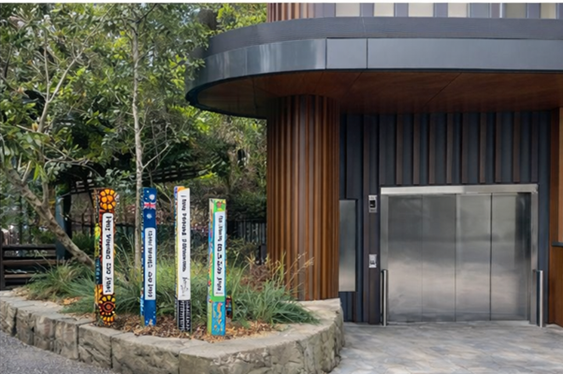
Location
3 and AI generated visualisation of peace pole structures in situ
Similarly, while some respondents suggested
tree planting would provide greater community benefit, the proposal is not
inconsistent with Council's environmental objectives. Council already
undertakes extensive tree planting programs, adding approximately 200 trees
across the municipality each year. The Peace Poles are intended to complement,
rather than replace, these ongoing initiatives.
On balance, staff consider that the project's
alignment with Council's cultural and social objectives, the strong support of
a respected local community organisation, the negligible financial impact on
Council and the contribution it makes to community identity and connection
outweigh the concerns raised during consultation. Accordingly, it is
recommended that Council proceed with the installation of the Peace Poles at
Location 3.
Financial
Considerations
The project will be funded by Rotary with
only a small contribution from Council to install appropriate footings within
an existing planter bed.
Council's contribution is limited to staff
time associated with approvals, coordination and ongoing maintenance within
normal operational budgets.
No additional budget allocation is
required.
Governance and Risk Considerations
The proposal represents a low-risk
community infrastructure project.
Potential risks include:
· minor vandalism or graffiti;
· community disagreement regarding public art and symbolic
installations;
· ongoing maintenance requirements.
These risks can be managed through standard
asset maintenance and operational processes.
The project has no identified legal,
accessibility or public safety concerns.
Environmental Considerations
The project involves small-scale
installation within an existing urban public space and is not expected to
result in significant environmental impacts.
The preferred location avoids impacts on
existing mature trees, landscaping and garden beds.
Social Considerations
The proposal supports:
· Community
connection and social cohesion
· Recognition
of cultural diversity
· Opportunities
for intergenerational learning and engagement
· Positive
community-led placemaking initiatives
The project aligns with Council's objectives of fostering an
inclusive community with a strong sense of identity and belonging.
Timing
Subject to Council endorsement,
installation is anticipated during the 2026/27 financial year following final
design confirmation and site preparation.
Link to Strategy
This report relates to the Community
Strategic Plan Outcome/s and Goal/s:
4 Our
Culture - Fostering an inclusive community rich in culture with a strong
identity
4.2 Cultural
Places
4.2.1 Support
activities that strengthen local identity and help people feel connected
Stephanie Kelly
Director - Community and Culture
Community and Culture Division
ATTACHMENTS:
There are no supporting documents for this report.
Ordinary Council Meeting 18 June 2026
Draft Submisssion - NSW
Strategic Plan For Children 2027 - 2030
Item No: 14.2
Subject: Draft Submisssion - NSW Strategic Plan For Children 2027 -
2030
Record No: SU11006 - 41316/26
Division: Community and Culture
Division
Author(s): Stephanie
Kelly
Purpose
The purpose of this report is to seek
Council’s endorsement of Lane Cove Council’s submission to the NSW
Strategic Plan for Children and Young People 2027–2030.
Executive
Summary
· The NSW Office for
Youth is preparing a new Strategic Plan for Children and Young People
2027–2030 and has invited submissions until 30 June 2026.
· Lane Cove Council
has prepared a submission which draws on extensive local evidence, including
Council’s recently adopted Children and Families Strategy, Community
Strategic Plan engagement, Social Inclusion Strategy and feedback from the
Youth Advisory Group.
· The submission
supports the 5 proposed themes of the NSW Government Strategic Plan and
provides practical recommendations informed by the experiences of children,
young people and families in Lane Cove.
· A key advocacy
position is that local government be formally recognised and resourced as a
frontline partner in delivering outcomes for children, young people and
families. Councils operate many of the services, facilities and community
spaces where young people learn, connect and participate.
· This
report recommends that Council endorse the submission which will enable Council
to contribute local insights to the development of the State Government’s
future policy framework and reinforce Council’s commitment to supporting
children, young people and families.
|
RECOMMENDATION
That Council:
1. endorse
the submission to NSW Strategic Plan for Children and Young People
2027–2030, as attached to this report.
2. authorise
the General Manager, or their delegate, to lodge the submission with the NSW
Office for Youth ahead of the 30 June 2026 deadline.
|
Background
The NSW Office for Youth is developing a
new Strategic Plan for Children and Young People 2027–2030. The Plan will
provide a whole-of-government framework to improve outcomes for children and
young people aged 0–24 and is currently open for public consultation
until 30 June 2026.
The consultation paper identifies 5
priority themes: Educated and Thriving, Community Connection, Supported and
Safe, Healthy and Well, and Voice and Influence.
Lane Cove Council is well placed to
contribute to this consultation through its direct delivery of early childhood
education and care, youth services, libraries, recreation facilities, community
programs and family-focused public spaces. Council recently adopted its
Children and Families Strategy following extensive engagement with local
children, young people, families and service providers, providing a strong
evidence base for the submission.
The submission also draws on Community
Strategic Plan engagement, the Social Inclusion Strategy, Youth Advisory Group
feedback and Australian Early Development Census data to provide a local
perspective on the challenges and opportunities facing children and young
people.
Discussion
The draft Council submission responds to
each of the 5 themes identified in the NSW consultation paper and is informed
by local evidence, community engagement and the lived experiences of children,
young people and families in Lane Cove.
Key messages include:
1. The need to improve access to early childhood
education, life skills development and pathways to employment.
2. Recognition of the importance of community
infrastructure, public spaces and trusted adult relationships in supporting
social connection and belonging.
3. Improved service awareness, outreach and coordination
to ensure children, young people and families can access support when needed.
4. Greater investment in mental health, wellbeing and
preventative approaches, supported by access to recreation, sport and open
space.
5. Engagement approaches that reflect how young people
prefer to communicate and participate in decision-making.
A central recommendation of Council’s
submission is that local government be explicitly recognised as a delivery and
engagement partner within the Strategic Plan. Councils provide many of the
services, facilities and community connections that contribute to positive
outcomes for children, young people and families and are well placed to support
implementation of the Plan at a local level.
Community
Consultation
Council’s draft submission was
informed by community engagement undertaken through the development of the
Children and Families Strategy (2025–2026), the Community Strategic Plan
review (2025), direct engagement with the Youth Advisory Group, and operational
evidence from library services and youth workers.
Council needs to lodge this submission by
the 30 June for consideration.
Financial
Considerations
The recommendations of this report pose no
financial impact on Council.
Governance
and Risk Considerations
Lodging a submission to a NSW Government
consultation is consistent with Council’s advocacy role and aligns with
the Lane Cove Community Strategic Plan, which identifies community health and
wellbeing, family-friendly services, and inclusive community life as strategic
priorities.
Environmental
Considerations
The subject of this report has no
environmental implications for Council.
Social Considerations
The submission advocates for equitable
access to services and infrastructure, particularly for CALD families, children
with disability, young people experiencing vulnerability, and families living
in high-density housing. It highlights the importance of libraries, youth
services and community organisations as trusted community infrastructure that
supports connection, wellbeing and participation.
The submission also supports evidence-based
approaches to youth mental health and wellbeing, meaningful engagement with
young people, and the integration of housing, infrastructure and social
planning to ensure growing communities remain family friendly and inclusive.
Timing
This submission needs to be made by 30 June
2026.
Link to Strategy
This report relates to the Community
Strategic Plan Outcome/s and Goal/s:
3 Our
Society - An Inclusive, interconnected, active and resilient community
3.3 Community
Services & Facilities
3.3.4 Lobby
for increased government funding for services and support for Lane Cove
residents
Stephanie Kelly
Director - Community and Culture
Community and Culture Division
ATTACHMENTS:
|
AT‑1 View
|
Written submission to the NSW Strategic Plan for Children
and Young People 2730
|
|
Available Electronically
|
Ordinary Council Meeting 18 June 2026
Tender Outcome - Lane
Cove Aquatic Centre Electrification Upgrade
Item No: 14.3
Subject: Tender Outcome - Lane Cove Aquatic Centre Electrification
Upgrade
Record No: SU11086 - 42095/26
Division: Community and
Culture Division
Author(s): Stephanie
Kelly
Purpose
To provide a report on the outcomes of the
Lane Cove Aquatic Centre Electrification Upgrade Tender and to seek Council's
endorsement of the recommended contractor to undertake the works.
Executive
Summary
· Council invited
tenders in accordance with the Local Government Act 1993 and Council's Tender
and Quotation Procedure for the design and construction of electrification
works at the Lane Cove Aquatic Centre.
· The project forms
part of Council's commitment to reducing greenhouse gas emissions, improving
energy efficiency and reducing long-term operating costs at the Aquatic Centre
and funds for the project have principally been obtained through the Australian
Government’s Community Energy Upgrades Fund (CEUF).
· The scope of works
includes the replacement of existing gas-dependent infrastructure with electric
alternatives and associated electrical upgrades required to support the
transition.
· Tenders were
evaluated against the published assessment criteria of Pricing, Capacity &
Methods of Service Delivery, Experience & Capability, Work Health &
Safety and Sustainability & Environmental Factors.
· Following a
detailed assessment process, the evaluation panel identified a preferred
tenderer that demonstrated the strongest overall combination of value for
money, technical capability, project methodology and experience in delivering
comparable aquatic and electrification projects.
· Approval is sought
for Council to accept the recommended tender and authorise the General Manager
to execute the necessary contractual documentation.
|
RECOMMENDATION
That Council:
1. accept
the tender submitted by Hirotec for the Electrification of the Lane Cove
Aquatic Centre.
2. authorise
the General Manager to enter into all necessary contractual documentation to
give effect to this resolution.
3. authorise the
General Manager to approve variations within the approved project budget
where required.
|
Background
The Lane Cove Aquatic and Leisure Centre
(LCALC) is Council's highest energy-using facility, accounting for over 60% of
Council's energy usage and 99% of its gas usage.
As part of the Council's long-term plan to
improve energy efficiency and reduce emissions across the municipality, a
detailed site energy audit was completed and a roadmap for upgrades to the
Centre’s heating and cooling systems have been developed. The Lane
Cove Aquatic and Leisure Centre Energy Audit and Electrification Feasibility
Study provides a roadmap for electrification and includes modifications to
the heating and cooling control systems to improve energy efficiency. It was
presented to Council on 23 May 2024. The project forms part of the Council's
broader commitment to reducing operational emissions and improving energy
efficiency across its facilities.
The scope of work includes electrifying the
facility's heating systems by replacing existing gas-fired boilers with
high-efficiency electric heat pumps, along with associated electrical and
mechanical infrastructure upgrades. The project is expected to significantly
reduce greenhouse gas emissions and support the Council's transition towards
net-zero operations.
The project is supported by funding from
the Australian Government's Community Energy Upgrades Fund (CEUF), which
provided a $1.14 million grant. The grant is supplemented by matched funding
contributions from Lane Cove Council and the facility operator, BlueFit.
Discussion
Tender Process
In accordance with Council's Procurement Policy and
Procedures, the tender for the Lane Cove Aquatic Centre Electrification Project
was publicly advertised through TenderLink from 20 March 2026. Tenders closed
on Tuesday 21 April 2026, with Council receiving four submissions.
At the close of the tender period, four submissions were
received and subsequently assessed in accordance with the evaluation criteria
outlined in the Request for Tender documentation.
A tender specification was prepared
detailing the schedule of work, hours of work, safety requirements and
reporting requirements. The specification outlined that the tender
submissions would be assessed based on the following weighted criteria:
Pricing (35%)
Tenderers were
required to submit separate pricing for the Early Contractor Involvement (ECI)
phase and the Design and Construct (D&C) phase. This was done to provide
Council with added flexibility post ECI phase, whereby Council reserves its
rights as to how it shall proceed subject to the Contractor’s
performance, final design and cost estimate outcome. On this basis the pricing
assessment focused primarily on the total price incorporating the combined cost
for both stages. Submissions were evaluated on a pro-rata basis, with the
lowest conforming priced tender receiving the maximum score of 35 points and
all other tenders scored relative to that price. The assessment considered
overall value for money in delivering the project in accordance with Council's
requirements and project objectives. All pricing excludes GST.
Capacity
& Methods of Service Delivery (25%)
This criterion
assessed the tenderer's proposed project methodology, program, resourcing,
subcontractor management, quality assurance systems and ability to successfully
deliver the works within the required timeframe while maintaining uninterrupted
operation of the Aquatic Centre where possible.
To achieve the
maximum score, tenderers were required to demonstrate a detailed understanding
of the project, provide a robust construction methodology, identify key project
risks and mitigation strategies, and demonstrate sufficient resources to
deliver the project within the required timeframe.
Experience
& Capability (20%)
This criterion
assessed the tenderer's demonstrated experience in delivering similar
electrification, mechanical services, aquatic infrastructure or complex
building services projects.
To achieve the
maximum score, tenderers were required to demonstrate extensive relevant
experience, provide details of key personnel, evidence of successful delivery
of comparable projects and positive referee feedback.
Work Health & Safety (10%)
This criterion assessed the
tenderer's commitment to workplace health and safety and compliance with all
relevant legislation.
To achieve the maximum score,
tenderers were required to demonstrate comprehensive WHS management systems,
current insurances, safe work procedures and a strong safety performance
record.
Sustainability &
Environmental Factors (10%)
The tender evaluation panel consisted of:
• Director Major Projects
• Director Community & Culture
• Manager Facilities
• Manager Sustainability and Waste
Each tender was
assessed based on the above weighted criteria and ranked accordingly.
Analysis and
Ranking
A confidential
memorandum has been circulated separately to Councillors detailing the prices
submitted by each tenderer, the assessment of each weighted evaluation
criterion, and the outcomes of reference checks undertaken for the recommended
tenderer.
The recommended
tenderer demonstrated strong technical capability, relevant project experience,
a well-developed methodology, and a clear commitment to safety and
sustainability. The tender also offered several project-specific innovations
and value-add opportunities that are expected to improve project delivery and
long-term operational outcomes.
Hirotec Pty Ltd
achieved the highest overall score against the weighted evaluation criteria and
was assessed as offering the best value for money proposition. This assessment
was further supported by highly positive reference checks, which consistently highlighted
the quality, reliability and professionalism of the company's work.
Accordingly, the
Tender Evaluation Panel recommends that the Contract for the Lane Cove Aquatic
Centre Electrification Upgrade be awarded to Hirotec Pty Ltd and that the
General Manager be authorised to enter into a contract with Hirotec Pty Ltd for
the delivery of the project.
Financial
Considerations
Funding for the project is available
through Council's adopted Capital Works Program together with external grant
funding received under the NSW Government's Community Energy Upgrades Fund.
The project budget includes allowances for
construction, contingencies, project management and associated professional
services.
Governance
and Risk Considerations
The tender process was undertaken in
accordance with the Local Government Act 1993, the Local Government (General)
Regulation 2021 and Council's Procurement Procedures.
The project will be managed in accordance
with Council's project management framework, with appropriate controls in place
relating to cost, program, quality and safety.
The successful contractor will be required
to maintain all necessary insurances and comply with Council's WHS and
contractor management requirements.
Environmental
Considerations
The project supports Council's climate and
sustainability objectives by reducing reliance on fossil fuels and
transitioning key aquatic centre infrastructure to electric alternatives.
The project is expected to significantly
reduce greenhouse gas emissions and improve the overall energy efficiency of
the Aquatic Centre.
Social
Considerations
The project will support the long-term
sustainability and operation of the Lane Cove Aquatic Centre, which is a
significant community recreation and health asset used by more than one million
visitors annually.
The works will contribute to ensuring the
continued provision of high-quality aquatic, health and recreation services for
the Lane Cove community
Timing
Subject to Council approval, contract
execution is anticipated in July 2026 with works commencing shortly thereafter.
The contractor
has proposed completion of the ECI phase by September 2026.
Link to Strategy
This report relates to the Community
Strategic Plan Outcome/s and Goal/s:
2. Our
Built Environment - A well designed, liveable and connected area
2.3 Assets,
Infrastructure & Public Domain
2.3.5 Identify
innovative funding and partnerships to provide for new and upgraded assets and
infrastructure
Stephanie Kelly
Director - Community and Culture
Community and Culture Division
ATTACHMENTS:
There are no supporting documents for this report.
Ordinary Council Meeting 18 June 2026
Draft Submission - Low-rise
housing reforms and targeted assessment
Item No: 15.1
Subject: Draft Submission - Low-rise housing reforms and targeted
assessment
Record No: SU8439 - 39189/26
Division: Planning and
Sustainability Division
Author(s): Golrokh
Heydarian; Christopher Pelcz
Purpose
The purpose of this report is to keep Council
informed of Lane Cove Council’s upcoming submission on the NSW Government
low-rise housing reforms and targeted assessment.
Executive
Summary
· The
NSW Government has released a discussion paper proposing
significant changes to the assessment of low-rise housing in NSW. The
document is on public exhibition until 24 June 2026.
· The
discussion paper proposes a targeted assessment pathway which is a flexible, streamlined pathway for the low-impact and
low-risk nature of low-rise housing development, with a 50-day determination
timeframe.
· While
Council provides in-principle support to planning reforms that seek to deliver
needed housing in a timely manner, concerns regarding the assessment timeframe
and approval provisions under the pathway have been identified and the
submission highlights the need for greater clarity, particularly on application
fees.
· This
report seeks Council endorsement of the submission to the low-rise housing
reforms and targeted assessment discussion paper.
|
RECOMMENDATION
That Council:
1. endorse
the Lane Cove Council submission to the Low-rise housing reforms and targeted
assessment.
2.
authorise the General Manager to finalise Council’s
submission for submission to the Department of Planning, Housing and
Infrastructure.
|
Background
The NSW Government passed the Environmental
Planning and Assessment Amendment (Planning System Reforms) Act 2025 (PSR Act)
in December 2025. The reforms represent a significant update to the structure
and operation of the NSW planning system.
As part of the reforms, the Low-rise
housing reforms and Targeted Assessment have been introduced to bridge the gap
between complying development and full development application, streamlining
assessment pathways and aligning planning processes with broader
strategic objectives.
On 14 May 2026, the NSW Government released a discussion
paper proposing significant changes to the assessment of low-rise housing in
NSW. The discussion paper is available for public feedback on the NSW
Planning Portal until 24 June 2026.
Summary of the Discussion Paper
The discussion paper proposes a targeted assessment pathway
for low-rise housing, providing a flexible and streamlined approach for
developments that are low impact, low-risk and undergone
detailed assessment at a strategic level.
The pathway is intended to facilitate the
assessment of development proposals that are not eligible as complying
development, yet are of a nature and scale that does not warrant a full merit
assessment under Part 4 of the Environmental Planning and Assessment Act
1979 (EP&A Act).
The low-rise housing and targeted assessment discussion
paper explores how a statewide low-rise housing code could be developed to
simplify and align assessment pathways, including:
· a
targeted assessment pathway designed to bridge the gap between complying
development and a full development application
· alignment
and consolidation of complying development (CDC) standards and variations so
that all approval pathways can be found in the one place
· clearly
defined standards that apply to both the CDC and targeted assessment pathway to
create greater consistency
· clearly
defined objectives so that variations to CDC and targeted assessment standards
can be assessed transparently and consistently
· alignment
of definitions and permissibility to make the planning system easier to
navigate.
Targeted assessment is intended to capture
the middle ground between complying development and a full development
application.

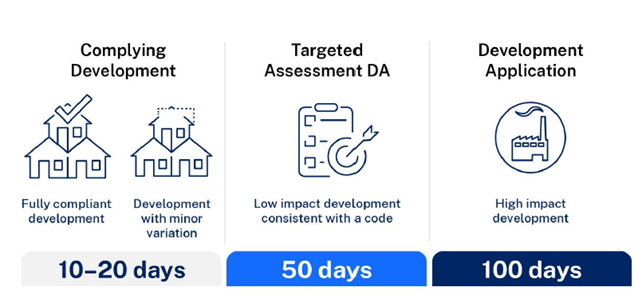
Figure 1. Proposed assessment pathways and indicative
timeframes
The proposed assessment pathway would apply to certain types
of low-impact, low- rise housing in locations where risk is low or can be
mitigated through appropriate controls. This approach
will allow standards to be varied without relying on Clause 4.6 of the Local
Environmental Plan. This pathway would have a targeted determination
timeframe of 50 days, which is approximately half the current average
assessment time for low-rise housing development across NSW.
Code
The NSW Governments discussion paper explores the use of
codes for targeted assessment and low-rise housing. A code is a form‑based
set of rules that guide how land and buildings can be developed. Codes aim to
create clear and consistent expectations so communities, councils and
developers understand what can be built and how development should relate to
its surroundings.
Codes are currently used in the NSW Planning System for
exempt and complying development, most notably through State Environmental
Planning Policy (Exempt and Complying Development Codes) 2008 (the Codes
SEPP).
According to the changes, most low-rise residential
development would be assessed through either a complying development pathway or
a targeted assessment pathway under the same unified code.
Interaction with the broader
planning system
Targeted Assessment’s
interaction with the broader planning system is explained in the table below.
|
SEPPs
|
The proposed reforms would require
amendments to existing SEPPs to remove or consolidate provisions that
duplicate or conflict with the new low-rise housing code, particularly within
the Codes SEPP and Housing SEPP.
Other SEPPs would continue to apply where
they address matters outside the scope of the code, such as state significant
development or broader policy areas.
|
|
LEPs
|
LEPs will continue to play a central role in the NSW
planning system under the proposed low‑rise housing reforms. However, detailed built form controls for low-rise housing would
largely be consolidated into a single low-rise housing code, simplifying the
planning framework and enabling more consistent application across assessment
pathways.
|
|
DCPs
|
Under the proposed reform framework, the role of DCPs in
regulating low‑rise housing would be reduced. Core development
standards and objectives relevant to low‑rise housing would be
consolidated into the single low‑rise housing code and would replace
many existing DCP controls.
|
While Council supports
initiatives aimed at improving coordination,
streamlining assessment pathways, several operational and assessment issues require further
clarification to ensure that the pathway can function effectively without
compromising assessment quality, environmental outcomes, or procedural fairness.
Council
also supports targeted assessment not being applicable to the complying
development and targeted assessment process. Heritage items and conservation
areas are currently excluded from complying development and this has largely
protected the items and areas and their respective integrity. Heritage also has
its own referral triggers and requires careful and thoughtful management.
On this basis, Council
supports the exclusion of Heritage Conservation Areas (HCAs) from the new
targeted assessment process.
Discussion
Key aspects of the Council submission are highlighted as
follows:
Assessment
Timeframes
Council is concerned about the 50-day determination
timeframe where applications are lodged with incomplete or
inadequate supporting documentation. In
practice, councils frequently identify missing or inadequate information during
the assessment process, which requires additional information from applicants.
Delays occur when applicants provide the requested information late in the
assessment period, significantly reducing the available time for assessment and
exhibition. This prevents applications from being determined in a timely
manner.
The 50-day assessment
period incorrectly assumes that an applicant lodges complete information from
the start to enable assessment. However, this has not been Council’s
experience as described above. The discussion paper does not clearly
explain what happens in the event of incomplete or inadequate information being
received from an applicant. Nor is there any incentive for an applicant to
respond to the request for further information within the time period.
Council recommends the
assessment clock should not commence until all mandatory documentation has been
submitted and verified as complete by the consent authority.
Moreover, a pre-lodgement or
pre-review process would significantly improve the effectiveness of the
targeted assessment pathway and help achieve the time frames mentioned.
Approval Provisions
Council notes that the targeted
assessment pathway does not clearly mention whether an applicant has the right
to appeal decisions, or whether deemed approval provisions apply if assessment
timeframes are not met.
Given that the intent of the
targeted assessment process is to reduce the amount of time taken for
approvals, having appeal rights and deemed approvals would not achieve this
objective. This would delay the process further and prevent potential approvals
from being given in a timely manner. As explained previously, there is
currently no incentive for an applicant to provide sufficient information
during the assessment time period if a deemed approval is in place and this
potentially may increase the amount of ‘stop the clock’ provisions
being used – again defeating the purpose of expediating the development
process.
Additional clarification from the
Department would assist councils and applicants in understanding how the
pathway is intended to operate in practice and help ensure a consistent
approach to implementation.
Fees
Council notes that the
discussion paper does not provide clarity regarding the fees for applications
received under the Targeted Assessment Pathway.
As the assessment
process is very similar to the Development Application process, Council
recommends that a fee structure for applications assessed under the Targeted
Assessment Pathway be aligned with the fees applicable to DAs, calculated in
accordance with the formula prescribed under Part 13 and Schedule 4 of the Environmental
Planning and Assessment Regulation – to ensure consistency.
Staff have detailed the
above matters for inclusion in the submission which will be made to the DPHI.
Financial
Considerations
The recommendations of this report pose no
financial impact on Council.
Governance
and Risk Considerations
There are no governance or risk
considerations associated with this report.
Environmental
Considerations
The subject of this report has no
environmental implications for Council.
Social
Considerations
The recommendations in this report maintain
social outcomes for the community as it would streamline assessment for
low-rise housing while considering social and environmental outcomes.
Timing
Submission to the low-rise housing reforms
and targeted assessment discussion paper are required to be lodged on the NSW
Planning Portal by 24 June 2026.
Link to Strategy
This report relates to the Community
Strategic Plan Outcome/s and Goal/s:
2. Our
Built Environment - A well designed, liveable and connected area
2.2 Housing
2.2.1 Ensure
planning controls require a diverse range of housing types and encourage
housing that is adaptable, accessible and affordable
Mark Brisby
Director - Planning and Sustainability
Planning and Sustainability Division
ATTACHMENTS:
|
AT‑1 View
|
Low-rise housing reforms and targeted assessment -
Discussion Paper
|
41 Pages
|
Available Electronically
|
|
AT‑2 View
|
Draft Submission - Targeted Assessment
|
3 Pages
|
Available Electronically
|
Ordinary Council Meeting 18 June 2026
Draft Submission -
Variations and Changes to Complying Development
Item No: 15.2
Subject: Draft Submission - Variations and Changes to Complying
Development
Record No: SU8439 - 39191/26
Division: Planning and
Sustainability Division
Author(s): Christopher
Pelcz; Golrokh Heydarian
Purpose
The purpose of this report is to seek endorsement
of Council’s submission om the NSW Government’s proposed changes to
allow variations and changes to the complying development pathway.
Executive
Summary
· The
NSW Government is proposing changes to the Complying Development Code process
to allow Council to consider variations to certain development standards in the
Code – through a variation certificate.
· A
variation would be submitted as part of a Complying Development application and
either forwarded by a private certifier or received by Council through the NSW
Planning Portal.
· Any
proposed variations would only be assessed/approved/refused by Council staff
and not a private certifier.
· The
proposed variations are relatively minor in nature and detailed within this
report and its attachments.
· While
Council is supportive in principle of the proposed reforms, the submission
highlights some issues which should be presented to the Department for their
consideration.
· This
report seeks endorsement of the Council submission.
|
RECOMMENDATION
That Council:
1. endorse
the Lane Cove Council submission to the NSW Government’s proposed
variations and changes to Complying Development.
2.
authorise the General Manager to finalise Council’s submission and to
submit it to the Department of Planning, Housing and Infrastructure.
|
Background
As part of changes to the Planning System
in NSW, the State Government is consulting on proposed changes to the existing
Complying Development pathway and is accepting submissions until 24 June 2026.
Currently, complying development is based
on achieving compliance with development standards specified in the State
Environmental Planning Policy (Exempt and Complying Development Codes) 2008.
These types of applications can be assessed by either a private certifier or
Council. All standards must be complied with exactly, otherwise an applicant
must lodge a Development Application (with Council).
The proposed changes would:
1. allow for variations for certain complying
development standards to be considered, and
2. expand opportunities for complying development by
changing the existing code.
Variations
In terms of the variations, the changes
would allow minor variations from certain complying development standards, to
be considered by Council, relating to:
· Maximum building height – allow minor height increases
consistent with Council’s Local Environmental Plan,
· Maximum Gross Floor Area – allow minor increase of GFA (up to
10%),
· Primary Road setbacks – vary where consistent with established
setback or Council’s controls,
· Side setbacks – allow for minor variations where appropriate,
· Rear setbacks – allow for minor variations where consistent
with Council’s controls,
· Primary road articulation zone – allow certain items within
the front setback articulation zone up to 50%,
· Privacy screens – allow variations if there’s no direct
line of sight into neighbouring property,
· Garage
door widths – allow variations to carparking setbacks to align with
building line and increased widths where appropriate,
· Building
design – not require certain two storey dwellings to have a window to a
habitable room,
· Dual
occupancies – allow minor variations for widths of two storey dual
occupancies,
· Swimming
pools – allow pools in secondary road setbacks on corner lots, and
· Tree
protection – allow for development to occur within 3 metres of a
protected tree, where supported by an Arborist report.
Under these changes, if an applicant wanted to use the
complying development pathway but required minor variations, then only the
matters mentioned above could (potentially) be varied and only a maximum of
four (4) variations could be sought through a variation certificate (explained
below). If an application required more variations then a full Development
Application would be required.
Changes to existing code
In terms of the changes to the existing Code, the proposed
changes include:
· Expanding
low-impact remedial works as complying development,
· Allow demolition
on bushfire prone land (provided that it doesn’t occur on Fire Ban days)
and minor changes to flood control lots,
· Amend primary road
setback to be consistent with established street setback and reduce separation
distances where appropriate,
· Allow complying
development on minor sloping sites and allow for modern designs and garages,
· Simplifying
balcony and privacy screen requirements, and
· Allow above-ground
rainwater tanks to be located closer to the side boundary.
All of these changes are explained in greater detail in both
AT-1 and AT-2 of this report.
Proposed process
Under the proposed changes, this would create a new pathway
called the complying development certificate (CDC) variation pathway. Councils
will be able to approve or refuse minor variations to complying development
standards, mentioned above. Councils will have:
· 10 calendar days
to assess the variation where the CDC is referred from a private certifier, or
· 20 calendar days
where the Council is assessing both the variation and the CDC.
Council will provide a determination on the variations
within the timeframes, or it will be ‘deemed approved’. Where
variations are supported, the Council will issue a variation certificate. Where
variations are deemed approved, the certifier or Council may continue assessing
the proposed development against the remaining complying development standards.
Importantly, if the variations are refused, an applicant
will either need to amend their plans to meet all complying development
standards to continue to be assessed as a CDC or alternatively submit a
development application to Council.
Overall, staff raise no issues with the proposed variation
standards as they will be assessed by Council staff and not a private
certifier. In terms of expanding the code, there is also no issue as these
changes have been based on previous feedback received by the State Government.
Discussion
In addition to the above, Council can
provide in-principle support to the following items in the changes:
· Any variations will be assessed by Council staff and not a private
certifier.
· Any assessment on variations would need to ensure that there will be
no significant additional adverse impacts.
· The proposed timeframes will only apply when an applicant has paid
the relevant fee and does not apply to the two-week period around Christmas.
· Variations that are not consistent with the changes, not allowed as
complying development (as defined in the State Environmental Planning Policy),
provide insufficient justification or information – can be refused by
Council.
· The
maximum number of variations in one application that can be sought is four (4)
– however it is recommended that safeguards be introduced (in the NSW
Planning Portal) to support this to prevent multiple applications received for
the same property.
· Variation
certificates do not require further conditions.
· A decision on variation certificates cannot be reviewed or appealed.
· If refused, the applicant must either amend their plans to fully
comply with the complying development standards or lodge a full Development
Assessment with Council.
· There
will be training and user guides associated with the implementation of these
changes.
Council’s main issues with the proposed changes are
described below.
Timeframes
Currently the reforms propose that the time
taken to assess these CDC applications be measured in calendar days.
Where a CDC application is being assessed
by a private certifier, council will need to determine the application for a
variation certificate within 10 calendar days. Where it is being
assessed by council, the determination must be within 20 calendar days.
This approach would create a resourcing
problem because this would effectively limit the assessment period (by Council
staff) to 1.5 weeks (with a certifier) and less than 3 weeks (if Council is the
certifier). However, changing this to working days would increase this period
to 2 and 4 weeks respectively. Council’s do not have access to the
resourcing that some private certifiers do, and it is expected that the
proposed changes would generate a greater workload for all Council’s (and
their relevant staff).
It is recommended that the proposed
calendar days be changed to working days to ensure that all variation
certificates received can be given proper and thorough assessment. It would
also assist in any resourcing requirements needed to achieve the timeframes.
Safeguards
While the document talks about safeguards
in the Environmental Planning and Assessment Regulation to prevent
deemed approvals that are not made in accordance with the relevant regulation
and State policy, it does not discuss any further safeguards. Given that these
applications are likely to be submitted via the NSW Planning Portal, further
safeguards should be implemented in the Portal system as well.
There is a concern that an applicant could
potentially submit multiple variation requests for the same property as well as
re-submit an application that was previously refused.
To prevent this, it is recommended that further
safeguards should be implemented into the Planning Portal system to prevent
both multiple requests for the same property address and re-submission of a
previously refused application (for the same property address).
Fees
One of the key proposals is the fee
structure for proposed variation certificates. It is either a set fee of
approximately $456 or fees based on the number of variations to the standards
submitted with the application as follows:
· One variation - $342,
· Two variations - $456,
· Three or four variations - $569.
No information is provided as to how these
fees were determined or why these fees are appropriate (or not). Regardless of
the approach all the fees mentioned above would be subject to increases as a
result of Consumer Price Index changes.
In any event, the fees based on the number
of variations are not supported, it is not clear how these obviously equate to
the amount of work, time and effort that will be needed for staff to assess
these applications – in addition to the applications that they are
currently assessing. While the set fee approach seems more appropriate, the
amount of money seems unfairly low given the additional assessment work that
will be generated.
Other matters
Although not directly related to these
proposed changes, Council wishes to raise the following matters for
consideration.
· Site inspections
Given that certifiers and Council’s
will be allowed to approve variations to the Codes, there should be a
requirement for a site inspection (either by Council/certifier or both). This
is already part of the Development Application process, and it would be able to
be done within the timeframes (if the timeframe was changed to working days).
This would also assist in assessing any potential significant additional
adverse impacts from the variation.
· Adequacy of Information
Based on Council’s current experience
with Development Applications and some Complying Development Applications, a
lot of time is wasted with applicants who do not submit the proper information.
There are also instances where applicants submit an application thinking that
they have provided all the information needed, however once it is reviewed (by
staff), there is not enough information provided for assessment. This prevents
applications from being determined in a timely manner.
Potential solutions could include further
guidance for applicants in the form of checklists, safeguards built into the
Planning Portal system, Councils conducting a pre-application review prior to lodgement
as well as using artificial intelligence.
Financial
Considerations
The recommendations of this report pose no
financial impact on Council.
Governance
and Risk Considerations
There are no governance or risk
considerations as a result of this report to Council.
Environmental
Considerations
The subject of this report has no
environmental implications for Council.
Social
Considerations
The subject of this report will
fundamentally shift the way Council, private certifiers and the community
interact.
Timing
The deadline for submissions is 24 June
2026.
Link to Strategy
This report relates to the Community
Strategic Plan Outcome/s and Goal/s:
2. Our
Built Environment - A well designed, liveable and connected area
2.1 Sustainable
Development
2.1.1 Ensure
land use planning is responsive to changes in community priorities, local
values and state government requirements
Mark Brisby
Director - Planning and Sustainability
Planning and Sustainability Division
ATTACHMENTS:
|
AT‑1 View
|
Explanation of Intended Effect - Variations and Changes to
Complying Development
|
63 Pages
|
Available Electronically
|
|
AT‑2 View
|
Summary of changes - Variations and Changes to Complying
Development
|
6 Pages
|
Available Electronically
|
|
AT‑3 View
|
Draft Submission - Variations and changes to complying
development
|
4 Pages
|
Available Electronically
|
Ordinary Council Meeting 18 June 2026
Draft Submisison -
Federal Parliamentary Inquiry into Artificial Intelligence and Data Centres
Item No: 15.3
Subject: Draft Submisison - Federal Parliamentary Inquiry into Artificial
Intelligence and Data Centres
Record No: SU8439 - 39821/26
Division: Planning and
Sustainability Division
Author(s): Christopher
Pelcz; Golrokh Heydarian
Previous 15.2
- Draft submission to NSW Parliamentary Inquiry into Data Centres in NSW -
Ordinary Council - 19 Mar 2026 7:00 PM
Items:
Purpose
The purpose of this report is to seek
endorsement of Council’s submission to the Federal
Parliamentary Inquiry into Artificial
Intelligence and Data Centres.
Executive
Summary
· This
report presents a draft submission to the Federal Parliamentary Inquiry into
Artificial Intelligence and Data Centres and seeks endorsement of the draft
submission.
· The
submission reflects similar concerns to those raised through Council’s
representation at the recent NSW Parliamentary Inquiry, however given the terms
of reference of the Federal Inquiry, staff have made further recommendations.
· The
draft submission calls out the inadequacy of the current
planning pathway as well as the environmental, health and community impacts of
data centre expansion.
· There
are 13 recommendations in this submission informed by a community which has
already seen the impacts of data centre expansion in our area.
|
RECOMMENDATION
That Council:
1. endorse
the Lane Cove submission to the Federal Government’s Environment and
Communications References Committee on Artificial Intelligence and Data
Centres.
2. authorise
the General Manager to finalise council’s submission for submission to
the Federal Government’s Environment and Communications References
Committee on Artificial Intelligence and Data Centres.
|
Background
Earlier this year Council endorsed a
submission to the NSW Parliamentary Inquiry into Data Centres.
Council was subsequently invited to appear
before the Inquiry held in May 2026. Representatives spoke to the Council
submission in front of NSW Parliament members of the Public Accountability and
Works Committee.
On 13 May 2026, the Federal Senate referred
artificial intelligence and data centres to the Environment and Communications
References Committee for inquiry and report.
The Terms of Reference for the Inquiry are:
a) the effectiveness of existing regulatory frameworks
in managing the growth of data centres in Australia, including in relation to
existing and future deals between the Government and global Artificial
Intelligence (AI) companies;
b) the potential impacts of AI and data centres on
Australian communities, industries and the environment, water and energy; and
c) any other related matters.
Discussion
The key issues for our community remain
largely unchanged from the matters detailed in the submission made to the NSW
Parliamentary Inquiry, however given the terms of reference of the Federal
Inquiry, staff have made further recommendations.
For example, since Council’s original
submission was compiled in March, Infrastructure NSW has published its NSW Data
Centre Consultation Paper. The Paper highlighted a principles-based approach to
working through the opportunities and challenges associated with data centres
investment in NSW. Staff have reviewed the paper and support all five
principles listed:
1)
Investment in data centres should enable a wider
technology ecosystem that drives job creation and propels economic growth.
2)
Data centre developers and operators need to fund
their infrastructure requirements, in addition to what is already planned and
funded, so as to not increase prices for households.
3)
Data centres need to be efficient and make sustainable
use of our energy and water systems as well as the environment.
4)
Data centre approval and compliance must be based on
reliable and transparent data.
5)
Regulatory and planning settings must take account of
difference in the size and location of data centres, and community needs.
Given the Federal interest in existing
regulatory frameworks, it has been recommended that the government also seeks
to strengthen regulation associated with the Telecommunications Act 1997 to
improve consultation, amenity and restoration associated with infrastructure
works.
Council’s submission highlights Lane
Cove’s experiences and concerns
Our submission reinforces the view that the
current NSW State Government Planning pathway is inadequate and data centres
should be removed from the SSDA pathway. It recommends that local communities
and Councils are best placed to assess these developments.
There are 13 recommendations in this
submission informed by a community which has already seen the impacts of data
centre expansion in our area.
It is noted that there is Notice of Motion
listed for consideration at the June 2026 Council meeting. If the Notice of
Motion is passed the draft submission will be updated to reflect the council
resolution.
Financial
Considerations
The recommendations of this report pose no
financial impact on Council.
Governance
and Risk Considerations
The recommendations of this report pose no governance
or risk considerations for Council.
Environmental
Considerations
The submission to this Inquiry has no
environmental implications for Council.
Social
Considerations
The submission to this Inquiry has no
social implications for Council.
Timing
Submissions to the Federal Inquiry are due
on 26 June 2026.
Link to Strategy
This report relates to the Community
Strategic Plan Outcome/s and Goal/s:
2. Our
Built Environment - A well designed, liveable and connected area
2.1 Sustainable
Development
2.1.3 Focus
infrastructure planning and management on supporting sustainable ‘local
living’ to meet the 2036 Energy Emissions and Water Use Reduction Targets
and improve resilience to climate change
Mark Brisby
Director - Planning and Sustainability
Planning and Sustainability Division
ATTACHMENTS:
|
AT‑1 View
|
REPORT - Draft submission to NSW Parliamentary Inquiry
into Data Centres
|
5 Pages
|
Available Electronically
|
|
AT‑2 View
|
Draft Submission to Federal Government Inquiry into
Artificial Intelligence and Data Centres
|
5 Pages
|
Available Electronically
|
Ordinary Council Meeting 18 June 2026
Response to Notice of
Motions - Habitat log salvage program and Enhancing urban biodiversity through
scalable habitat initiatives
Item No: 16.1
Subject: Response to Notice of Motions - Habitat log salvage program and
Enhancing urban biodiversity through scalable habitat initiatives
Record No: SU3912 - 40230/26
Division: Open Space and
Infrastructure Division
Author(s): Jeff
Culleton
Purpose
To report back to Council on two Council
resolutions relating to the Habitat log salvage program (resolution 48/2026)
and Enhancing urban biodiversity through scalable habitat initiatives
(resolution 70/2026).
Executive
Summary
· The
two initiatives, Habitat Log Salvage Program and Enhancing Urban Biodiversity
can be delivered collectively via Council’s existing bushland programs
without requiring significant additional resources.
· It
has been confirmed that salvaging hollow or partially hollow logs from Council
tree works and repurposing them as habitat is achievable and can be
incorporated into existing operations.
· The
collection of materials from existing resource collection points such as
Kimbriki is not possible as these resource centres have their own programs in
place to recycle and reuse materials and therefore these materials would not be
available.
· Alternatively,
it is recommended that Council promote an initiative where residents are
encouraged to utilise materials readily available on their own properties or
from Council’s stockpile of hollow logs that can be repurposed into
artificial habitat refuges. This initiative can be effectively integrated with
existing bushland programs.
· In
the early stages of the program, access to habitat logs will be prioritised to
residents engaged with the relevant bushland programs.
· Council
will also support partnerships with local groups such as the Men’s Shed
or qualified carpentry practitioners to deliver upcycling workshops and habitat‑making
activities by inviting them to participate in Council’s nursery
workshops.
|
RECOMMENDATION
That Council:
1. endorse
the implementation of a Habitat Log Salvage program whereby hollow or
partially hollow logs generated through Council tree maintenance works are
retained and repurposed as habitat structures for bushland programs.
2. develops
an initiative that encourages residents to utilise materials found on their
own property or from Council’s stockpile of hollow
logs for use as artificial habitat refuges.
3. support
partnerships with local groups such as the Men’s Shed or qualified
carpentry practitioners to deliver upcycling workshops and habitat‑making
activities.
|
Background
At the 19 March 2026 Council resolved
(48/2026) to:
1) Investigate the feasibility of salvaging hollow or
partially hollowed sections from fallen or removed trees as part of
Council’s tree maintenance program.
2) Assess the potential for these logs to be repurposed
as habitat structures for urban wildlife, particularly in residential streets
that do not adjoin bushland, and to supplement the existing Backyard Habitat
Program.
3) Report back to Council within three months on:
a) the practicality of implementing such a program,
b) the resources and processes required,
c) estimated costs,
d) potential demand and interest from local
residents, including members of the Men’s Shed,
e) any relevant environmental, fire safety, liability or
other considerations,
f) whether the concept could be incorporated into
Council’s existing Backyard Habitat Program.
Subsequently, at the 23 April 2026 Council
meeting, Council resolved (70/2026) to:
1) Request that staff investigate and report back to
Council on a cost-effective urban habitat program that encourages participation
by residents and improves habitat availability for native reptiles and other
small fauna.
2) The report should consider:
a) low-cost habitat creation methods suitable for
residential properties, including the use of repurposed materials such as clay
pipes (e.g. sourced from resource collection points such as Kimbriki Tip), rock
shelters, timber offcuts and other artificial refuges,
b) the relative costs of implementing the program and
any implications it may have on Council’s adopted budgets,
c) that the program should be considered in conjunction
with the Habitat Log Salvage program that was adopted for investigation at the
March 2026 meeting,
d) opportunities for community participation and
integration with existing Council initiatives such as the Backyard Habitat
Program, Bush Friends, On the Verge Program, Bush Kids Activities and Nursery
Workshops.
Discussion
The two resolutions aim to enhance habitat
availability, particularly in residential areas lacking proximity to bushland,
and to explore integration with the existing bushland programs.
For the log salvage program, there is a
current council program where hollow logs are salvaged for the creation of
habitat in Council facilities open spaces. Furthermore, all tree materials are
repurposed into mulch that is used in Council open spaces and made available
for residents. The investigation determined that this program could be expanded
to provide additional habitat logs for residents.
After investigating the potential for
developing a program of Enhancing Urban Biodiversity as per the April 2026
resolution it has been determined that the objectives of this resolution can be
combined with the log salvage program.
This new initiative will focus on low‑cost
and low carbon footprint habitat creation methods suitable for residential
properties. Investigations into the availability of recycling facilities within
close proximity to the Lane Cove local government area (LGA) determined that
Kimbriki Resource Recovery Centre (located at Terrey Hills on the Northern
Beaches) is the only appropriate location, as it has an on-site reuse shop
where items salvaged from landfill are sold back to the community.
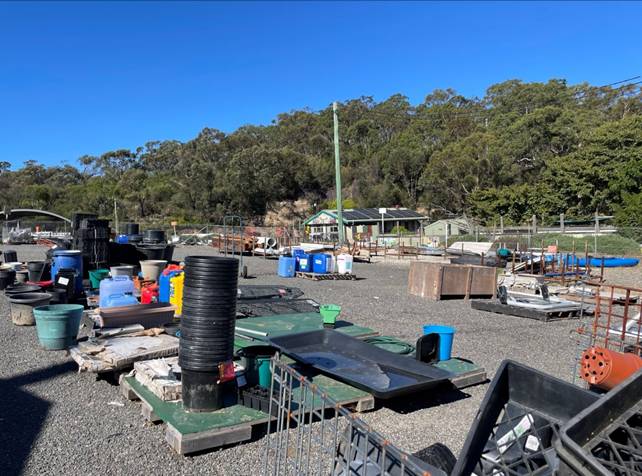
Fig 1. On-site
reuse shop at Kimbriki facility
The investigation found that the Kimbriki
Resource Recovery Centre already has a program to recycle clay pipes and
comparable materials. The Kimbirki centre operates as a large‑scale
recycling facility rather than a site where reusable materials can be freely
accessed. While a resale area exists for items in good condition, only PVC
pipes were available, with no suitable materials identified for habitat
creation. The most suitable materials are processed into aggregate for
landscaping purposes and there is no access to them prior to being
processed.
Fig 2. Recycled
aggregate from Kimbriki facility
Given these constraints, it is not
considered that sourcing or recovering materials from a resource recovery
centre is a viable option. The time, effort and fuel required to locate
suitable materials would not be an efficient use of Councils limited resources.
Options for habitat creation have been
explored and the most appropriate course of action would be to implement a
community‑based campaign to encourage residents to use recycled materials
from their own properties such as clay pipes and other suitable materials or
from Council’s stockpile of hollow logs that could be repurposed into
artificial habitat refuges.
Where appropriate Council could stockpile
some suitable materials from residents that have been engaged in these
programs. These materials could then be made available to other participants in
Council’s bushland programs.
In respect of engaging local organisations
such as the Men’s Shed it is noted that Council runs environmental and
bushland workshops at our Community Nursery and the Men’s Shed has
previously provided their support. Given the existing relationship with the
Men’s Shed staff will contact the Men’s Shed to see if they are
interested in delivering or supporting upcycling workshops and habitat‑making
activities.
Both the initiatives: Habitat Log Salvage
Program and Enhancing Urban Biodiversity can be delivered collectively via
Council’s existing bushland programs without requiring significant
additional resources. It is proposed to pilot the programs with residents that
are engaged in existing bushland programs and if successful, the program will
be expanded as resources allow.
Community
Consultation
No community consultation is required at
this stage.
Financial
Considerations
The recommendations of this report pose no
financial impact on Council.
As this proposal uses
donated / salvaged materials and will be incorporated into existing bushland
programs.
Governance
and Risk Considerations
Risks are covered under existing bushland
program processes.
Environmental
Considerations
The proposed actions in this report will
result in a beneficial environmental outcome by encouraging reuse and
upcycling.
Social
Considerations
The subject of this report will have a
positive impact on social outcomes for some members/ groups of the community by
giving access to free habitat logs and reuse workshops on how to upcycle.
Timing
It is proposed that the
program commence in the 2026/27 financial year.
Link to Strategy
This report relates to the Community
Strategic Plan Outcome/s and Goal/s:
1. Our
Natural Environment - Preserving and Regenerating our Natural Environment so it
thrives now and into the future
1.1 Environmental
Protection
1.3 Bushland
1.1.1 Implement
community information and education programs and initiatives to promote
sustainable living, including practices for homes, workplaces, businesses and
public and open spaces
1.3.1 Extend
programs that involve the community in bushland protection and conservation
1.3.3 Continue
to enhance and increase wildlife habitat on public and private land
Martin Terescenko
Director - Open Space and Infrastructure
Open Space and Infrastructure Division
ATTACHMENTS:
There are no supporting documents for this report.
Ordinary Council Meeting 18 June 2026
Local Transport Forum -
May 2026
Item No: 16.2
Subject: Local Transport Forum - May 2026
Record No: SU1326 - 41438/26
Division: Open Space and
Infrastructure Division
Author(s): Sashika
Perera
Purpose
The purpose of this report is to seek
Council endorsement of recommendations from the Lane Cove Local Transport Forum
held on 19 May 2026.
Executive
Summary
· The Lane Cove Local Transport Forum considers upcoming transport and
parking proposals and assesses the impact of proposals on local, regional and state
roads and provides evidence-based information on which decisions regarding
transport and parking proposals can be made.
· The Lane Cove Local Transport Forum met in May 2026 and provided
recommendations for Council’s consideration.
· The attached Agendas (AT-1) provides a background for proposals,
results of community consultation and a recommendation.
· The
Minutes (AT-2) provide a summary of the discussion from Forum members and a
final recommendation.
· This
report recommends the adoption of the Minutes of the Local Transport Forum
meeting held on 19 May 2026.
|
RECOMMENDATION
That Council adopt the
recommendations of the Lane Cove Local Transport Forum held on Tuesday 19 May
2026.
|
Background
The Lane Cove Local Transport Forum is a requirement of
Transport for NSW and is primarily a technical review forum which provides
advice to Council on matters referred to it by Council.
These matters must relate to prescribed traffic control
devices and traffic control facilities for which Council has delegated
authority.
The Forum has no decision-making powers but provides
recommendations for Council to consider, noting that Council is not bound by
its advice.
Local Transport Forum meetings can be held
physically, digitally or via correspondence. As physical meetings are held
bi-monthly, traffic and parking changes that require urgent referral to the
Local Transport Forum can be done via an electronic meeting format.
This involves:
· Circulating a
report for each proposal by email to all members of the Local Transport Forum,
· Each report
includes details of consultation, investigations and assessments undertaken
with a preliminary recommendation for consideration by members,
· Responses from
members are requested within 7 days,
· Council will then
amend the recommendations if required and circulate minutes collating all
feedback from members of the Local Transport Forum,
· This report
including minutes will then be referred to the subsequent Council meeting for
consideration after which the Council adopted recommendation is implemented,
· All residents that
provided a submission on each item as part of the consultation process will be
notified of the Local Transport Forums recommendation and the date of the
Council meeting it will be reported to, should they wish to register to speak
at the public forum,
· All residents that
provided a submission on each item as part of the consultation process will
also be notified of the adopted final Council resolution,
· Out of Cycle
Reports are circulated electronically, face to face meetings are not required
and will not be held.
This process is a common and necessary practice to ensure
minimal delays with implementing time sensitive traffic and parking changes.
Discussion
The Lane Cove Local Transport Forum was held on Tuesday 19
May 2026. The Agenda is included as AT-1.
The Local Transport Forum recommendations are outlined in
the Minutes of the meeting (AT-2), which address:
1. Local
Transport Forum confirmation of minutes – Tuesday 17
March 2026 and out of cycle report circulated on 2 April 2026.
2. Phoenix Street between Epping Road and DOrritt Street, Lane Cove
– Installation of ‘No Stopping’ Zone at 28 and 30 Phoenix
Street
3. Parklands Avenue between Epping Road and Landers Road, Lane Cove
– Parking Bay Marking at 6 Parklands Avenue
4. Wood
Street between Beatrice Street and Lloyd Rees Drive, Lane Cove West –
Installation of ‘No Stopping’ Zone from 40 to 44 Wood Street
5. Miramont
Avenue, Riverview – Alternation of Time Restricted ‘No
Parking’ Zone
6. Jospeh
Street, First Avenue, Osbourne Street and Cobden Avenue, Lane Cove Parking and
sight distance concerns.
Community
Consultation
Community consultation is undertaken for
each proposal and is outlined in the Agenda included in AT-1.
Financial
Considerations
The Agenda included in AT-1 outlines the
financial considerations for each proposal.
Governance
and Risk Considerations
Reporting of the recommendations of the
Local Transport Forum to Council for endorsement by council is a statutory
requirement.
Environmental
Considerations
The subject of this report has no
environmental implications for Council.
Social
Considerations
The subject of this report has no social
impactions for Council.
Timing
The items discussed in the Agenda and
Minutes are proposed to be implemented this financial year.
Link to Strategy
This report relates to the Community
Strategic Plan Outcome/s and Goal/s:
2. Our
Built Environment - A well designed, liveable and connected area
2.6 Traffic
2.4 Transport
& Mobility
2.6.1 Facilitate
improvements to car, bicycle and pedestrian safety
2.6.2 Ensure
application of appropriate traffic management measures to ensure the safety and
amenity of local streets and improve traffic flow
2.6.4 Provide
shared user paths and other related infrastructure as an alternative to driving
2.4.2 Implement
infrastructure upgrades for people to incorporate more walking and cycling into
their daily lives
Martin Terescenko
Director - Open Space and Infrastructure
Open Space and Infrastructure Division
ATTACHMENTS:
|
AT‑1 View
|
Agenda - Local Transport Forum - May 2026
|
26 Pages
|
Available Electronically
|
|
AT‑2 View
|
Minutes - Local Transport Forum - May 2026
|
12 Pages
|
Available Electronically
|
Ordinary Council Meeting 18 June 2026
Community Safety
Precinct Committee - North Shore Police Area Command
Item No: 18.1
Subject: Community Safety Precinct Committee - North Shore Police Area
Command
Record No: SU129 - 42620/26
Division: Community and
Culture Division
Author(s): Susan
Heyne
Purpose
To report on the Community Safety Precinct
Committee meeting held by the North Shore Police Area Command (NSPAC) at
Chatswood Police Station on Tuesday, 9 June 2026.
Executive
Summary
· The
North Shore Police Area Command Community (NSPAC) Safety Precinct Meeting was
held on Tuesday 9 June 2026. This is the first meeting for 2026.
· The
purpose of the meeting is for the North Shore Police Area Command to update
participants on current Police initiatives and an opportunity to share
information on work that is being done across the area by the Police as well as
councils and other agencies. The meeting is also an opportunity to meet local
police officers.
· The
NSPAC covers the local government areas of Lane Cove, Mosman, North Sydney,
Willoughby, and part of Ku-ring-gai.
· Representatives
from all levels of Government within the North Shore Police Area Command are
invited to attend including councillors and local members of both state and
federal parliament. Other attendees include security companies operating in the
area and local community service providers.
· Officers
from the Crime Prevention and Traffic Units were in attendance.
· A
summary of the matters discussed at the meeting are presented to Council as
required in Resolution 253/25.
RECOMMENDATION
That Council note the report.
Background
Community
Safety Precinct Meetings have been held by the NSPAC for many years. Meetings
are organised by NSPAC and are held at Chatswood Police Station. Meetings are
generally held 2 to 4 times a year.
The purpose of
the meetings is to provide information to community and government
representatives on local issues, current operations and other police activities
in the local area.
Meetings are
also an opportunity for police and community members to meet and raise any
issues or concerns they may have.
Discussion.
The meeting
held on 9 June 2026 was the first Community Safety Precinct meeting held in
2026. Summary of information presented and discussed at the Community
Safety Precinct is as follows, noting that no minutes are circulated by NSPAC
following the meeting:
· Eight (8) new probationary constables were welcomed to the NSPAC on
5 May 2026.
· Crime overview - statistics from the NS Command Intelligence Unit.
|
|
Dec 25-Feb 26
|
Mar-May 26
|
Increase/
decrease
|
% difference
|
|
Assault DV
|
82
|
81
|
-1
|
-1.2%
|
|
Assault Non-DV
|
123
|
137
|
+14
|
+11%
|
|
Break & enter - Residential
|
92
|
68
|
-24
|
-26%
|
|
Break & Enter Commercial
|
49
|
34
|
-15
|
-31%
|
|
Stolen Vehicle
|
42
|
45
|
+3
|
+7%
|
|
Steal from Motor Vehicle
|
100
|
65
|
-35
|
-35%
|
|
Steal from Dwelling
|
74
|
69
|
-5
|
-7%
|
|
Malicious Damage
|
139
|
155
|
+16
|
+11.5%
|
|
Robbery
|
4
|
3
|
-1
|
-25%
|
· Domestic Violence:
o Operation
Amorok XIII – Statewide operation engaging known domestic violence
offenders – occurred from 13-16 May 2026.
o Results:
§ ADVO
compliance checks - 138
§ Bail
compliance checks - 30
§ Breach
AVO – 2
o NSPAC
continue to proactively encourage the rate of reporting domestic violence,
acting and protecting victims against further offending. The Domestic Violence
Team review all DV matters, provide guidance, make recommendations, assist with
enquiries and support investigations.
o Police
recommend always call triple zero to anyone in fear for their safety or anyone
who has been assaulted. This includes bystanders. Anyone observing any form of
domestic violence call 000 and report it immediately.
o NSPAC DV reduction initiatives
§ Liaising
with multicultural communities and actively interacting with them to encourage
further reporting and building trust within the community.
§ NSPAC
doorbell camera initiative in partnership with Bunnings provides doorbell
cameras to improve home safety
§ Empower
You: an app developed by NSW police to support people experiencing domestic and
family violence. The App is designed for victim-survivors to discreetly record
evidence that can be used in court
· Stolen vehicles: 45 total incidents for
March to May 2026 (7% increase). April was busiest month. On 15 April a
Mercedes AMG was stolen from a St Leonards car park. The vehicle was tracked to
Lane Cove where the offender fled on foot before being arrested. At the time the
offender was wanted for several other property offences and bail was refused.
The use of CCTV
was vital in identifying and linking the offenders to the crime. Crime
prevention officers liaised with victims and tenants to notify and encourage
solutions to prevent further offending.
Police encourage
vehicle owners with tracking devices on their cars to notify police immediately
and to ensure software is regularly updated.
· Scams in NSPAC
NSW Police have
issued urgent community warnings following a resurgence of fake tradie
(tradesmen) operations.
Specifically
targeting elderly and vulnerable homeowners across Sydney using high-pressure
tactics to sell fraudulent, severely overpriced, or completely unnecessary roof
and gutter repairs.
Common tactics
include:
o Unsolicited
knocking – claiming they ‘just noticed’ damage from the
street
o Aggressive
up-selling – low up-front fees with costs escalating once the property is
‘assessed’
o Deliberate
damage – intentionally breaking roof tiles or gutters while
‘inspecting’
o Fake
credentials – using stolen ABNs, mimicking legitimate local businesses
o Bank
escorts - driving the person to the bank to get their money
· Current proactive taskings
o Strike
Force Sweetenham: Police are tasked to patrol suburbs of Chatswood, Roseville,
Lindfield, Mosman, Willoughby, Northbridge, Lane Cove and Longueville to deter
youths targeting homes for keys to luxury vehicles.
o Chatswood
Railway/ Oval / Rose Gardens / Interchange: Police are tasked to patrol the
locations to prevent antisocial behaviour particularly by youth and targeted
crimes between youths after 3:00pm and into the early evening
o Regular
proactive operations by NSPAC staff: Firearms and Weapons prohibition orders,
drug supply, retail theft, youth crime, domestic violence, break and enter,
knife offences and bail/ADVO compliance.
o Operation
Shelter – Jewish Synagogues and schools, and Muslim prayer halls: this
involves general duties and available units to conduct hi-visibility mobile
patrols of key locations in the command.
· Other issues discussed
o E-bikes: riders on footpaths and
pedestrian/dismount zones is an issue across the area. The introduction of
Bikes is adding to the problem. Young people on e-bikes is also an issue of
concern. Local representatives shared initiatives and work being done in the
area.
o Clr
Southwood suggested a round-table discussion to work together on potential
shared solutions which was supported by meeting attendees.
o Retail theft: Operation Discounts is an
ongoing police operation to address retail theft and shoplifting. Retail theft
is a big issue in the area. Police are working with local businesses to address
the issue. Liquor stores have been particularly targeted and can involve young
people around the ages of 14 to 16. Offenders sometimes operate in
‘swarms’ where a large group enter the store, with some creating
distractions while others steal goods.
· Crime prevention tips: police provide
tips to prevent crime prevention for many of the issues raised at the meeting.
There are flyers available on the NSW Police website: Crime
Prevention - NSW Police Public Site. These can be
printed, or hard copies are available from the NSPAC Crime Prevention Team.
Tips provided
are often included in the Council’s monthly seniors newsletter, the Lane
Cove Connection. The Library often has copies as does Synergy Youth Centre.
Conclusion
The NSPAC Community Safety Precinct
Meetings are a valuable opportunity for Council representatives to learn about
current issues as well as providing an opportunity to connect with local police
officers. The frequency of the meetings has reduced over the years. However,
Council has a strong relationship with staff across the NSPAC units and work
regularly with them on a range of issues throughout the year.
Stephanie Kelly
Director - Community and Culture
Community and Culture Division
ATTACHMENTS:
There are no supporting documents for this report.
Ordinary Council Meeting 18 June 2026
Council Snapshot May
2026
Item No: 18.2
Subject: Council Snapshot May 2026
Record No: SU220 - 43493/26
Division: Office of the
General Manager
Author(s): Corinne
Hitchenson
Purpose
This report provides the monthly Snapshot
report, a current Resolution Tracker as well as copies of the recent meeting
minutes of Council’s Advisory Committees.
Executive
Summary
· Attached
for the information of Councillors is a review of Council’s recent
activities for the month of May 2026 at AT-1
· Council’s
Resolution Tracker showing the progress of Council’s resolutions is
included at AT-2
· A
copy of the relevant Advisory Committees Meeting Minutes is included for
Council’s informationExec Summary single sentence 3
· All
Advisory Committee Meeting minutes are available on Council’s website
irrespective of whether they are reported to Council
RECOMMENDATION
That Council receives and notes the Council
Snapshot for May 2026, the Resolution Tracker for the 18 June 2026 Council
meeting, and the minutes of the following Advisory Committees:
· Access and
Age-Friendly Advisory Committee – February and April 2026
· Bicycle Advisory
Committee – May 2026
· Bushland
Management Advisory Committee – April 2026
· Carisbrook House
Advisory Committee – May 2026
· Companion Animal
Advisory Committee – May 2026
· Inclusive
Communities Committee – April 2026
· Kindy Cove
Management Advisory Committee – April and May 2026
· Sporting Club
Advisory Committee – May 2026
· Sustainability
Advisory Committee – May 2026
· Youth Advisory
Group – May 2026
Background
On a monthly
basis, Council staff compile a snapshot for Councillors outlining recent Council
activities.
In addition,
staff review and update the Council Resolution Tracker [AT-2], which identifies
outstanding actions and notes those recently completed in response to Council
resolutions.
Council convenes a number of
Advisory Committees who meet throughout the year. While Council's website
includes a list of all Advisory Committee Meeting Minutes, from May 2026
Council commenced the process of reporting recently held Advisory Committee
Meeting Minutes for Councillors’ information.
Discussion
This Snapshot
report provides a summary of the operations of each Division within Council for
the month of April 2026 [AT-1].
The Resolution
Tracker is also updated to reflect the latest actions of staff.
Advisory
Committees typically meet at least once a quarter as set out in each
Committee’s Charter.
From May 2026
onwards, each monthly Council Snapshot report includes attachments of the
minutes from any recent Advisory Committee meetings. The meeting minutes
reported to this meeting include:
|
Committee name
|
Meeting held
|
|
Access and Age-Friendly
Advisory Committee
|
February 2026
April 2026
|
|
Bicycle Advisory Committee
|
May 2026
|
|
Bushland Management Advisory
Committee
|
April 2026
|
|
Carisbrook House Advisory
Committee
|
May 2026
|
|
Companion Animal Advisory
Committee
|
May 2026
|
|
Inclusive Communities
Committee
|
April 2026
|
|
Kindy Cove Management Advisory
Committee
|
April 2026
May 2026
|
|
Lane Cove Festival Advisory
Committee
|
Minutes of May meeting to be
reported in July
|
|
Lane Cove Public Art Advisory
Committee
|
N/A no recent meeting
|
|
Sporting Club Advisory
Committee
|
May 2026
|
|
Sustainability Advisory
Committee
|
May 2026
|
|
Youth Advisory Group
|
May 2026
|
Although some
Advisory Committees may have been held recently, the meeting minutes included
in this report are those which had been most recently published at the time of
the preparation of the Council Agenda for the June 2026 meeting.
As each
committee meets on its own schedule, sometimes several months will pass before
some Advisory Committee minutes are due to be included in future Snapshot
reports.
All Advisory Committee meeting
minutes are available on Council’s website irrespective of whether they
have been subsequently reported to Council: Your Committees | Lane Cove Council.
Staff have identified the
opportunity to standardise the Meeting Minutes template further to assist with
consistency in reporting both on Council’s website and to future Council
meetings.
Conclusion
The monthly Council Snapshot, Resolution
Tracker and Advisory Committee Meeting Minutes are provided for the information
of the June 2026 Council meeting.
Louise Kerr
General Manager
Office of the General Manager
ATTACHMENTS:
|
AT‑1 View
|
Council Snapshot May 2026
|
41 Pages
|
Available Electronically
|
|
AT‑2 View
|
Resolution Tracker for 18 June 2026 Council meeting
|
53 Pages
|
Available Electronically
|
|
AT‑3 View
|
Access and Age-Friendly Advisory Committee - MINUTES - 17 February
2026
|
|
Available Electronically
|
|
AT‑4 View
|
Access and Age-Friendly Advisory Committee - MINUTES - 7
April 2026
|
|
Available Electronically
|
|
AT‑5 View
|
Lane Cove Bike Advisory Committee Meeting Minutes - 13 May
2026
|
|
Available Electronically
|
|
AT‑6 View
|
Bushland Management Advisory Committee - MINUTES - April
2026
|
|
Available Electronically
|
|
AT‑7 View
|
Minutes - Carisbrook Advisory Committee Meeting 13 May
2026
|
|
Available Electronically
|
|
AT‑8 View
|
Companion Animal Advisory Committee - MINUTES - May 2026
|
|
Available Electronically
|
|
AT‑9 View
|
Inclusive Communities Advisory Committee - MINUTES - 1
April 2026
|
|
Available Electronically
|
|
AT‑10 View
|
Minutes - Kindy Cove Management Advisory Committee 15
April 2026
|
|
Available Electronically
|
|
AT‑11 View
|
Minutes - Kindy Cove Management Advisory Committee 20 May
2026
|
|
Available Electronically
|
|
AT‑12 View
|
Sporting Club Advisory Committee - MINUTES - May 2026
|
|
Available Electronically
|
|
AT‑13 View
|
Sustainability Advisory Committee Meeting Minutes - May
2026
|
|
Available Electronically
|
|
AT‑14 View
|
Youth Advisory Group Meeting - MINUTES - 11 May 2026
|
|
Available Electronically
|